Majority of Kansas, Missouri congressional delegations will object to Biden’s victory
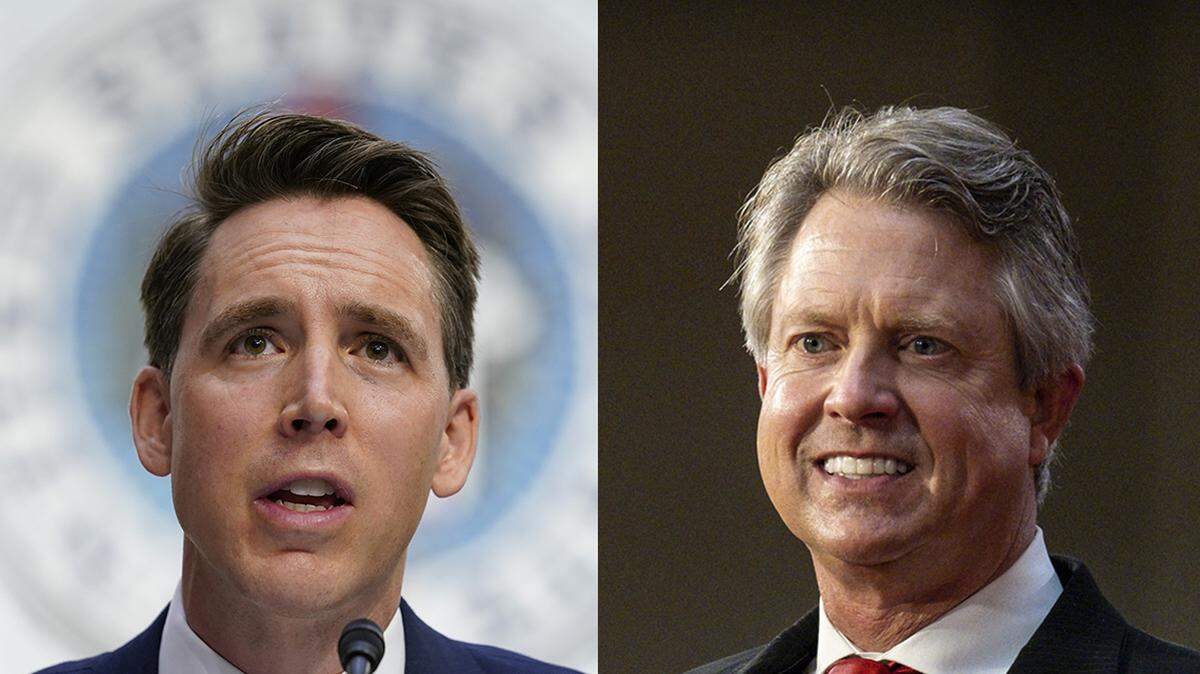
Most of the congressional delegation from Kansas and Missouri will join Missouri Republican Sen. Josh Hawley in opposing certification of the 2020 presidential election—an act of protest with no chance of success but potentially long-term consequences for American democracy.
Hawley has emerged as the face of the effort to contest President-elect Joe Biden’s Electoral College victory, announcing last week that he would object to results in swing states, such as Pennsylvania.
Newly-elected Kansas Republican Sen. Roger Marshall is among at least 12 GOP senators who have signed on to the challenge since Hawley’s announcement, despite Biden winning by a 7 million-vote margin and capturing the Electoral College 306 to 232.
The decision by GOP senators to join the effort appears driven by the ambitions of potential 2024 contenders, such as Hawley and Texas Republican Sen. Ted Cruz. Other members, from states that went strongly for President Donald Trump, are concerned about re-election in 2022 or beyond.
Trump, who has spent weeks making baseless claims of voter fraud as he refuses to concede, will continue to be force in Republican politics and his political favor could determine primary races for years to come.
Marshall pointed to calls he had received from constituents in support of the objection.
“Our congressional office has received thousands of emails and phone calls and I personally have received hundreds of texts, phone calls, and emails on the matter. An overwhelming majority believes we should reject some of the Electoral College votes from certain states,” Marshall said in a statement Saturday, a day before he officially joined the Senate.
In the U.S. House, the numbers of Republican objectors will be even larger, with as many as 140 House Republicans expected to dispute the validity of an election in which their party gained seats.
Eight come from Kansas and Missouri: Kansas City area Reps. Sam Graves and Vicky Hartzler; southern Missouri Reps. Billy Long and Jason Smith; and Kansas Reps. Ron Estes, Jake LaTurner and Tracey Mann.
Missouri Rep. Blaine Luetkemeyer announced Wednesday morning that he would also join the objections, saying in a statement it “will not diminish the value of the vote of any individual citizen, but rather protect that value,” even though entire states would have their votes discarded if the objections succeeded.
Frank Bowman, a professor at the University of Missouri School of Law, said the effort to delegitimize a free and fair election will cause long-term damage to American democracy even if it has no chance of keeping President Donald Trump in office.
“2024, 2028, whatever, what you’re doing is creating a deep skepticism in perhaps a third of the American population that democracy can be trusted. Once you do that, we don’t know what the endpoint is,” said Bowman, a former federal prosecutor who authored a book on Trump’s 2019 impeachment.
“One of the things that you see here is that Donald Trump’s effort is going to fail, but it’s only going to fail because there are some members of the Republican party who still have some guts,” Bowman said. “But imagine a situation where the norm in the Republican Party becomes attempting to steal elections.”
At least three Republicans from the region will oppose the objections: Missouri Sen. Roy Blunt, Kansas Sen. Jerry Moran and St. Louis area Rep. Ann Wagner.
Wagner, a former chair of the Missouri Republican Party, said in a statement Monday that objecting to the Electoral College results “would amount to stealing power from the People and the States” and “would, in effect, replace the Electoral College with Congress.”
Wagner had signed onto an amicus brief in support of a Texas lawsuit that sought unsuccessfully to overturn the election in swing states. But Wagner noted that the suit had been rejected by the U.S. Supreme Court and that other lawsuits seeking to overturn the results have been repeatedly rejected by federal and state courts.
Both Moran and Blunt could face primary challenges from Trump-backed candidates in 2022. The outgoing president has already vowed to back primary challenges against GOP lawmakers who oppose the measure.
Moran said Tuesday that protecting the country’s institutions outweighed short-term political concerns.
“Support of the institutions and legal processes established in the Constitution by those who founded this exceptional American Republic are necessary to preserve our most cherished American values,” Moran said.
Hawley has argued that Pennsylvania’s 2019 law expanding mail-in voting in the state, passed by a GOP-controlled Legislature, violated Pennsylvania’s Constitution and that the state’s 20 electoral votes should be discarded.
Bowman, a former colleague of Hawley’s at Mizzou, called this position “poignantly hypocritical” for Hawley as a constitutional conservative who typically favors states’ rights.
“Josh’s position here seems to be that he as a senator from Missouri… is entitled to tell Pennsylvania how it can or cannot conduct its elections and that the United States Senate is entitled to disagree with the Pennsylvania Supreme Court on the way it conducts their elections. The irony is thick,” Bowman said.
“Let’s put it this way: Nothing that Josh is saying here makes any legal sense and he knows it. He’s simply blowing smoke.”
Pennsylvania Republican Sen. Pat Toomey blasted it as an “effort to disenfranchise millions of voters in my state and others.” Hawley responded by accusing Toomey of making a personal attack.
Rick Hasen, an election law expert at the University of California, Irvine, School of Law, noted that the U.S. Supreme Court has rejected three lawsuits related to Pennsylvania’s voting law.
Fox News host Brett Baier pressed Hawley Monday evening on whether he believed his objection would enable Trump to remain in office beyond Jan. 20.
“Well, that depends on what happens on Wednesday. I mean, this is why we have the debate,” Hawley said.
Baier responded, “No, it doesn’t. I mean, the states, by the Constitution... they certify the election. They did certify it. By the Constitution, Congress doesn’t have the right to overturn the certification, at least as most experts read it.”
Both Kansas and Pennsylvania allowed voters to cast mail-in ballots for any reason and both states accepted them up to three days after the election. The late-arriving ballots did not affect the results in either state.
Despite the similarity between the voting systems in the two states, Kansas Republicans have enthusiastically backed the effort to object to the results.
LaTurner, a Pittsburg Republican who took the oath of office Sunday, said he doesn’t expect the protest vote to change the election results but that he joined the effort to highlight what he believes were violations of states’ election laws.
“The point of it for me is we have states that were not following their own law, instances of voter fraud. I think it’s important to highlight that and have a conversation,” LaTurner said.
Trump has repeatedly asserted widespread voter fraud in his public statements since the election, but his campaign’s attorneys have offered scant evidence in court and judges have consistently rejected their arguments as lacking merit.
Rep. Sharice Davids, the lone Democrat in the Kansas delegation, lamented her GOP colleagues’ decision to join the objection effort.
“The American people voted in record numbers this past election – and they selected Joe Biden to be their next President. The efforts by some members to overturn those results not only undermine our democratic republic – they ignore the will of the American people and threaten people’s confidence in our electoral system, the foundation of our democracy,” Davids said in a statement.
“Not to mention, this is all an extraordinary waste of time that should be spent helping people get the relief they need during this pandemic. It is time for us to turn the page and heal, just as we have so many times before, by continuing with a peaceful transfer of power.”
The vote comes days after The Washington Post published audio of Trump pressuring Georgia Secretary of State George Raffensperger, a fellow Republican, to announce that the state had recalculated its results to give Trump a victory.
Raffensperger rebutted the unprecedented request, which legal experts have said could warrant criminal prosecution.
Rep. Emanuel Cleaver, the senior Democrat in the Missouri delegation, called on his Republican colleagues to denounce Trump’s
“While it will have no effect on the fact that President-elect Biden will be sworn-in as the 46th President on January 20, I pray that we can overcome the tribalism that has taken hold of our nation and resoundingly condemn this gross abuse of power, regardless of political affiliation or ideology,” Cleaver said.
Marshall, Hawley and Hartzler’s offices did not respond to a request for comment on the matter Monday. LaTurner told The Star that he disagreed with the president’s actions, but would still support the effort to contest the election.
The Kansas City Star’s Jonathan Shorman contributed to this report.
This story was originally published January 6, 2021 at 5:00 AM with the headline "Majority of Kansas, Missouri congressional delegations will object to Biden’s victory."