Historic African-American theater to become community center as Wichita reboots plan
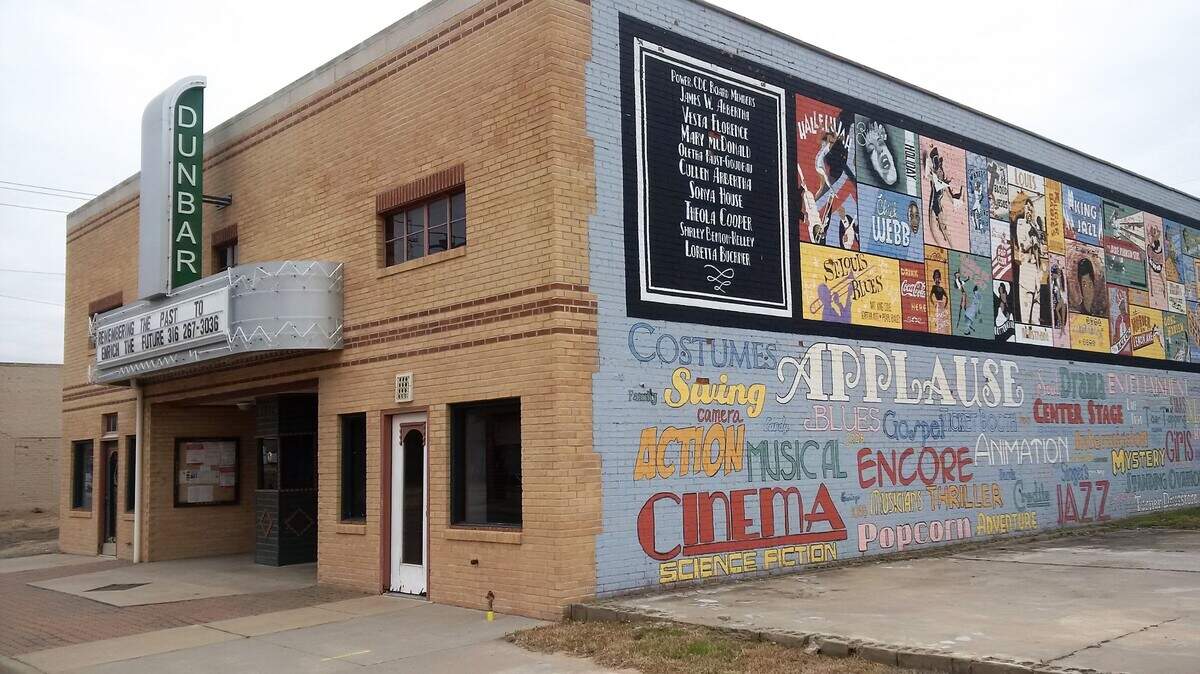
Wichita City Hall has thrown a lifeline to a stalled effort to restore a historic African-American theater to its former glory.
The Dunbar Theater, once a center of activity for Wichita’s African-American community, will be repurposed for the time being as a small community center, while its owner continues to try to raise funds for an ambitious $13 million project to renovate and expand it into a larger performing arts center.
The theater, at 1007 N. Cleveland, operated from 1941 to 1963. During the city’s segregation era, it was the only place where African-American Wichitans were allowed to go to the movies.
Restoring it has passionate backing from African-American community leaders, including former council member Lavonta Williams.
“I remember going there every Saturday afternoon to spend time there, with probably 25 cents extra to buy candy,” Williams said.
She said a revitalized Dunbar would help fill a void left from the demolition of other staple attractions of her childhood, such as the Joyland amusement park that closed in 2006 and Kiddie Land, a children’s fun park that was razed in the late 1960s for the Wichita Mall.
“I have memories of the Dunbar Theatre and that’s what I want to create for the young people in the community,” she said. “Right now, there’s not a lot for them to have memories of.”
In 2017, the City Council allocated about $650,000 in federal Community Development Block Grant funding to the project to help turn the Dunbar into a performing arts center. That money came from the proceeds of the sale of the Save A Lot grocery store at 2402 E. 13th St., which was built using a CDGB loan.
In addition, the council approved $250,000 in city funds to be used as “challenge grant” money to match private donations to the project and help jump start fund-raising by the building’s owner, Power Community Development Corp., which also developed the Save A Lot store.
The $250,000 came from the city’s proceeds from selling the downtown Hyatt Regency Hotel to casino magnate Phil Ruffin in 2016.
The CDC is a nonprofit group that supports neighborhood revitalization in the historically African-American area of northeast Wichita.
But fund-raising for the Dunbar has foundered, raising only $50,000 of the $5.2 million needed for the first phase of the project, which involves interior and exterior renovation of the existing theater building, officials said. Subsequent phases are supposed to include $7.7 million in expansion on the north and south sides of the building.
The original agreement had a deadline to complete the first phase by Jan. 1, but that’s obviously not going to happen, said Sally Stang, the city’s housing and community development director.
Complicating matters since the original agreement, Power CDC has spent $145,930 on “administrative costs, project management, fundraising consultant, outreach, legal services and schematic design,” none of which is eligible for federal funding, according to a city staff report.
The CDC also spent about $50,000 on mold removal and pouring a new concrete floor, which is eligible for federal funding, the report said.
To solve the problem, City Hall will put the Dunbar CDGB funding back in its federal CDGB pool and pay off the ineligible expenses with city dollars from the $250,000 set aside from the Hyatt sale, said City Manager Robert Layton.
That will leave $104,000 of Hyatt funding to operate the community center for the first five years, Layton said.
The city will draw $582,000 back out of its federal CDGB account to fund the construction to turn the Dunbar into the planned community center, Layton said.
The new center will have a seating capacity of 49 people, after the COVID-19 pandemic is over and there’s no longer a need for social distancing to help keep the disease at bay.
“What we’re hoping is for small cultural instruction — small classes, hopefully in the arts, but it could be for other community programming that the (CDC) board determines is appropriate,” Layton said. “It will be flexible space. It will allow for instruction and it will allow for performances, but in small groups.”
State Sen. Oletha Faust-Goudeau, D-Wichita, said the Dunbar is the key to revitalization of the neighborhood.
“It will serve as a hub for education, economic development, entertainment,” she said. “We have a host of little small businesses there that will connect to the Dunbar Theatre . . . I believe if we build up one community, we build up the city, we build up the entire state.”
The ongoing hope is that the CDC will eventually be able to raise enough money to execute something more like the original performing-arts center plan, Layton said.
This story was originally published December 16, 2020 at 5:01 AM.