Is Marshall plan really Marshall’s? It bears striking resemblance to Georgia senator’s
As the COVID-19 pandemic plunged the economy into crisis this spring, Georgia Republican Sen. Kelly Loeffler introduced her plan to ignite a recovery.
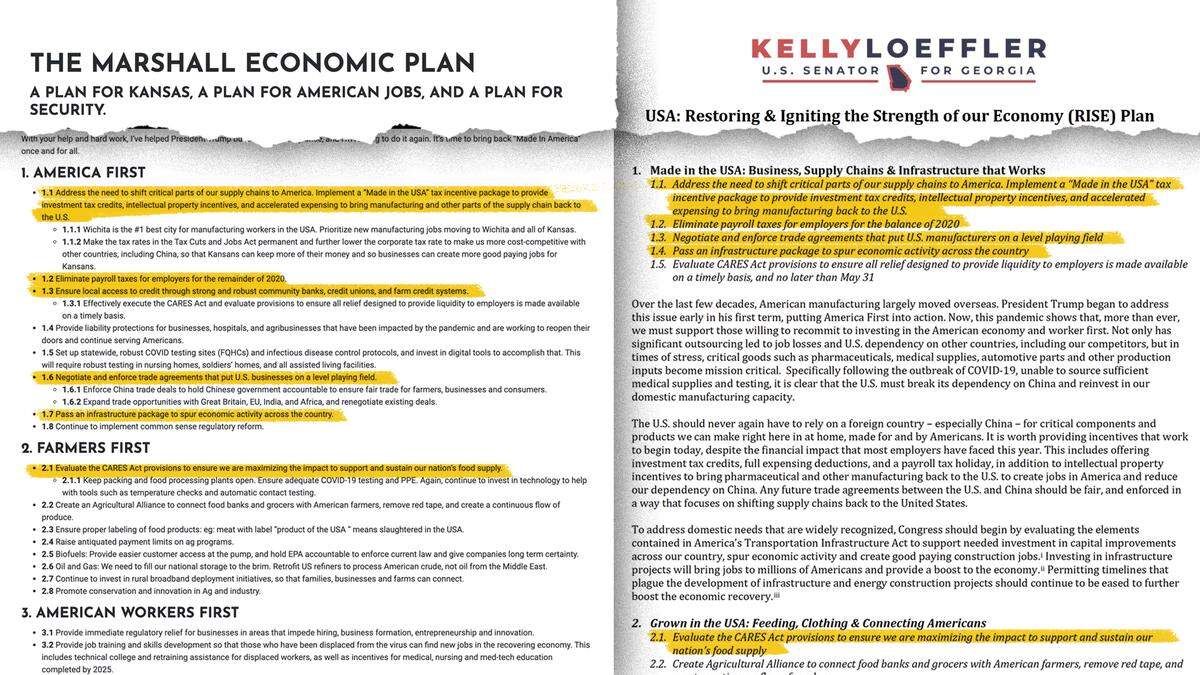
Loeffler’s proposals, posted to her official Senate website in April, included sections on goods “Made in the USA” and “Grown in the USA” with the goal of recharging U.S. manufacturing and agriculture.
“Address the need to shift critical parts of our supply chains to America. Implement a ‘Made in the USA’ tax incentive package to provide investment tax credits, intellectual property incentives, and accelerated expensing to bring manufacturing back to the U.S.,” states the first plank in Loeffler’s plan.
Two months later, Kansas Republican Rep. Roger Marshall’s campaign for U.S. Senate posted its own economic program.
“Address the need to shift critical parts of our supply chains to America. Implement a ‘Made in the USA’ tax incentive package to provide investment tax credits, intellectual property incentives, and accelerated expensing to bring manufacturing and other parts of the supply chain back to the U.S.,” the first provision of Marshall’s plan states.
Except for a few words inserted after “manufacturing,” the language was identical to Loeffler’s.
Using tax credits to spur investment or shifting the supply chain away from China and other competitors are not groundbreaking ideas. But there are only two places on the internet where they are phrased the exact same way: Loeffler’s official site and Marshall’s campaign site.
It’s one of several identical or near-identical phrasings in Marshall’s economic plan.
Marshall’s proposals to provide liability protections to businesses, enforce trade deals, create an “Agricultural Alliance” between grocers and farmers and to prevent “further expansion of unemployment insurance” are all phrased identically to the language that first appeared on Loeffler’s site.
It’s common for members of the same party in Washington to use similar and centrally-crafted talking points.
But while several of these ideas are fairly standard for Republicans, the specific phrasing of the “Agricultural Alliance” concept on Marshall’s site has only previously appeared on Loeffler’s website and in news coverage of her proposal.
Loeffler’s office did not directly address the striking resemblance between the plans. But it explicitly asserted that the provisions were the work of the Georgia Republican.
“As a political outsider and successful conservative businesswoman, Senator Loeffler used her decades of experience in the private sector to create her USA RISE plan in April to reignite our economy, create new jobs, and hold China accountable,” Nadgey Louis-Charles, Loeffler’s spokeswoman, said in a statement. “Senator Loeffler relied heavily on the input of families, businesses and employees around the state to craft her USA RISE plan.”
Marshall’s campaign downplayed the similarities Monday.
“It should come as no surprise that Republicans across the country share similar economic principles; less taxes, lower spending, holding China accountable for giving us the virus, bringing out critical supply chains back to the US, making made in the USA, hire American and buy American our guiding principles, and reopening the economy,” said Eric Pahls, Marshall’s campaign manager.
“This is the language the President and Republicans have been using for years.”
Marshall’s team consulted with national Republican groups on the language to make the sure the messaging was consistent, but it also sought input from Kansas businesses and agricultural communities, according to the campaign.
Hours after her initial comment, Loeffler’s spokeswoman sent an additional email after 10 p.m. stating that the senator “is excited to work with Roger Marshall in the U.S. Senate, and she’s grateful that he is willing to amplify a strong conservative message of rebuilding the economy.”
Both Marshall and Loeffler have been Republican establishment favorites in their races this year.
The campaigns have both used Repubclick, a digital consulting and strategic communications firm with offices in Atlanta and Washington. Marshall has paid the firm more than $21,000 since last year; Loeffler’s paid $11,000 in April. Marshall’s campaign said the firm was not involved in the crafting of its economic plan.
Marshall won last week’s Republican primary in Kansas with 40 percent of the vote, double digits above his closest competitor in the 11-candidate field, after receiving support from the Senate Leadership Fund and other GOP establishment groups in the final weeks of the race.
He will face Democrat Barbara Bollier in November in the race to succeed retiring GOP Sen. Pat Roberts.
Loeffler was appointed by Georgia Gov. Brian Kemp earlier this year to fill Sen. Johnny Isakson’s seat for this year after the Georgia Republican retired after 14 years in the Senate.
During her brief tenure, Loeffler has faced scrutiny for selling millions in stock following a January briefing on COVID-19. Loeffler has maintained the sales were made by a third party financial adviser without her knowledge.
In the November special election to fill the final two years of Isakson’s unexpired term, she’ll face Republican Rep. Doug Collins among other candidates from both parties in the race without a primary. If no candidate receives 50 % of the vote, the state will hold a runoff election in January that could determine control of the Senate.
Loeffler is backed by many of the same groups that supported Marshall in the Kansas primary, including the Senate Leadership Fund and the National Right to Life Committee.
This story was update to reflect that Marshall’s campaign says the digital consultant used by both campaigns was not involved in its economic plan.
The Wichita Eagle’s Jonathan Shorman contributed to this report.
This story was originally published August 11, 2020 at 5:00 AM with the headline "Is Marshall plan really Marshall’s? It bears striking resemblance to Georgia senator’s."