
Roger Marshall was convicted of reckless driving in 2008. Here’s how it was erased
On Christmas Eve 2008, court documents show, Assistant Barton County Attorney Carey Fleske approached a district court judge with a request: erase Roger Marshall’s conviction that fall for reckless driving and replace it with a lesser charge.
The judge agreed, turning a suspended jail sentence for the future Kansas Congressman and Republican U.S. Senate candidate into a slap on the wrist.
But Fleske was more than a prosecutor. He was also the son of Marshall’s business partner and neighbor.
Marshall was originally charged with reckless driving and battery after a May 2008 encounter where he was accused of hitting a Great Bend resident with his truck. A civil lawsuit over the episode was settled out of court. Marshall has always denied hitting the man.
The incident surfaced during Marshall’s 2016 campaign for Congress, when Rep. Tim Huelskamp released an ad featuring audio of the 911 phone call. Marshall’s connection to the prosecutor was never reported. After a handful of stories, the matter faded from view and Marshall went on to win the western Kansas seat.
Four years later, as Marshall, 59, introduces himself to voters statewide as a Senate candidate, questions remain about why Barton County moved to reduce the charge against him after his conviction.
Marshall’s campaign has offered little explanation for the reduction in charges or the candidate’s ties to the prosecutor. The campaign also refused a request by The Star to release an affidavit in the criminal case that would likely contain a law enforcement narrative of the incident.
In response to questions, a campaign spokesman acknowledged the connection but dismissed it as irrelevant.
“Anyone in rural Kansas can attest that when you live in a town for three decades, deliver thousands of babies, chair church board, lead Rotary Club and run businesses and charities, you’re going to know most everyone. That’s just a fact of life out here,” Eric Pahls said in a statement.
Prosecutors dropped the battery charge after negotiations with Marshall, who pleaded no contest to reckless driving. He was sentenced to five days in jail — all time suspended — and a $150 fine, plus court costs.
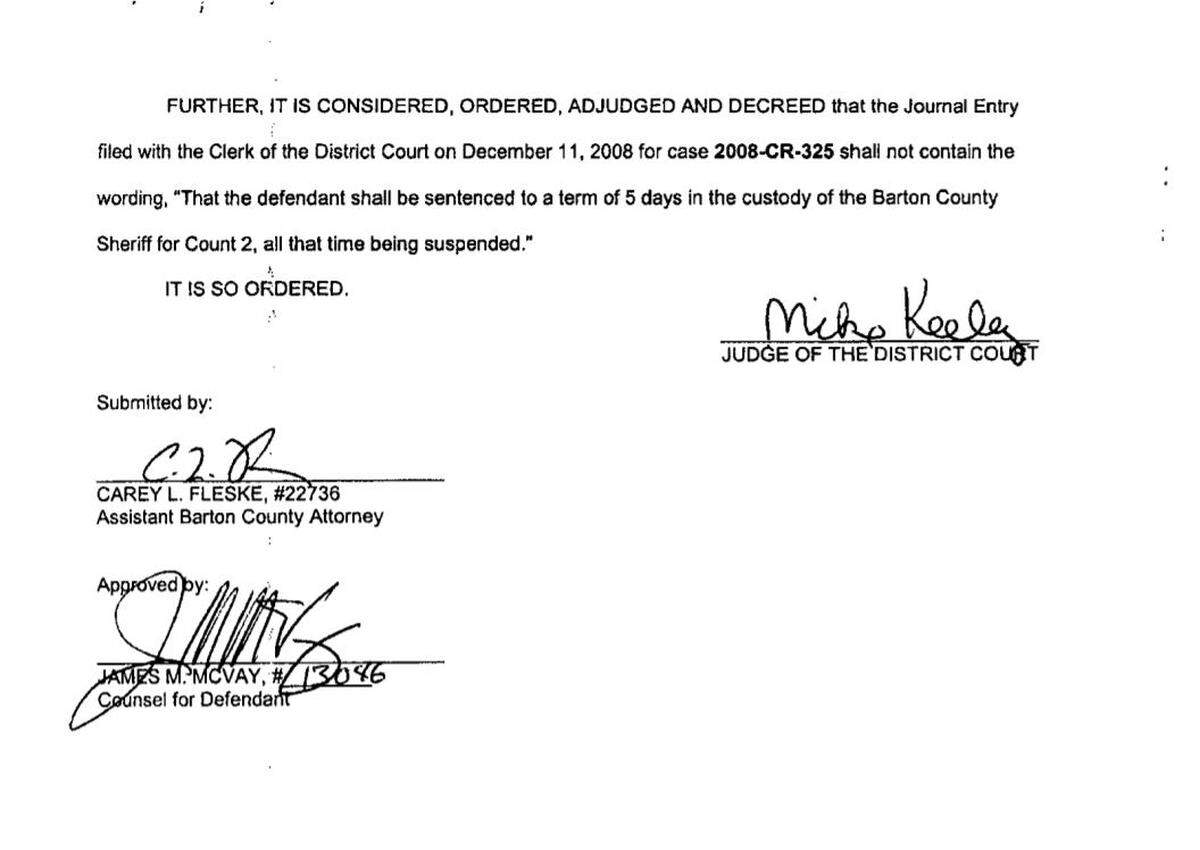
But weeks later on Christmas Eve 2008, Fleske went to District Court Judge Mike Keeley with a proposal to eliminate Marshall’s conviction from a sentencing document. It was in the form of an order called nunc pro tunc (the Latin phrase “now for then”), which would insert a traffic infraction in place of reckless driving.
Fleske is the son of Leonard T. Fleske, a prominent Great Bend orthopedic surgeon who in 2000 co-founded with Marshall and other physicians a surgical center that eventually became a hospital. Business records show Marshall and a living trust named for the elder Fleske’s wife both had ownership stakes of 9.4 percent in Great Bend Surgical Properties at the time of the case.
In addition, Leonard Fleske lived across the street from Marshall on Quail Creek Drive in Great Bend in 2008, according to business and court records. Since 2015, he and his wife, Sheila, have given a combined $3,500 to Marshall’s campaign.
Carey Fleske, now a defense attorney in Overland Park, told a reporter outside his home on Friday that his father’s connection didn’t influence the case, but otherwise declined to comment.
“It’s been a long time,” Fleske said.
In an interview, Keeley recalled that he had been told by the county attorney’s office and Marshall’s defense attorney that the intent had been for him to plead to failure to exercise due care in regards to a pedestrian, a traffic infraction. He said he was told “that it got typed up the other way” and that pro tunc orders are meant to correct past errors.
Keeley indicated the order had been brought to him for his signature. The order says it was submitted by Fleske, who had represented the state throughout the case, and approved by Marshall’s attorney, James McVay. The signatures of both men are on the document.
“When it was approved by both parties, I figured they knew what they were doing, so I approved it,” said Keeley, who was elected as a Democrat and plans to retire at the end of the year.
It’s unclear how Marshall could have been convicted of reckless driving in error. A Journal Entry of Plea and Sentencing — the formal court record of the conviction — was submitted and signed by Fleske. Both McVay and Marshall signed that they approved of the Dec. 11, 2008, document. Judge Don Alvord, who oversaw most of the case, also signed.
Patrick McInerney, a defense attorney who works in both Kansas and Missouri, called the nunc pro tunc order bizarre.
“It’s interesting that the prosecutor, defense lawyer, judge would miss that big of an error, particularly the defense lawyer,” said McInerney, who previously worked as a prosecutor in Jackson County, Mo., and in the U.S. Attorney’s Office in Western Missouri. “That’s very unusual.”
Pahls said the issue “was put to bed in 2016 when another rival campaign tried to make this anything more than an inexpensive traffic ticket.”
A voicemail for Leonard Fleske on Thursday wasn’t returned. Barton County Attorney Levi Morris declined to comment.
Randy Suchy, the Great Bend resident who filed a lawsuit accusing Marshall of hitting him with his truck, appeared unaware of the prosecutor’s connection to Marshall until a Thursday phone call. But he was familiar with the older Fleske.
“I know they’re old neighbors,” Suchy said.
He declined to speculate on whether the connection played a role in the decision to reduce charge against Marshall.
“I don’t hold any hard feelings or grudges. It’s all water under the bridge,” he said.
‘Just about ran over me’
Marshall’s May 9, 2008, encounter with Suchy appears to have been triggered by Suchy’s belief that the future congressman had ventured onto his property.
“This is Randy Suchy. I’ve got Dr. Marshall over here trespassing. He just about ran over me,” Suchy told an emergency dispatcher, according to Suchy’s 911 call.
Suchy owns roughly 45 acres in southern Great Bend to the east of the hospital and surgery center where Marshall, an OB-GYN, held an ownership stake along with Leonard Fleske and other medical professionals. A lake covers much of the land and Suchy’s house is surrounded by water on three sides.
McVay, Marshall’s attorney, said during a hearing in Suchy’s lawsuit that after three years of heavy rain, the water table had risen considerably.
On the morning of the incident, after overnight rain, Suchy dammed a natural streambed that flows into his property, McVay said, according to a partial transcript of the hearing.
McVay said Marshall went to inspect flooding on the surgery center’s property. In a silver Dodge truck, he drove north along a road that borders Suchy and the surgery center’s land.
The legal status of the road was murky at the time. McVay said at the hearing that the road had no name and that Suchy had posted a “no trespassing” sign. A reporter who approached Suchy’s property this week found five such signs.
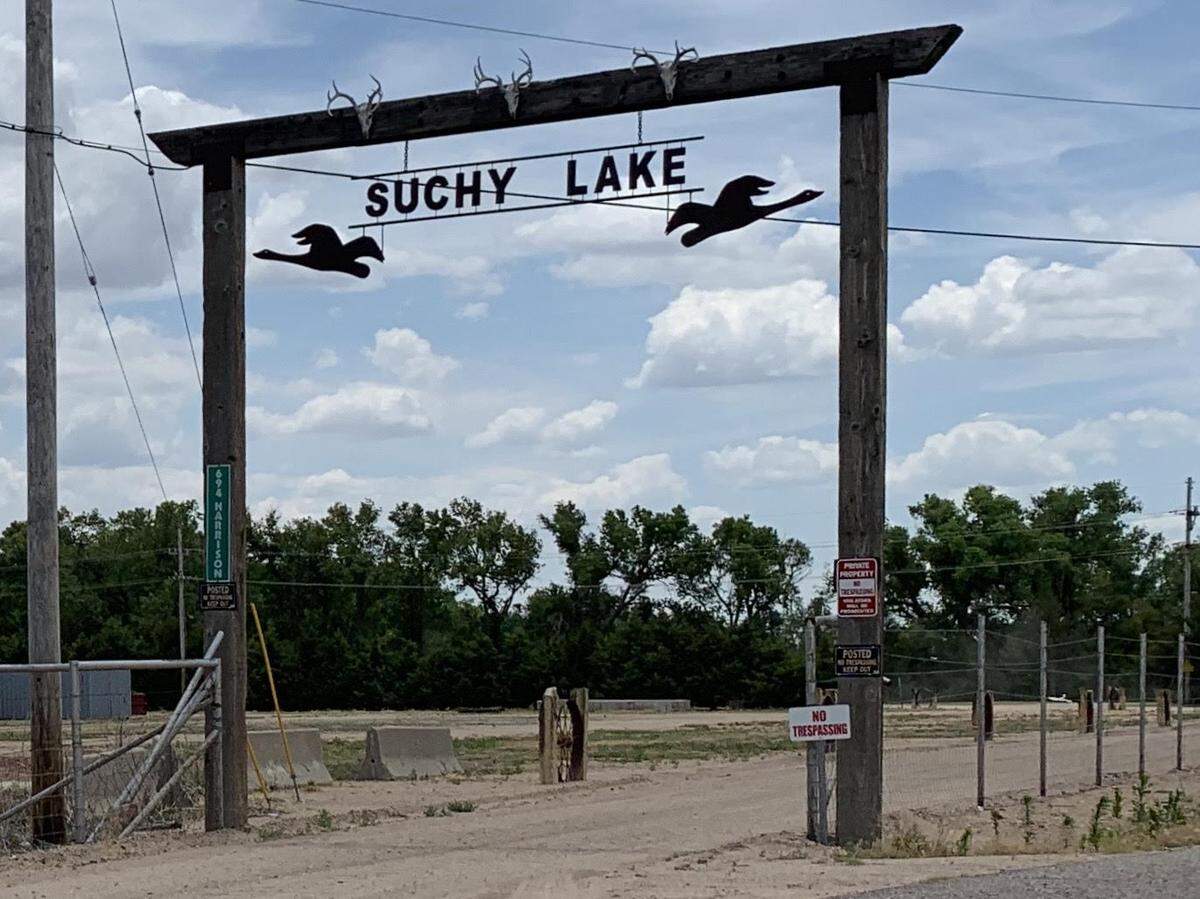
While Marshall was parked, Suchy approached in his own truck from the north.
With the two vehicles facing each other, McVay said, Suchy got out of his truck. McVay said that, according to Marshall, Suchy “aggressively came up to his vehicle clearly wanting to get into a fistfight, a physical confrontation.”
Marshall started to back out to get out of “this violent confrontation,” McVay said, but that Suchy again closed in on Marshall’s truck.
“Dr. Marshall then accelerated some more to get out of the area, and then there’s the split in what is claimed happened,” McVay told the court.
At that point, Suchy alleges, Marshall struck him. Marshall has always said no contact occurred, a denial McVay repeated at the hearing.
On the 911 call, the dispatcher asked Suchy about Marshall: “And he tried to run you over?”
“Well, yeah, then he got me in between the telephone poles,” Suchy replied. “He was spinning out.”
Charge downgraded
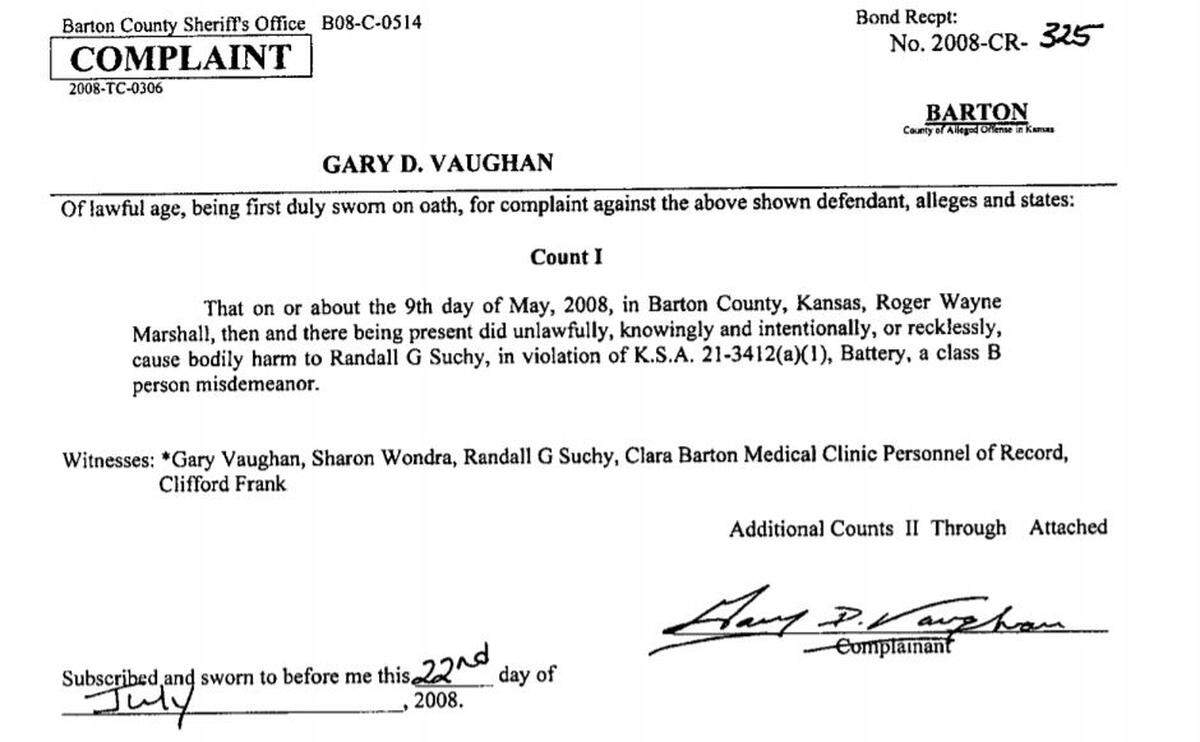
More than a month later, the Barton County Sheriff’s Office filed a complaint with the district court alleging one count of battery and one count of reckless driving. According to the complaint, Marshall “did unlawfully, knowingly and intentionally, or recklessly, cause bodily harm” to Suchy.
Both charges were misdemeanors.
An affidavit supporting the complaint, filed the next day, is under seal. While Kansas law was changed a few years ago to allow routine disclosure of probable cause affidavits, those filed prior to July 1, 2014 are accessible only by court order at the request of defendants or their attorneys.
Marshall’s campaign has refused to release the document.
In the months following the filing of the complaint, Marshall negotiated with prosecutors. At an October 6, 2008, hearing, Fleske, the assistant county attorney, dropped the battery charge.
In turn, Marshall pleaded no contest to reckless driving. Alvord, the judge, sentenced him to 5 days in jail, but suspended the jail time. Alvord also ordered Marshall to pay a $150 fine and $75 in court costs.
In his ruling, Alvord found that a “factual basis” existed for the reckless driving charge and decreed that Marshall was guilty beyond a reasonable doubt.
Alvord filed a Journal Entry of Plea and Sentencing — the court document memorializing Marshall’s conviction and sentence — on December 11, 2008, that described the outcome of Marshall’s case.
But on Christmas Eve, Keeley signed the nunc pro tunc order that eliminated Marshall’s conviction for reckless driving. The order says that Marshall, McVay and Fleske all appeared for a hearing that day and that Fleske requested the order.
But in an interview this week Keeley said that, contrary to what the order says, no formal hearing took place and that Marshall didn’t attend.
“I do not recall him appearing, having a hearing, having any arguments. I thought it was all stipulated to or agreed upon,” Keeley said.
Keeley said Alvord, who had previously handled the case and lived in Lyons, would come to Barton County on Mondays. Christmas Eve 2008 was a Wednesday.
“Judge Alvord probably wasn’t around,” Keeley said.
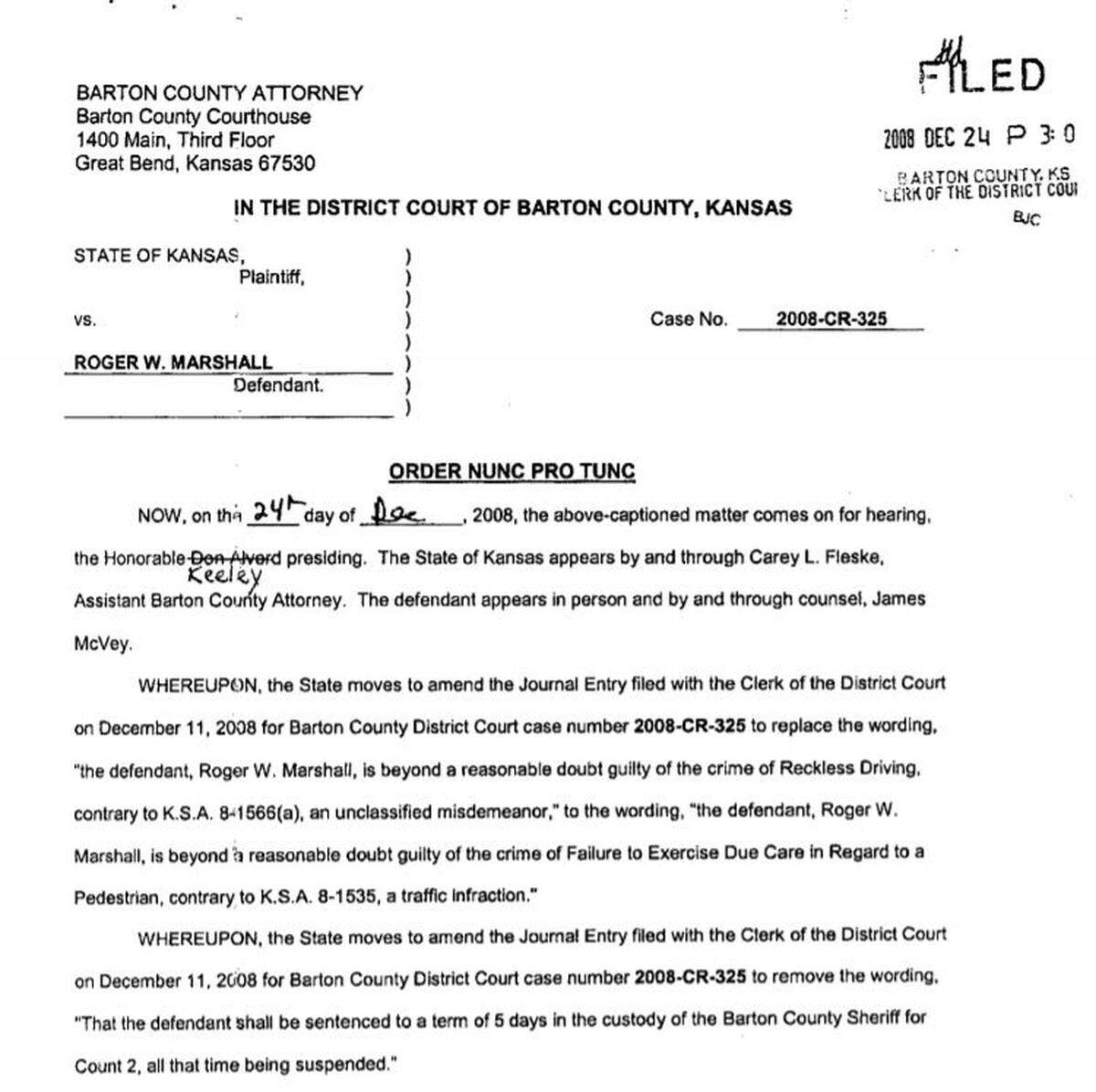
The order mandated the editing of the Journal Entry of Plea and Sentencing to strip out the reference to reckless driving and replace it with failure to exercise due caution in regards to a pedestrian — a traffic infraction.
The order also removed references to Marshall’s suspended jail sentence.
It’s unclear whether the journal entry was ever edited. The document still contained the original language when a reporter looked it up this week.
Marshall’s campaign offered no explanation for the order, but has pointed to the minor nature of the traffic infraction to dismiss the incident.
McInerney, the former prosecutor, said Kansas law allows the court to amend criminal judgments for clerical errors, mistakes and omissions, but that its use in this case extends beyond normal usage.
“Procedure to address a clerical error is designed for situations where a 1 should have been a 2. It’s not to replace a whole charge,” McInerney said.
McInerney said the lowered charge Marshall received is the same charge you would face for “your front wheels going over the white line in the crosswalk.”
Marshall sued over incident
When Suchy sued Marshall in April 2009, he alleged the physician struck him and that he suffered injuries to his arm and shoulder that required surgery.
In a September 2009 court filing, Suchy said he had accumulated medical bills of $10,794 and that treatment was ongoing.
Marshall denied the allegations and in a court filing said Suchy was “solely at fault” for any damages he suffered. In 2016, Marshall’s congressional campaign told The Hutchinson News that according to a deposition Suchy had chronic arthritis in his shoulder and that medical records showed he had been treating it for years.
As the case moved toward trial, Marshall’s defense accused Suchy of pursuing the lawsuit because of the water drainage dispute.
“Mr. Suchy showed some aggressiveness and anger over the water issue, and we believe that’s driving this personal injury suit,” McVay, Marshall’s defense attorney, said during a Sept. 3 hearing.
Later that September, the case was dismissed after Suchy and Marshall settled out of court on undisclosed terms.
“It’s all over with, I’ve forgiven him,” Suchy said last week. “It was just a bad deal that he did.”