
Kelly’s plan for Kansas: Restaurants can open, bars and theaters will stay shut for now
Kansas Gov. Laura Kelly will allow some businesses to reopen next week as long as they maintain social distancing and limit crowds to no more than 10. But going to the bar, catching a movie or getting your hair cut at the salon will remain off limits.
The Democratic governor unveiled her statewide reopening plan in a rare televised address on Thursday, the same day health authorities reported 500 new coronavirus cases and four more deaths. The disease has sickened at least 4,200 and killed 129 in Kansas.
Beginning Monday, Kansas will move into the first phase of a four-part reopening. The initial phase will last at least 14 days and allow some activities to resume.
But many of the rites and routines of spring and summer will be forbidden during the first period. Organized sports, community swimming pools, festivals, parades and graduation ceremonies won’t be allowed. Theaters, museums and gyms will remain closed.
“Kansas will approach this process slowly, gradually and cautiously,” Kelly said, while warning that life will not fully return to normal until a vaccine is developed. Experts say that could take more than 18 months.
The governor’s 25-minute speech, which struck both somber and optimistic tones, marks an attempt to chart a path forward into a new normal that balances public health with economic needs. Kelly’s stay-at-home orders and bans on mass gatherings – along with fear of the virus itself – have sent the Kansas economy crashing. Last week alone, more than 28,000 people lost jobs.
“It’s an effort to balance non-negotiable public health considerations with jaw-dropping unsustainable economic realities,” Kelly said bluntly.
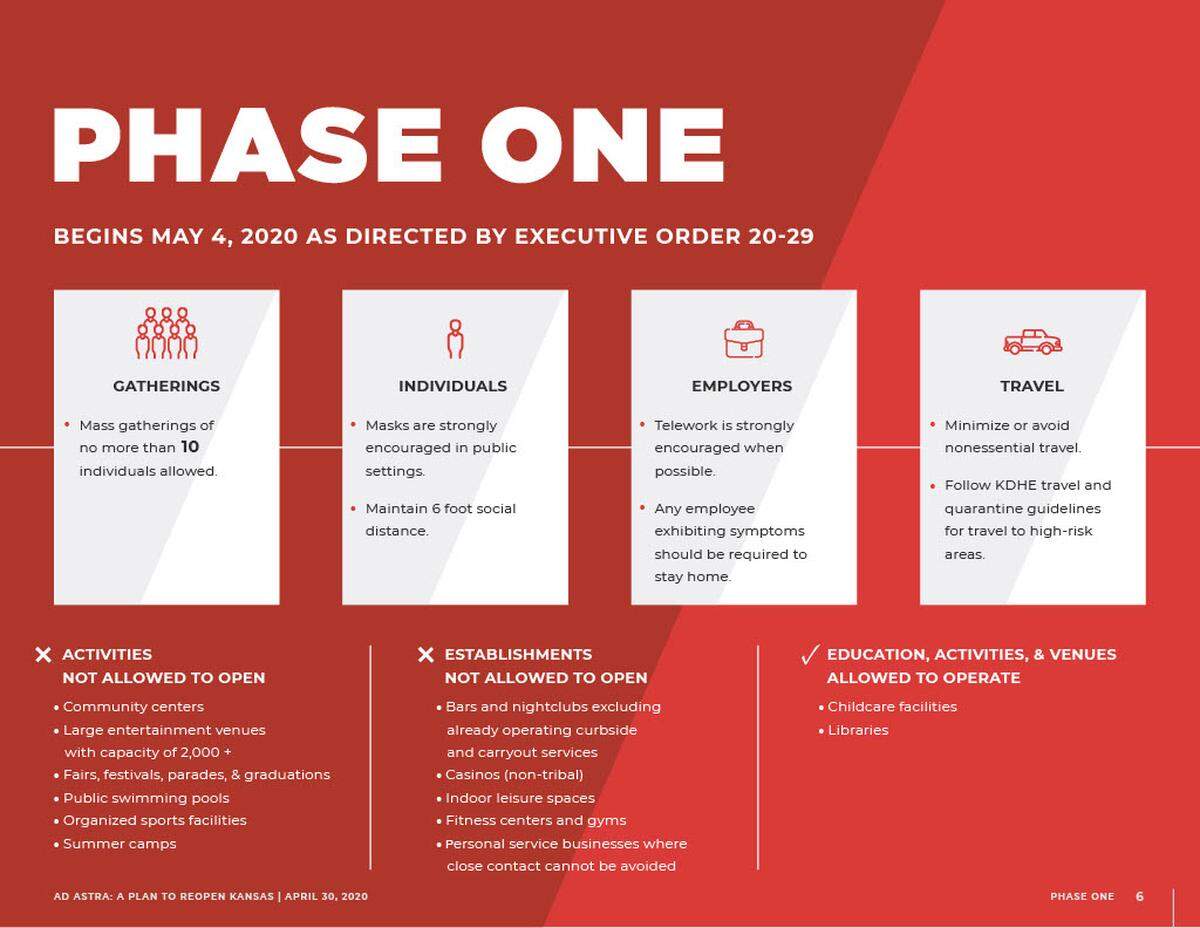
During the first phase, businesses that open must maintain 6 feet of separation between customers. Mass gatherings will remain limited to 10 or fewer.
Restaurants will be allowed to offer dine-in service, but tables will be limited to parties of 10 and must be kept 6 feet apart. Back-to-back booths will be allowed with barriers between them.
Churches and other houses of worship can hold services, but they will look different. More than 10 people can be present, but they must maintain social distance. Kelly was sued over an earlier order limiting in-person religious gatherings to 10.
The second, third and fourth phases will each roll back additional restrictions and allow more businesses and facilities to open. Transitions will be contingent in part on falling death rates and new hospital admissions.
Kelly plans to use an executive order to implement her plan. Republican legislators, who had been pushing Kelly to release a plan, will have the chance to weigh in when she seeks an extension of her emergency powers in May from the State Finance Council. The panel is chaired by Kelly and comprised of top legislators.
The Legislature must also reconvene by May 21, when lawmakers could debate limiting her authority during the crisis.
“There’s a lot of restrictions in this order and instead of helping us out, she put her foot on the gas and she implemented restrictions that no one expected,” Senate President Susan Wagle, a Wichita Republican, said in a video conference with reporters.
Many Kansans had been eagerly awaiting details after weeks of semi-lockdown to fight COVID-19’s spread, a protocol that has left tens of thousands jobless and kept families and friends physically separated.
“The pandemic has impacted us all in different ways, but one thing is certain. This is a ‘before and after’ moment for our state, for our nation, and for our world,” Kelly said. “In the years ahead, when we reflect on this time, we will instinctively think about life as ‘before COVID’ and ‘after COVID.’”
Even as the governor offered an outline of how Kansas will begin to return to some semblance of normal, she sought to prepare residents for a potentially long slog.
“I don’t know if life will truly ever go back to ‘normal,’” she said.
A patchwork of local guidelines
The plan gives local governments sweeping powers to set rules that are more restrictive than the statewide standards. It leaves city and county officials to make crucial decisions in the coming days and weeks about just how far to go in allowing residents to venture out and businesses to restart.
Kelly emphasized that the reopening framework isn’t a suggestion that local communities roll back safety measures automatically because they can. The plan should be considered a “floor, not a ceiling,” she said.
“Local communities are both allowed and strongly encouraged to take additional steps as they deem appropriate,” Kelly said.
The discretion granted local officials seems likely to create patchwork of guidelines across the state. Some counties will adhere to the minimum statewide rules while others could continue to keep businesses shut and advise residents to remain at home.
Similar businesses in different counties may be forced to operate under separate standards.
Alan Cobb, president and CEO of the Kansas Chamber of Commerce, said local restrictions must remain reasonable. He suggested that businesses overly burdened can go to court to fight excessive limits.
“There is recourse if a county or local health officer becomes too restrictive or unreasonable,” Cobb said in a statement.
Kansas House Republican leaders, including Speaker Ron Ryckman, issued a joint statement saying Kelly “passed the buck onto the counties” and left business to deal with the patchwork of regulations.
Johnson County earlier on Thursday extended its local stay-at-home order through May 10. The county represents roughly 20 percent of the state’s population.
Joseph LeMaster, the public health officer, said that while the county appears to be reporting fewer new COVID-19 cases, he worries about the virus spreading throughout the Kansas City metro as more residents begin commuting, working and shopping across state lines.
Johnson County officials will meet Friday afternoon to approve their own plan for reopening the economy. Beginning May 11, the county could allow nearly all businesses to reopen with social distancing restrictions.
Gatherings of more than 10 people would still be prohibited. Restrictions would slowly be lifted until all businesses and gatherings are permitted.
A few county commissioners expressed frustration that Johnson County is not following Kelly’s plan, arguing that businesses should reopen as soon as possible. But LeMaster contended that “the virus does not respect county lines,” and that neighboring counties continue to see an increase in cases, which could lead to further spread of the virus.
In Sedgwick County, the state’s second-most populous, officials appear ready to begin reopening. County Commission Chairman Pete Meitzner, also head of the county health board, said the governor’s speech set a good tone for a safe reopening of the economy and left him feeling hopeful.
“I appreciate the governor’s plan,” he said. “I think it’s well thought-out, reasonable and very responsible. She’s clearly talked to everybody she can and I think her message is clear that she’s ready for the state to open back up.”
As for local businesses that will remain closed by executive order, “It looks like if they can hang on for another 14 days, they’ll be part of the next wave,” Meitzner said.
“They’ve been patient and suffering for over a month, so if everybody does good, they’ll be open,” he said.
The County Commission is scheduled to meet Friday to discuss the governor’s order and decide how to proceed.
While counties have the option to put in place more restrictive rules, Meitzner said he couldn’t think of any businesses beyond those identified by the governor that should stay shuttered.
Distinct phases of reopening Kansas
Over the past week, a growing chorus of Republican lawmakers urged Kelly to release a reopening plan. Wagle, who is running for U.S. Senate, went as far as releasing her own plan, which called for most businesses to reopen at 50 percent capacity immediately.
Kelly’s plan doesn’t move as fast.
Phase one of the reopening will last at least until May 17. Phase two will begin no sooner than May 18.
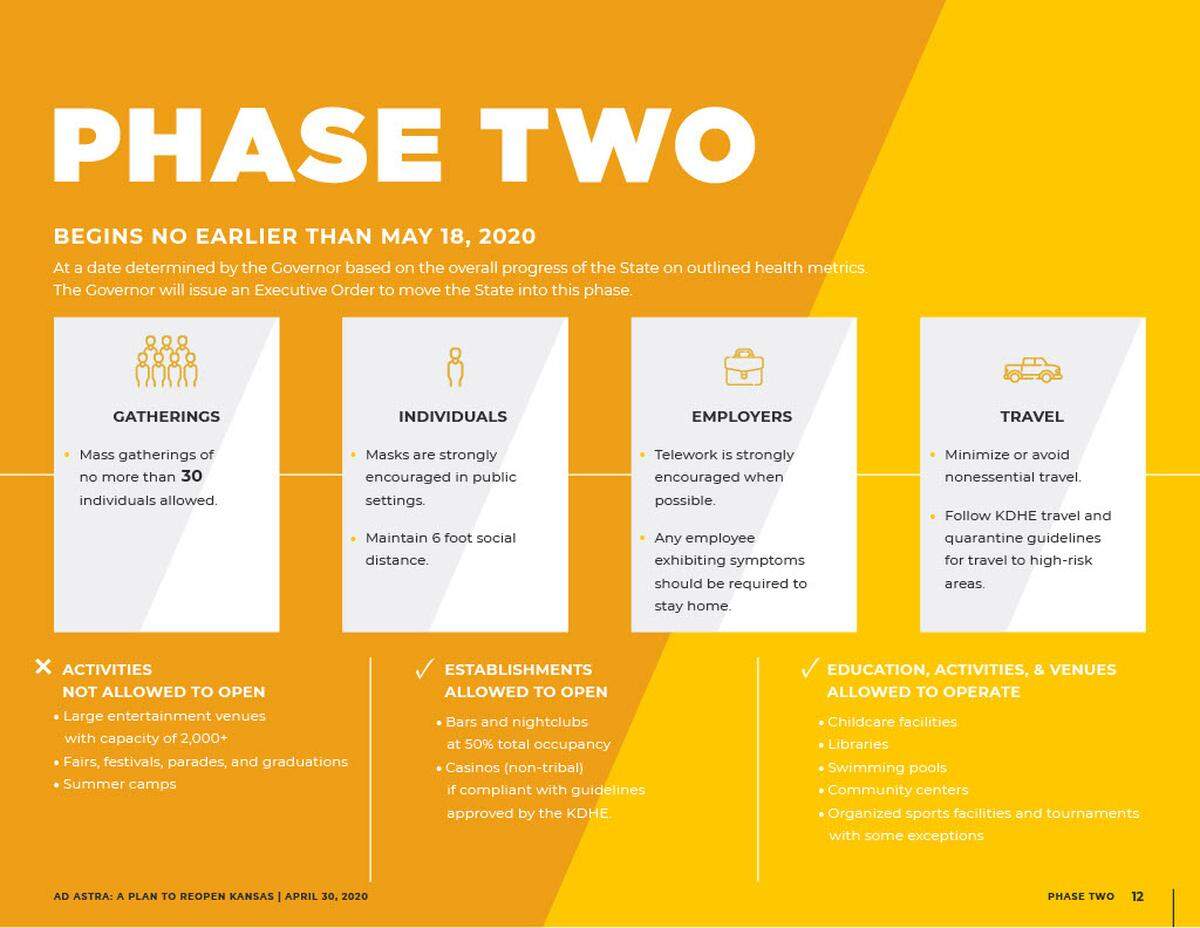
During the second period, gatherings of up to 30 will be allowed. Fitness centers and barber shops can operate as long as they follow industry-specific guidelines the state will post online.
Bars and nightclubs will be allowed to reopen at 50 percent of total occupancy.
Non-tribal casinos can open if they follow uniform guidelines approved by the Kansas Department of Health and Environment.
Other activities, like festivals and parades, as well as summer camps, will remain prohibited.
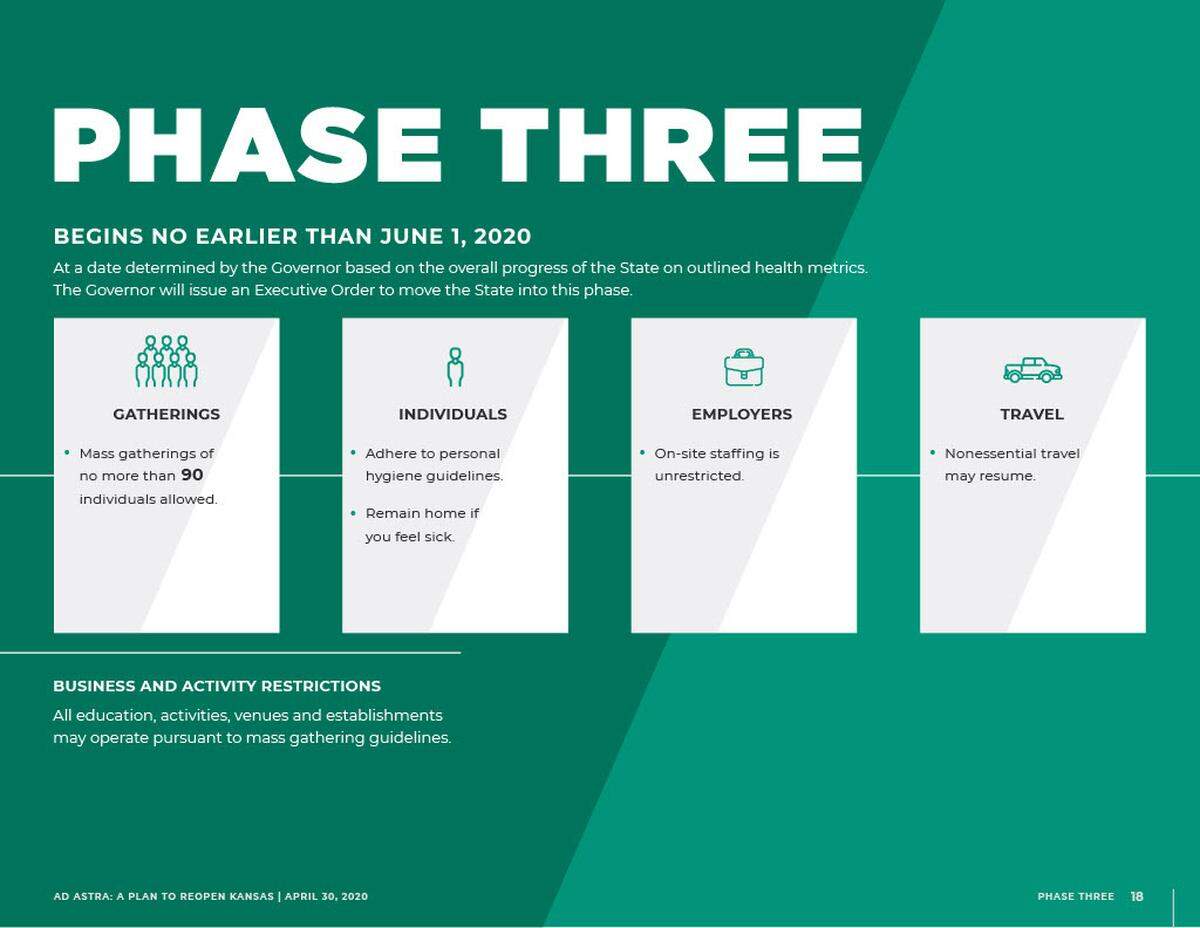
By phase three, which could begin as early as June 1, gatherings of 90 will be allowed, according to Kelly. All prohibitions on businesses and activities will be lifted as long as social distancing is observed.
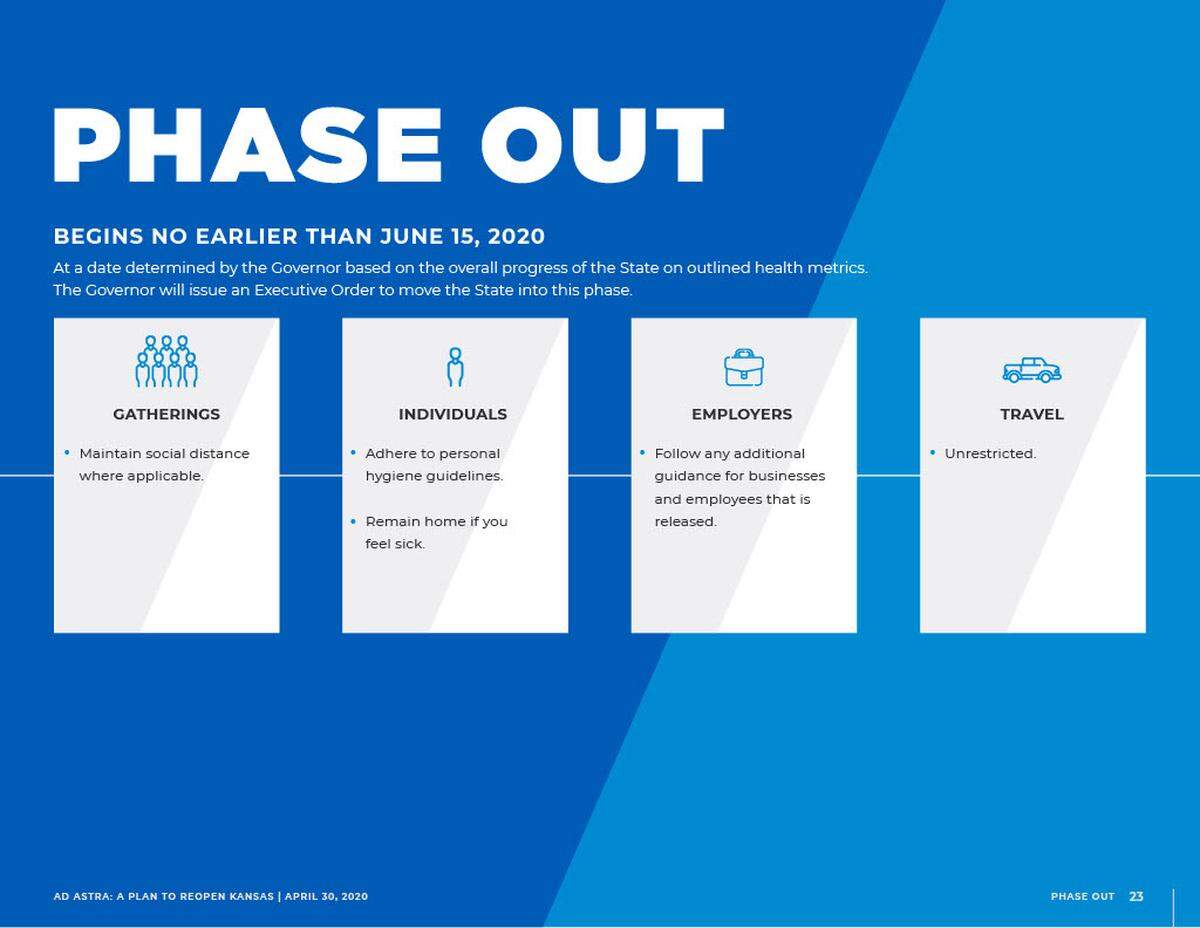
Phase four would be a “phase out” period where remaining state restrictions would be lifted. That final phase will come no sooner than June 15.
Despite the framework, many decisions are still ahead.
“We don’t yet know what school will look like in August. Or if college dorms will open to students for the fall semester,” Kelly said. “It’s unclear what steps we need to take to protect our elections in August and November.”
Rep. John Carmichael, a Wichita Democrat, said he realizes Kelly is under great pressure to hit restart, but thinks it might be too much too soon.
“I think she may be too optimistic,” Carmichael said. “I believe we have not seen the factors that President Trump lined out in his formula for our return to business as usual. We don’t have a decrease in the number of cases in Kansas, in fact at this point we’re having more and more COVID-19 clusters every day.”
He said he would be as happy as anyone to get back to some semblance of normalcy and hopes the phased approach to reopening is enough.
“But we should not presume this virus takes its instructions from politicians,” he said. “It is going to run its course and we can take steps to mitigate that course, but a declaration from the governor means nothing to the virus.”
COVID-19 cases will increase
As rules are relaxed, the number of reported cases will almost certainly go up. Kelly, health authorities and local officials will all play a role in deciding what level of risk is acceptable in communities and across the state.
Kansas, along with most states, hasn’t achieved the kind of widespread, on-demand testing that experts say is the ideal. Time and again in the past few weeks, Kelly has emphasized the important role testing will play in reopening even as Kansas struggled to improve.
The reported number of tests in Kansas has hovered around 1,000 tests per day over the past two weeks, though the number of tests performed has been mostly declining since April 24.
But Kelly and other officials have pointed to tangible signs of progress. Perhaps most significantly, the state has ordered 500,000 testing kits from an overseas supplier. The first 5,000 are en route and shipments of 10,000 a week are expected. An additional 50,000 kits are also expected from the federal government over the next two weeks.
“Kansas has made great strides in expanding our testing abilities in the last week -- securing 18 times the test supplies we had this time last week,” Kelly said.
Lee Norman, the Kansas state health officer who is leading the response to the virus, has said the state appears to have crested on hospitalizations and that its death rate is falling. In addition, the number of influenza-like sicknesses reported – a potential indicator of undiagnosed COVID-19 – has fallen precipitously since late March.
Officials view all of those signs as encouraging, even as the total number of cases reported climbs.
“We’re going to see a continual tailing off of COVID-19,” Norman said.
Contributing: Sarah Ritter of The Star
This story was originally published April 30, 2020 at 6:54 PM.