
Michael O’Donnell headed back to court Aug. 17, seeks to get fraud charges dropped
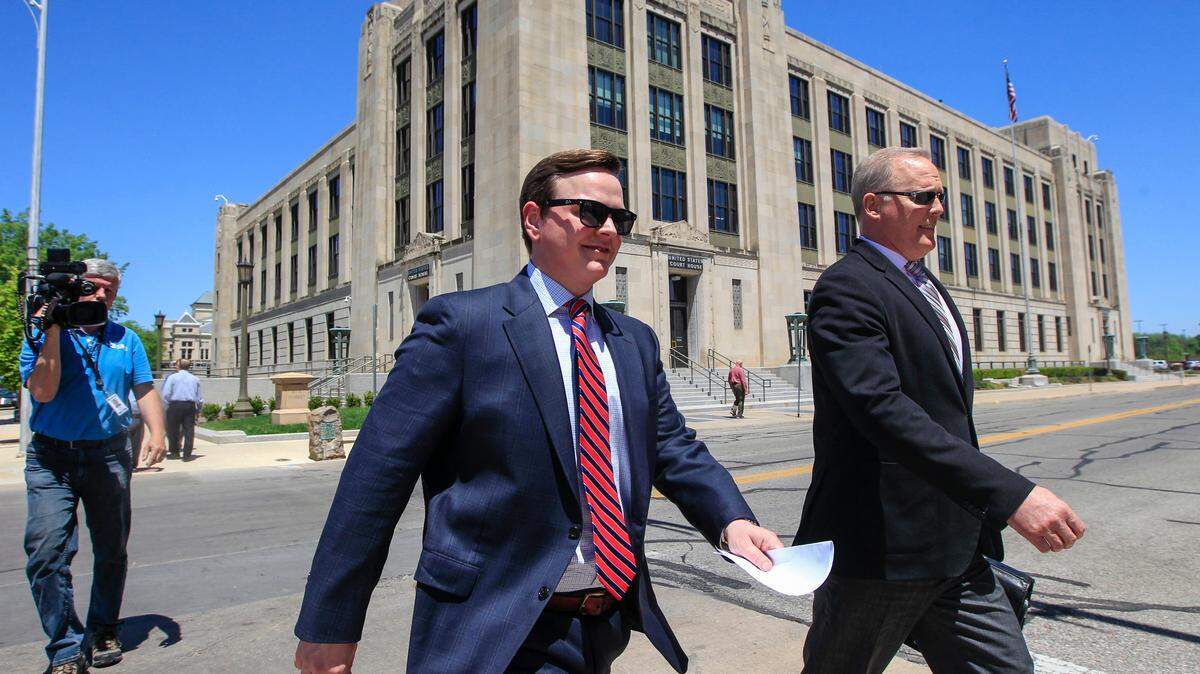
Sedgwick County Commissioner Michael O’Donnell will be back in federal court Aug. 17 asking a judge to dismiss charges against him of campaign-finance fraud and money laundering.
District Judge Eric Melgren will preside over the hearing, which he scheduled after an exchange of written arguments from O’Donnell’s lawyer, Mark Schoenhofer, and federal prosecutors Aaron Smith and Mona Furst.
O’Donnell faces five counts of wire fraud, five counts of bank fraud and two counts of money laundering. All the counts relate to alleged abuse of election campaign funds.
The hearing will be the first time O’Donnell’s case has come before Melgren, a former U.S. attorney for Kansas who was appointed to the federal bench by former President George W. Bush. Melgren was assigned to the case after O’Donnell pleaded not guilty in May.
The scheduling of the hearing came a day after Schoenhofer filed a brief arguing that the federal government has no business prosecuting O’Donnell.
Schoenhofer wrote that federal prosecution of O’Donnell would violate the state’s rights and could upset the balance of power between federal and state governments.
Schoenhofer opened the argument with a paragraph — in all capital letters and bold-faced type — accusing prosecutors of an “ATTEMPT TO REDIRECT THE COURT’S FOCUS FROM THE OBVIOUS PROSECUTORIAL OVERREACH AT THE HEART OF THIS CASE. “
If the federal case is dismissed, O’Donnell would likely face only administrative fines from the Kansas Governmental Ethics Commission, or at most a state misdemeanor prosecution, Schoenhofer said.
A footnote in the case said O’Donnell has already self-reported violations of campaign-finance law to the commission.
“Permitting the (federal) government to arbitrarily select one candidate among a dozen over the past ten years — who has allegedly committed a campaign finance violation — for federal prosecution not only disrupts our nation’s balance of power . . . but also invites a sweeping expansion of federal criminal jurisdiction,” Schoenhofer wrote.
The basic allegations against O’Donnell are that he took campaign funds for his personal use and/or gave money to friends for non-campaign-related purposes.
The indictment also charges that he filed false reports to the Governmental Ethics Commission seeking to cover up the illegal payments.
Schoenhofer’s filing was a response to a brief filed last week by federal prosecutors, who cited several cases they say set precedent for prosecuting a local official in federal court.
The federal prosecutors said in their filing that the situation is almost identical to a 2015 Louisiana case where the court ruled a politician could be prosecuted for federal fraud because he had solicited money for a campaign and used it for other purposes.
That court ruled the politician’s actions were “consistent with the conduct the federal fraud statute was intended to proscribe,” according to the prosecutors’ argument.
Schoenhofer, however, wrote that “the federal prosecutors in this case have bulldozed over traditional principles of federalism and deference to states in local criminal matters.”
In addition, Schoenhofer contended that prosecuting O’Donnell harms the state itself.
“Depending on whether the (federal) government selects a particular state candidate for federal prosecution or not, a campaign finance violation could result in as a little as a fine — the usual penalty — or in an unusually harsh penalty such as federal prison,” the filing said. “There will be no uniformity in the handling of campaign finance violations in Kansas if the government continues to intrude in an area that traditionally and statutorily lies with a state agency.”
O’Donnell remains free on an unsecured bond of $5,000 and is continuing to serve as a county commissioner pending the outcome of the federal case.
If the case is not dismissed, delayed or settled first, O’Donnell is scheduled for trial Sept. 18.