First-of-its-kind video shows deep-sea fish escape by swimming backward. Take a look
From a research vessel in the Pacific Ocean, scientists watched the feeds of several cameras sitting on the seafloor. Miles below, a deep-sea fish approached the camera’s bait then, changing its mind, swam backward to escape.
The footage turned out to be a first-of-its-kind sighting — but it wasn’t the last.
A team of scientists set out aboard a research vessel in June 2023 for a six month survey across the Pacific Ocean. At dozens of sites, they dropped cameras equipped with bait and watched deep-sea life for hours, according to a study published Jan. 8 in the peer-reviewed Journal of Fish Biology.
As they reviewed the hundreds of hours of footage, researchers noticed several instances of deep-sea fish seemingly swimming backward. Were they seeing that right?
For years, scientists assumed that, “in the darkness and relatively featureless environment” of the deep sea, fish didn’t need to “navigate complex environments,” the study said. Although some long and slender coastal fish had been seen swimming backward, “there has been no evidence that deep-sea fishes” used such an “escape maneuver.”
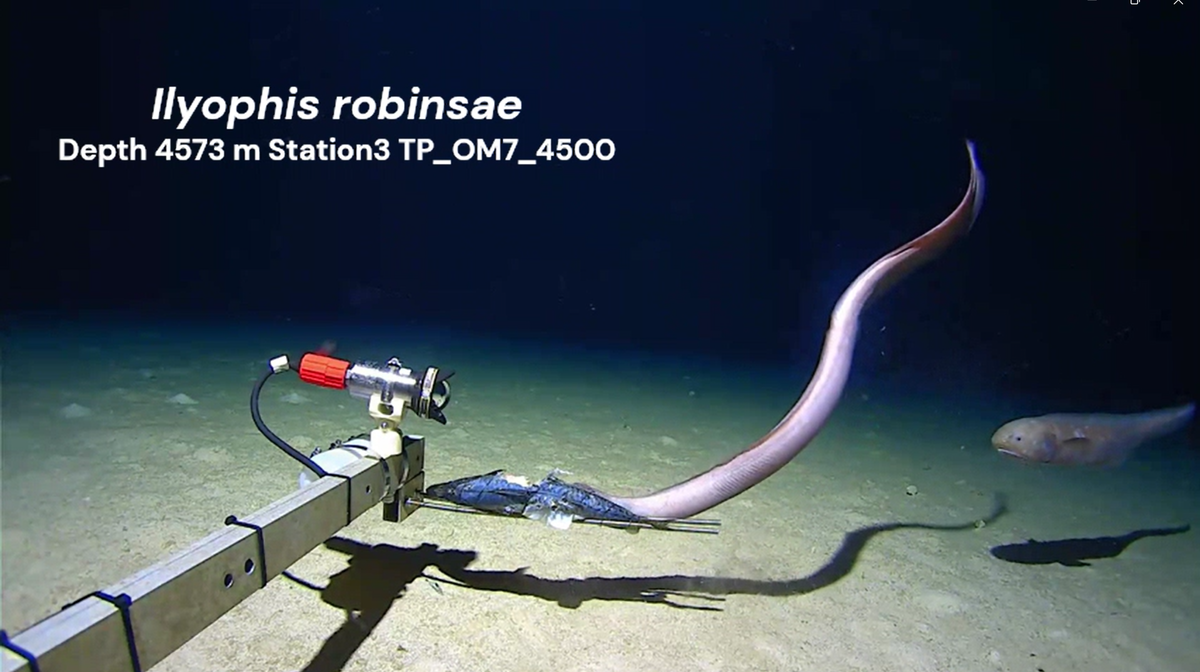
Intrigued, researchers took another look at their footage. They tracked down 14 clips of fish seeming to move backward and reviewed each one in slow motion. Sure enough, the clips showed four different fish species swimming backward to navigate “obstacles on the seafloor,” such as the baited camera, the study said.
The first-of-their-kind videos showed a cutthroat eel, or Ilyophis robinsae, moving tail-first away from the camera in an almost ribbon-like manner.
Another type of fish, an abyssal grenadier or Coryphaenoides yaquinae, was seen swimming backward with the help of its fins. The “trapped” and “upside down” fish swam backward to get out from under the camera equipment.
Other videos showed two species of cusk eel, Bassozetus sp. and Barathrites iris, swimming tail-first away from the camera with the help of top fins. “After the backward escape maneuver, the fish would usually turn before swimming forward in a new direction,” the study said.
Researchers concluded that “in the darkness of the abyss, … backward swimming has the great advantage that the fish automatically reverses along the presumed safe path.” Additionally, many deep-sea fish have eel-like body shapes, which helps make backward swimming possible.
The backward-swimming deep-sea fish typically measured between 1 and 2 feet in length and were seen at depths of roughly 2.8 miles to 4 miles down, the study said.
The research team included Imants Priede and Alan Jamieson.
This story was originally published January 9, 2025 at 9:58 AM with the headline "First-of-its-kind video shows deep-sea fish escape by swimming backward. Take a look."