
Kansas astronomer helps discover new planet outside our solar system
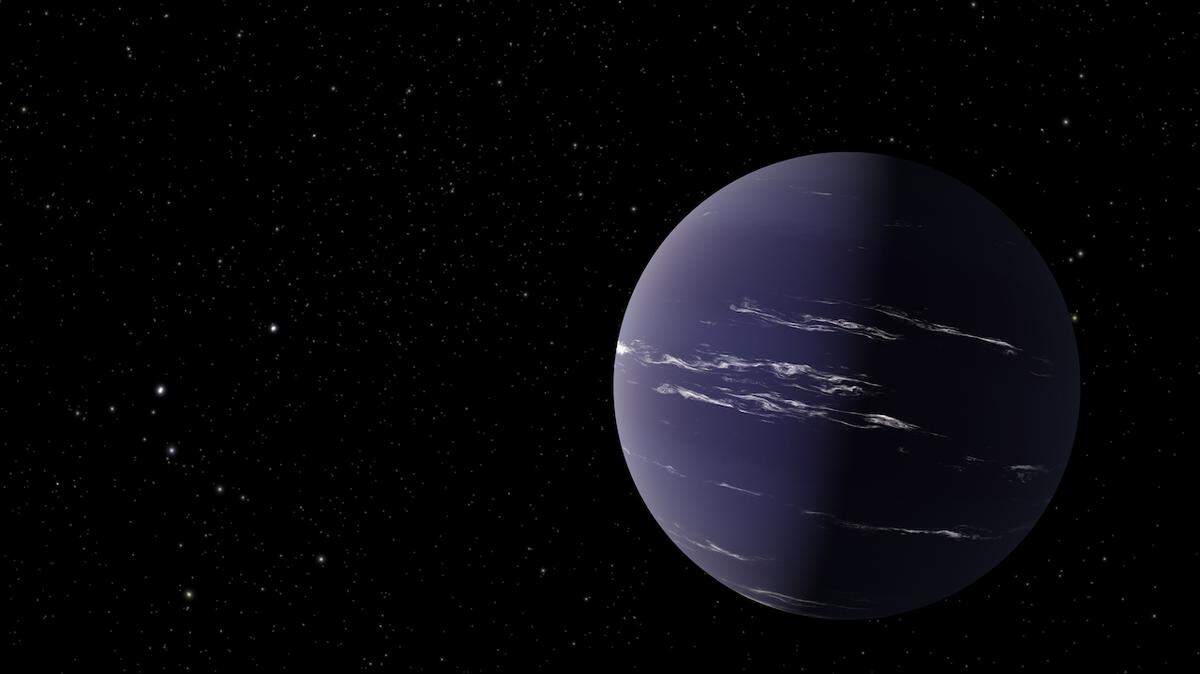
A Kansas scientist has helped discover a planet 90 light years away from Earth that might contain water clouds and has an enticing atmosphere.
The planet, TOI-1231 b, is an exoplanet, a planet located outside of our solar system. The discovery was made by an international team, including scientists from NASA’s Jet Propulsion Laboratory and the University of Kansas.
“It’s one of the lowest temperature planets with a big atmosphere that we know about,” Ian Crossfield, an assistant professor of physics and astronomy at the University of Kansas who was involved in the study, said. “It’s interesting as a unique object we should be able to study in detail.”
The study describing the discovery of the planet will be published in a future issue of the Astronomical Journal.
Discovering planets outside of our solar system
Scientists discovered TOI-1231 b using data from NASA’s Transiting Exoplanet Survey Satellite (TESS) and verified it by using the Planet Finder Spectrograph (PFS) on the Magellan Clay telescope at Las Campanas Observatory in Chile.
TESS observes areas of the sky for 28 days, looking for changes in the brightness of stars. When an exoplanet like TOI-1231b passes in front of its star, the brightness of the star will decrease in relation to the size of the exoplanet and the star. Smaller stars like the red M-type dwarf that TOI-1231 b orbits are easier to block and so planets around them are easier to discover.
The speed at which the brightness of the star decreases can also inform scientists whether an atmosphere is present.
“When that brightness level drops a few hundredths of percent, it does it a little more slowly [for a planet with an atmosphere]. If it were just a straight rocky planet, it would be a sharper drop,” Gary Hug, a Kansas-based amateur astronomer who has observed near-Earth objects and tracked asteroids for over two decades, said. “It would be the same amount of drop [in brightness], but it would take a little longer to reach.”
To calculate the correct period of orbit, the exoplanet needs to pass in front of the star at least twice during the 28-day observation period. Most of the exoplanets discovered by TESS have orbital periods of less than 14 days, making TOI-1231 b with its orbital period of 24 days more valuable to scientists.
“This is exciting because it’s one of only two or three objects like this so far,” said Kaitlin Rasmussen, a post-doctoral research fellow in the department of astronomy at the University of Michigan, who was not involved in the study.
TOI-1231 b might have water clouds
With a mass over fifteen times that of Earth and a radius one third that of Jupiter, the largest planet in our solar system, researchers were able to calculate the density of TOI-1231 b and infer its composition.
“Working with a group of excellent astronomers spread across the globe, we were able to assemble the data necessary to characterize the host star and measure both the radius and mass of the planet,” Jessica Burt, a scientist at NASA Jet Propulsion Laboratory and the lead author of the study, said in a statement released by the University of New Mexico.
“Those values in turn allowed us to calculate the planet’s bulk density and hypothesize about what the planet is made out of. TOI-1231 b is pretty similar in size and density to Neptune, so we think it has a similarly large, gaseous atmosphere.”
But while it may be Neptune-like in size, it is more Earth-like in temperature at 134 degree Fahrenheit (57 Celsius).
Other research suggests that planets of similar temperatures may have clouds in their atmosphere. In the case of one exoplanet’s atmosphere, K2-18 b, scientists found water.
“TOI-1231 b is one of the only other planets we know of in a similar size and temperature range, so future observations of this new planet will let us determine just how common (or rare) it is for water clouds to form around these temperate worlds,” Burt said in a statement.
“The composition of a planet’s atmosphere really provides some fairly unique fingerprints that help tell us how it might have formed and it might have gotten to where it is today,” Crossfield said.
The future of exoplanet studies
With over 4,000 discovered exoplanets and thousands more waiting for additional observations, scientists are moving away from simply detecting exoplanets to starting to understand their properties.
Researchers are planning to conduct further study on TOI-1231 b later this month using the Hubble Space Telescope and hope to expand their work using the James Webb Space Telescope, set to launch later this year.
“Here in our own Solar system, all of these gas giants are really far away from the sun, Jupiter, Saturn, Neptune, but here in this new planetary system we found, there’s this planet that’s even warmer than the earth so it’s even closer to its star but it is a big gas giant planet. This is clearly a solar system that’s different than our own solar system,” Crossfield said.
“The best way to understand how Earth and the rest of the planets in our solar system got to be here is to understand them in a broader context, understand not just our solar system but all of them and how all they fit together.”
Finding planets like those in our solar system might not be that far off either.
“In the next decade, we’re going to have huge telescopes, 30-meter (100-feet), 40-meter (130-feet) telescopes,” Rasmussen said. “Those telescopes are going to have cutting edge spectrographs, which are going to allow us for the first time to start to look at not just sub-Neptunes and not just Jupiter-sized planets on short orbits, but we’re actually going to be able to find these Earth-sized planets.”
How Kansans can get involved
In theory, anyone with the right equipment can discover exoplanets.
“All it amounts to is detecting a drop in brightness,” Hug said.
In practice though, Hug said that many amateur astronomers tend to focus on near-Earth objects such as asteroids and comets.
He recommended that people interested in getting involved should reach out to a local astronomy group such as the Wichita-based Kansas Astronomical Observers. The department of physics and astronomy at the University of Kansas maintains a list of astronomy groups elsewhere in the state.
“There’s a lot of stuff that’s going on that amateurs can do,” Hug said. “People don’t think about Kansas as being a prime spot to be looking at stuff through telescopes, [but] you have to remember, the same things that go over the big observatories go overhead here.”