
Rarely seen red lightning lights up Canada’s night sky. What caused ominous display?
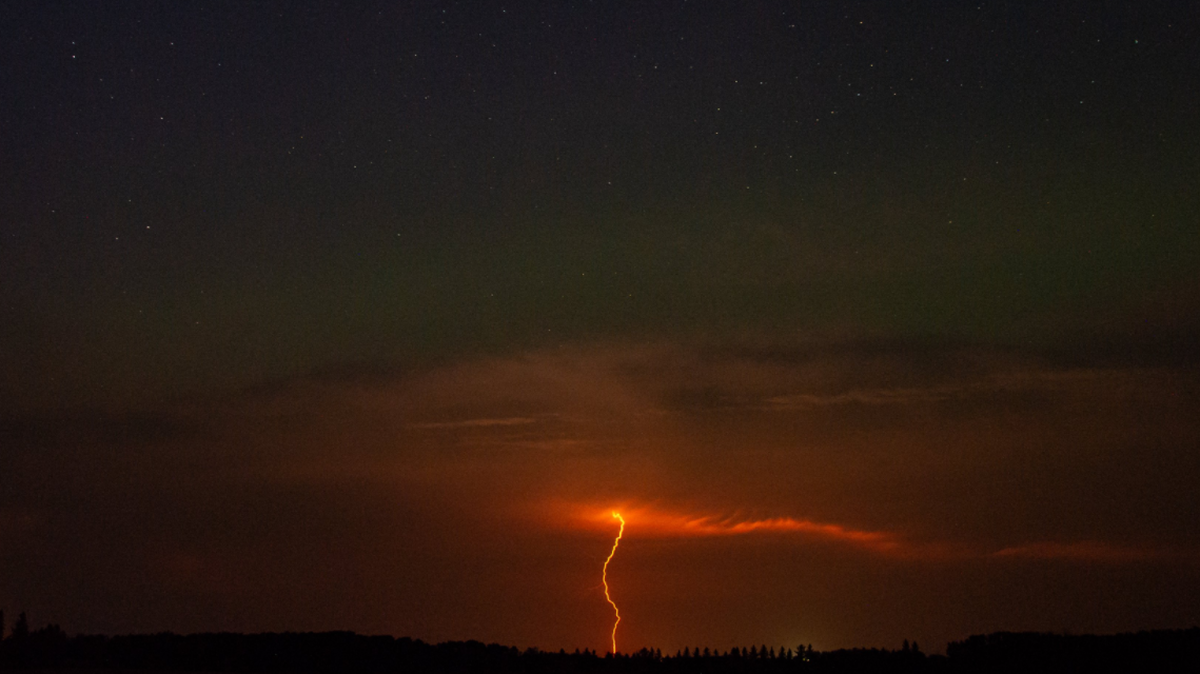
Red lightning appeared over Western Canada this week and photos show the rarely seen phenomenon resembled something akin to dragon’s breath.
It appeared Tuesday night over southern Manitoba, as photographer Deb Maluk was trying to capture images of the Aurora Borealis.
Maluk tweeted three photos of the fiery red bolt, which appears to have shot out of the sky and then splintered across the horizon.
Red lightning doesn’t exist in the literal sense, according to the National Weather Service.
The closest known phenomena is something called a red sprite, which occurs high in the atmosphere “directly above an active thunderstorm,” NOAA says. “They are rarely seen with the human eye ... and not well understood, “ NOAA reports.
So what did Maluk photograph?
The Cooperative Institute for Meteorological Satellite Studies shared her photos on Facebook and explained the lighting strike was “wrapped in a reddish haze of wildfire smoke.”
There are more than 80 wildfires burning in 13 U.S. states, and nearly 370 “uncontrolled” or “held” fires in Canada, according to government reports.
The resulting smoke has spread across the continent, and is credited for generating red and pink sunsets, along with orange and red moons at night.
“The light produced by a flash of lightning is white. The more particles in the air, the greater the impact is on the light we see,” John Jensenius of the National Lightning Safety Council told McClatchy News.
“At long distances or when there are a lot of particles in the air, the shorter wavelengths of light (blues, indigos, and violets) tend to be absorbed or scattered. The longer wavelengths (reds, oranges, and yellows) are what remain. So, in this case, both the distance from the lightning flash and the smoke particles in the air are preventing the blue, indigo, and violet light from reaching the observer, causing the lightning to appear red.”
Maluk says the “light show” was short and did not surprise her, given the abundance of smoke in Canada.
“Sadly, the whole world seems orange/red these days,” she said, adding the smoke “made for an orange moon rise” the same night.
This story was originally published July 30, 2021 at 10:08 AM with the headline "Rarely seen red lightning lights up Canada’s night sky. What caused ominous display?."