
Huge hammerhead shark tagged by researchers was almost too much for boat, photos show
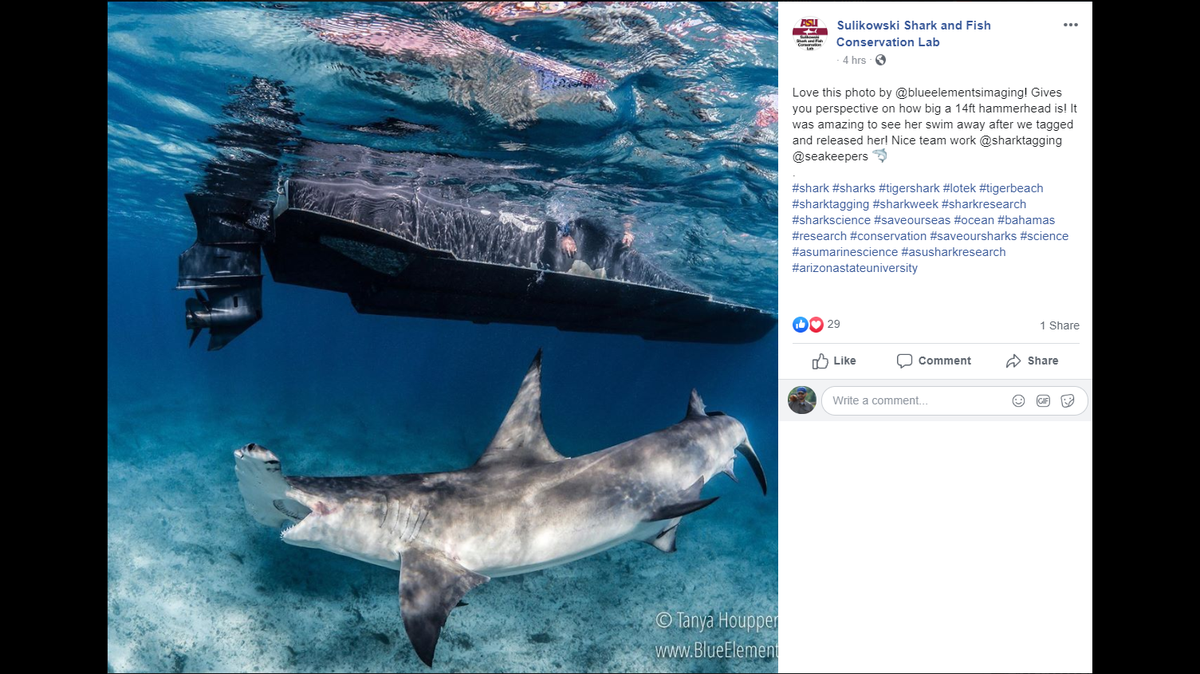
A 36-foot boat sounds big, but even the most spacious deck can feel cramped when a live shark is involved.
Shark researchers from Arizona State University proved that point this week, with photos of a fierce test subject that appeared to equal the size of their research vessel in the Bahamas.
“Gives you perspective on how big a 14-foot hammerhead is,” researcher James Sulikowski told McClatchy News. “Her hammer-shaped head was over three feet across.”
The Sulikowski Shark and Fish Conservation Lab shared the photo on Facebook, and credited it to Tonya Houppermans. The lab is part of Arizona State’s School of Mathematical and Natural Sciences.
It was taken during a December expedition to study tiger shark reproduction, which meant wrangling the sharks to the side of the boat and holding them still for ultrasounds.
The team also fitted the sharks with National Marine Fisheries tags, which Sulikowski admits wasn’t easy in the case of the hammerhead.
“The hammerhead was magnificent,” Sulikowski told McClatchy. “The boat was 36 feet long, so the shark took up almost half the length. This was by far the largest hammerhead I have ever seen.”
They actually get a lot bigger. Some hammerheads can grow to 20 feet and weigh 1,000 pounds, according to National Geographic.
Even with this one at 14 feet, Sulikowski says he learned that they can be a powerful force, even when pitted against a bigger boat.
“She dragged our gear almost 1,000 feet and we still had to chase her down to retrieve it,” he told McClatchy.
“When we saw her head come out of the water, everyone was like, ‘Whoa!’ It took everyone’s effort for us to secure her safety alongside the boat. We conducted an ultrasound and she was not pregnant, but that didn’t take away from the opportunity to see such an incredible shark up close.”
The Sulikowski Shark and Fish lab has been searching for the nursery grounds of coastal sharks, including putting transmitters (called Birth Tags) inside the uterus of pregnant sharks.
Once placed in the uterus, the tags stay inactive until they pop out with the newly born shark pups and begin transmitting location signals to satellites.
This story was originally published January 15, 2020 at 2:46 PM with the headline "Huge hammerhead shark tagged by researchers was almost too much for boat, photos show."