
Trump pitches coronavirus-related stimulus package on Capitol Hill
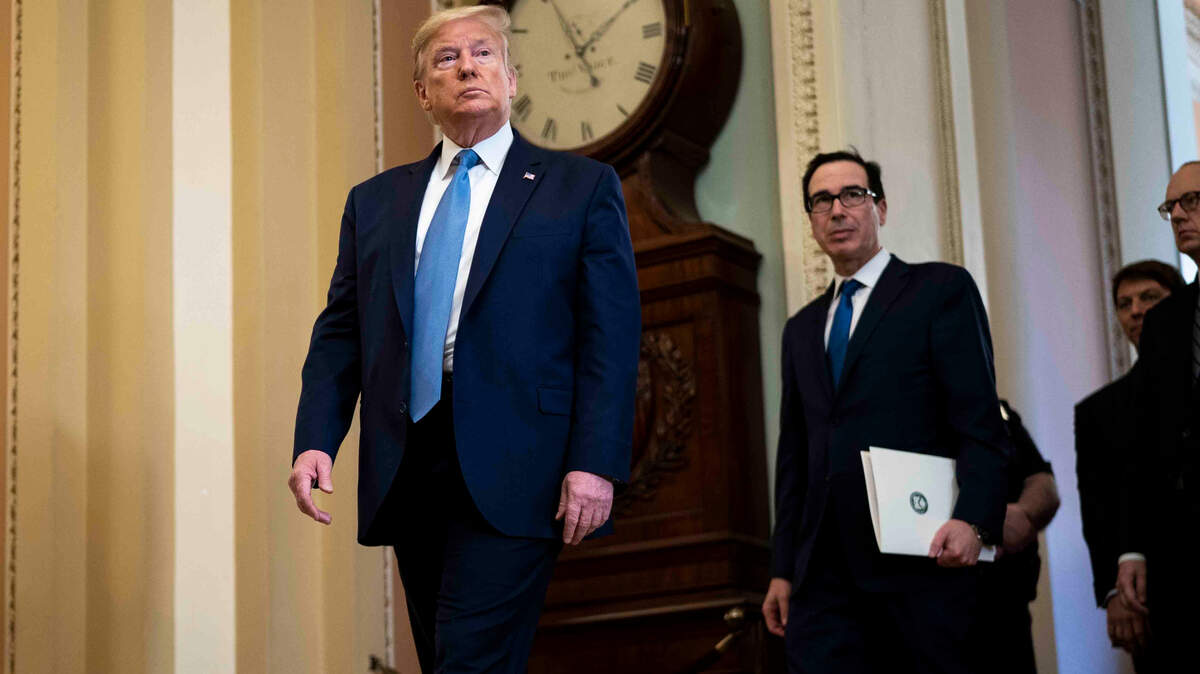
WASHINGTON — President Donald Trump took his pitch for a coronavirus-related economic stimulus package to Capitol Hill on Tuesday, joining Senate Republicans over lunch to discuss cutting payroll taxes, offering targeted relief to tourism and hospitality industries, and other possible steps to lift economic growth.
After the meeting, a Senate aide said Treasury Secretary Steven Mnuchin and Speaker Nancy Pelosi of California would take the lead on negotiating a bipartisan package.
Trump emerged from his lunch with no new details to share on the package, which remained in flux throughout the day on Tuesday, amid internal struggles at the White House and a cool reception among congressional Republicans to the temporary payroll tax cuts that the president has floated. Trump said the payroll tax cut and other ideas were discussed, adding that “there’s great unity within the Republican Party.”
He acknowledged there was not yet a consensus on how to proceed but expressed confidence that the economy would endure.
“Be calm,” he said from Capitol Hill, after speaking with lawmakers. “The consumer has never been in a better position than they are now.”
Trump and his advisers are also considering using the Federal Emergency Management Agency as a vehicle to deliver funds to stimulate the economy, a move that could allow the administration to begin bolstering growth without waiting for Congress. The president could approve major disaster declarations in a growing number of states that have seen coronavirus outbreaks, according to officials in the administration and in Congress.
Such approvals would allow FEMA to begin distributing aid to affected individuals, such as emergency food stamps, and to states and local governments for efforts including “emergency protective measures.”
The idea is one of many options being proposed to help alleviate economic strain from a virus that is quarantining workers and consumers, scuttling vacations, closing factories and causing other disruptions.
Lobbyists in Washington suggested that several possible plans were under consideration on Tuesday, including tax credits for companies that retain employees who are unable to work because of quarantines and the possibility of allowing firms to delay paying a portion of their estimated quarterly corporate tax bills until the spread of the virus — and its economic effects — subside.
Other possibilities included temporarily suspending some excise taxes, such as the 7.5% tax airlines pay to the Federal Aviation Administration; increasing community development block grants; and fixing an error in the 2017 Republican tax overhaul that makes it more expensive for restaurant owners to do renovations.
Trump previewed several ideas at a news conference on Monday evening, but discussions remain in flux and many of the proposals would require congressional approval at a time of deep partisan ire and with the 2020 election looming.
The idea of a payroll tax cut in particular has divided Trump’s advisers, with Mnuchin and Larry Kudlow, the director of the National Economic Council, expressing concerns about the cost, whether it would address the problems caused by the virus and what Democrats would demand if they reopen the tax code.
However, Peter Navarro, Trump’s trade adviser, has been a proponent of the idea, and Trump has been pushing for it to be included in a package of options.
Leaders in the Democratic-controlled House have also reacted with skepticism to the payroll tax plan. They have pushed for the administration instead to ramp up spending on the public health response to the virus.
One area of agreement among Republicans and Democrats is the need for any package to include government-provided sick pay to workers who are unable to perform their jobs as a result of quarantines or caring for children whose schools are canceled over virus fears. It is unclear how such a program would work and how it would ramp up fast enough to prevent affected workers from missing payments on rent, credit cards or other bills.
Markets rallied on Tuesday morning on news of the stimulus request, after suffering steep losses Monday. But several congressional aides cautioned it will likely take weeks, at minimum, to complete and approve any stimulus bill.
While his advisers worked on the package, Trump on Tuesday called the Federal Reserve “pathetic” for keeping interest rates too high, renewing a regular gripe as coronavirus spreads both globally and domestically, roiling markets and threatening the economic outlook.
“Our pathetic, slow moving Federal Reserve, headed by Jay Powell, who raised rates too fast and lowered too late, should get our Fed Rate down to the levels of our competitor nations,” he tweeted. “The Federal Reserve must be a leader, not a very late follower, which it has been!”
This story was originally published March 10, 2020 at 4:55 PM with the headline "Trump pitches coronavirus-related stimulus package on Capitol Hill."