Wichita schools will seek November bond issue. Here are three proposals
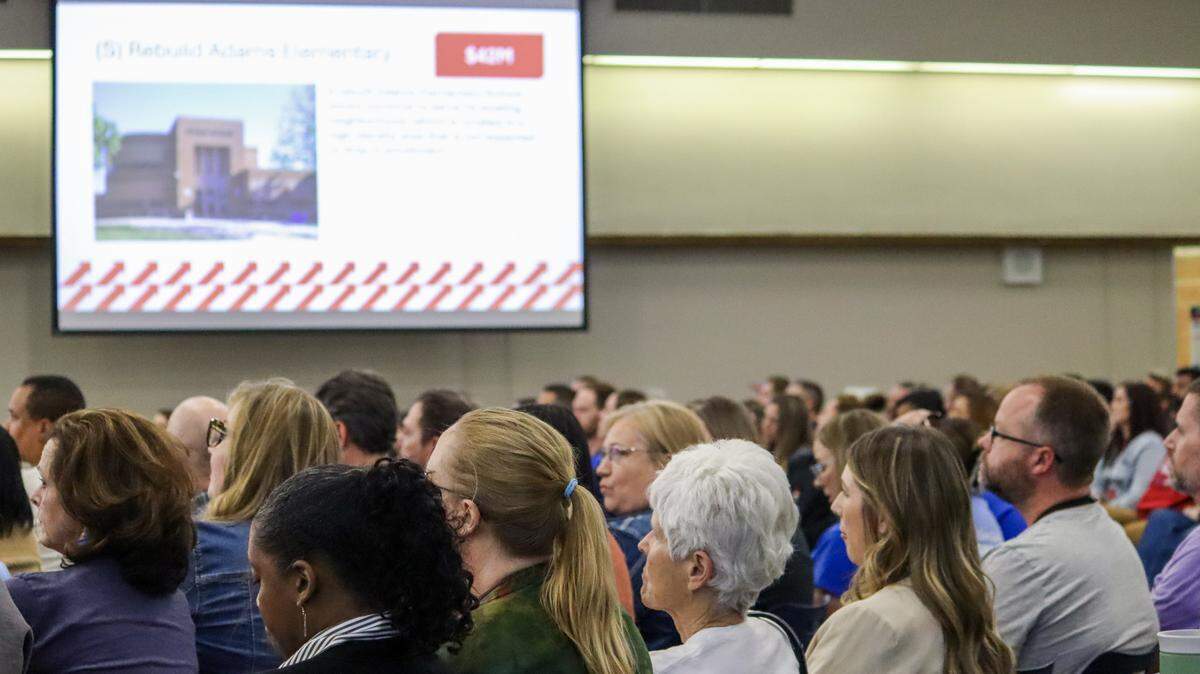
Wichita school district administrators shared three tentative proposals Monday night for a $615 million bond question they hope to put on the Nov. 3 ballot.
Each proposal would allocate the $615 million differently but all, if approved in their current preliminary form, would direct bond money to rebuild schools like Truesdell Middle School, Black Traditional Magnet Elementary, McLean Science & Technology Magnet Elementary and Chisholm Trail Elementary; restore and preserve North and East high schools; and make long-delayed upgrades to career readiness buildings, facility air quality and traffic flow.
“Our approach this time is not a one-size-fits-all solution,” Chief Financial Officer Addi Lowell said. “We want to give our community options so they can tell us what’s most important to them and what meets their needs right now.”
Items included in the tentative proposals, Deputy Superintendent Gil Alvarez said, were chosen based on a “high need for our district and/or high support from our community” with pricing that reflects community feedback while still providing options.
The proposed bond value is higher than that of the narrowly rejected $450 million issue from 2025, but district leaders said it contains fewer projects.
“The only really new project was Chisholm Trail Elementary. This is really a scaled back bond compared to the projects,” Superintendent Kelly Bielefeld said. “The numbers are higher because the cost of things goes up.”
Homeowners in the Wichita school district currently have a 5.5 bond and interest mill levy to pay off debt from 2008 bonds. The three proposals, Wichita schools strategic communications supervisor Susan Arensman said, have taken this existing 5.5 mill rate into account.
“The strategy that we have here is that we would essentially wrap the new millage with the old millage, so the taxpayer on some of these proposals, if they vote yes, could see a little bit of a tax decrease, and some of them would be flat,” Bielefeld said.
Some would also cause a tax increase, with an expected repayment period of 20 years.
Lowell said the district tried to be especially cognizant of rising costs affecting constituents when drafting the three proposals. Each proposal has two questions, and the second question is contingent upon the first. That means that if voters reject the first question, the second would fail automatically.
Proposal 1: ‘The facilities needs proposal’
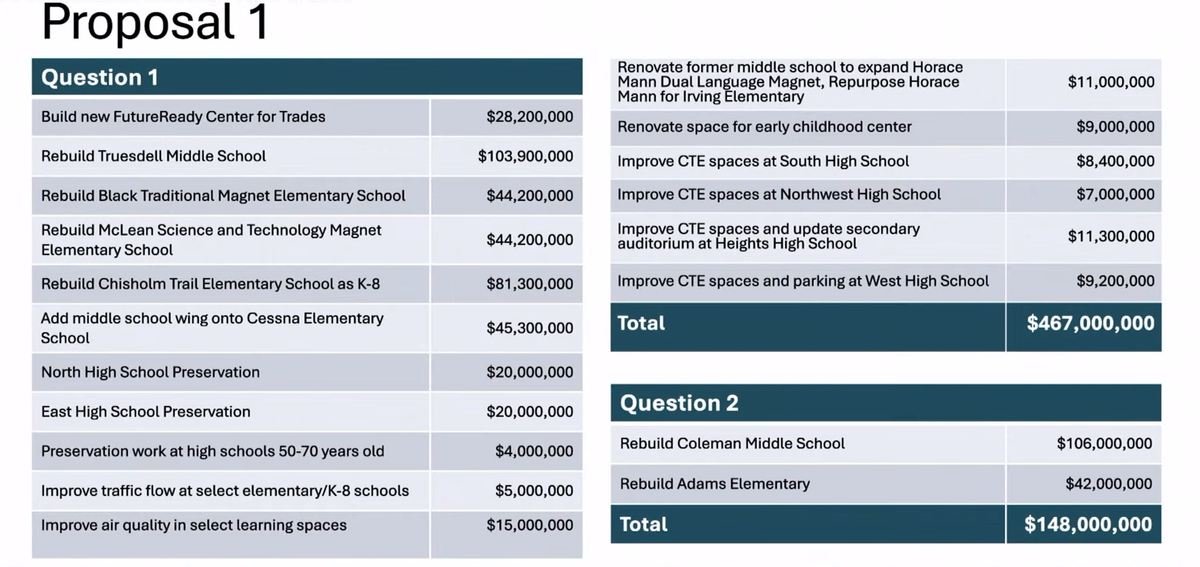
The first proposal places the highest priority on addressing as many in-need facilities as possible, Lowell said. Question 1 would have $467 million of the bond’s $615 million total, with only two items on Question 2.
“Question 1 would get us what we felt like was absolutely the most critical, and the urgency was needed,” Lowell said. “Proposal 1 really puts the priority on those projects we cannot kick the can on.”
That includes addressing nearly $104 million in major structural issues at Truesdell, which will require rebuilding, along with 16 other rebuilding and preservation work projects. Question 2 would total $148 million to cover the costs of rebuilding Coleman Middle School and Adams Elementary.
Lowell and Alvarez also provided an estimate for tax implications based on if each proposal were put to vote. For the owner of a $200,000 home, a taxpayer would see an increase of $1.66 per month, or about $20 annually, if Question 1 were approved and $4.16 per month, or $50 annually, if both questions were approved.
Proposal 2: ‘The tax-neutral proposal’
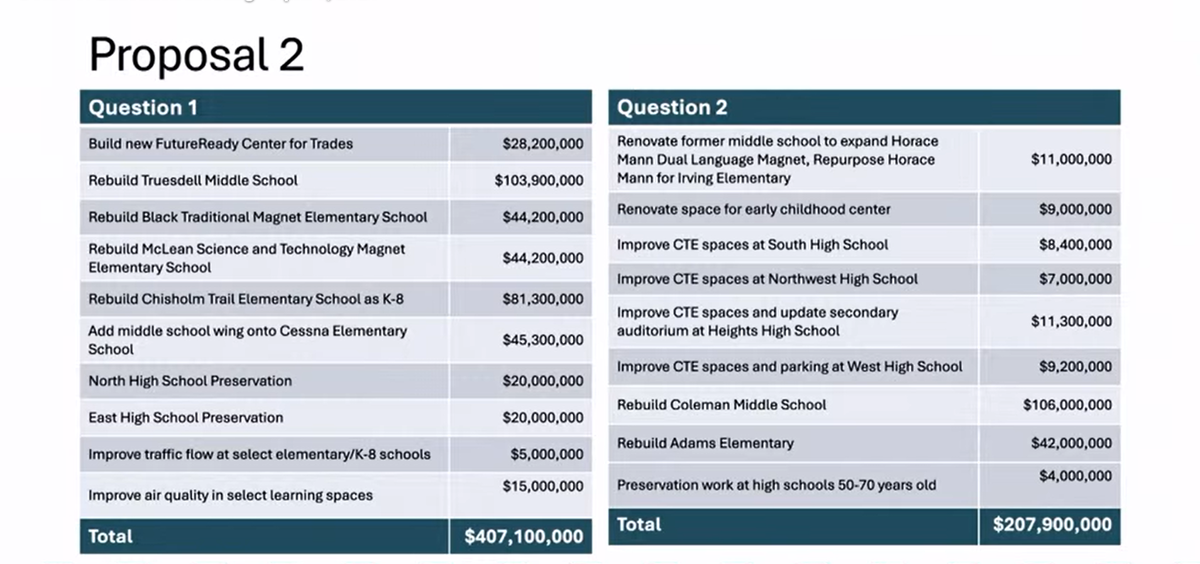
Proposal 2 was based upon the community feedback finding that 77% would support a tax-neutral bond issue option, Lowell said. That means that if the district were to issue $407 million in bonds for the first question, it wouldn’t change the tax rate property owners now pay.
In order to do so, projects that could potentially be funded by the district’s capital improvement plan were moved over to Question 2.
For the owner of a $200,000 home, no annual property tax increase would apply if Question 1 were approved because the new bond payments would replace the 2008 bond payments. If Question 2 were also passed by voters, it would then cost a $200,000 homeowner about $50 more annually.
Proposal 2 has 10 of Proposal 1’s 17 items included on Question 1. Redistributed to Question 2 is about $11 million to expand and repurpose Horace Mann, $9 million for early childhood center renovations and almost $36 million for improving career and technical education spaces.
Proposal 3: ‘The tax fatigue proposal’
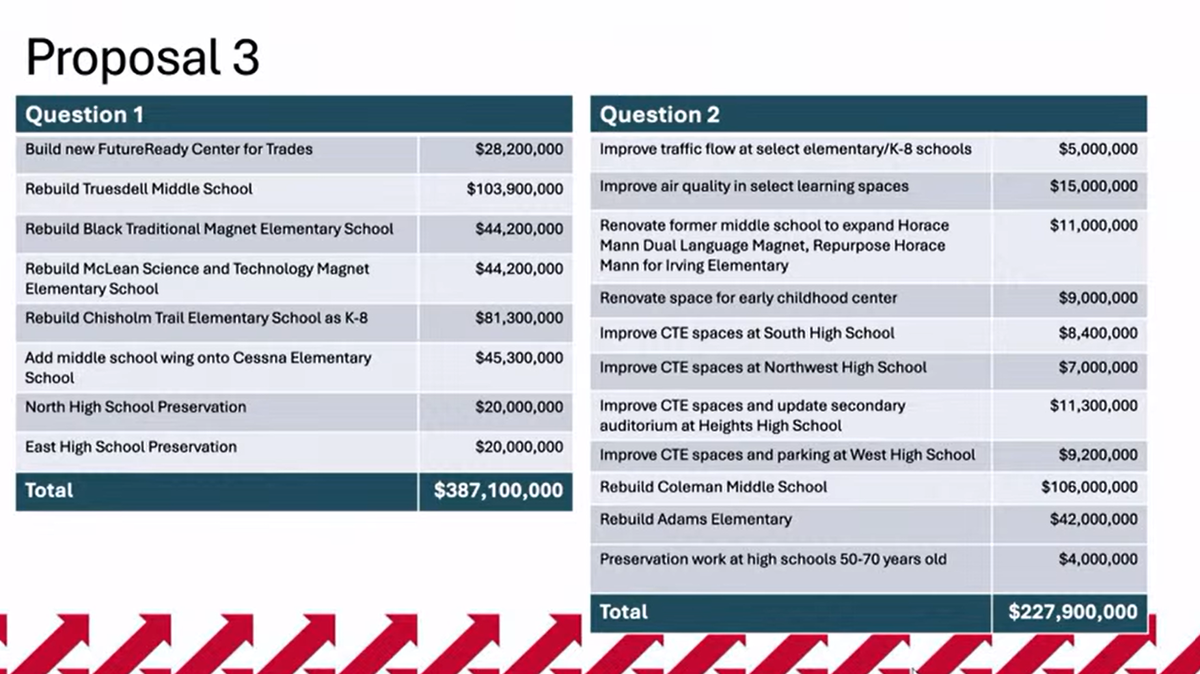
The third tentative proposal acknowledges that tax fatigue may make some voters hesitate to support a bond issue.
It includes $387,100,000 in Question 1 for rebuilding three schools, preserving North and East high schools, building a new FutureReady Center and adding a middle school wing to Cessna Elementary School.
Question 2 would comprise 11 projects, including the traffic and air quality improvements encompassed in Proposal 1 and 2’s first question.
That means passage of the second question would be even more vital, Lowell said.
District officials said Question 1 under Proposal 3 would translate to a small net tax decrease — about $5 a year for the owner of a $200,000 home — because the district’s current bond-related debt payments are expected to decline as the 2008 bonds are retired in 2029, and the amount borrowed in the first question would not fully replace that falling debt service. However, the tax decrease would be larger if voters approved no new bond at all.
If Proposal 3’s Question 2 was put to a vote and passed, the same sample taxpayers would pay about $4.16 more per month, or about $50 more annually.
No final decisions have been made regarding the proposals as the district gathers feedback via community engagement sessions. And, Alvarez said, if none of the proposals are desirable, community members can use a “Build-a-bond” simulation to create their own alternative projects worth up to $615 million. The first is set for Tuesday, April 7, from 5 to 7 p.m. at Horace Mann Dual Language Magnet.
“Starting tomorrow, 24 hours from now, the clock is ticking,” Bielefeld said. “But we have a robust opportunity for the community to engage, and we hope that everyone takes part, whether that’s virtually, whether that’s through the build-a-bond or the in-person opportunities. It’s an exciting time for our community, and I think we have some important decisions ahead of us.”
A single plan will be proposed to the Wichita Board of Education in May, with the board expected to vote on it in June.
This story was originally published April 6, 2026 at 11:52 PM.
CORRECTION: This report has been updated to correct the current tax rate home owners in the school district pay to retire school bonds. It is 5.5 mills.