Is enrollment declining in Wichita schools? What’s happening in city and suburban districts
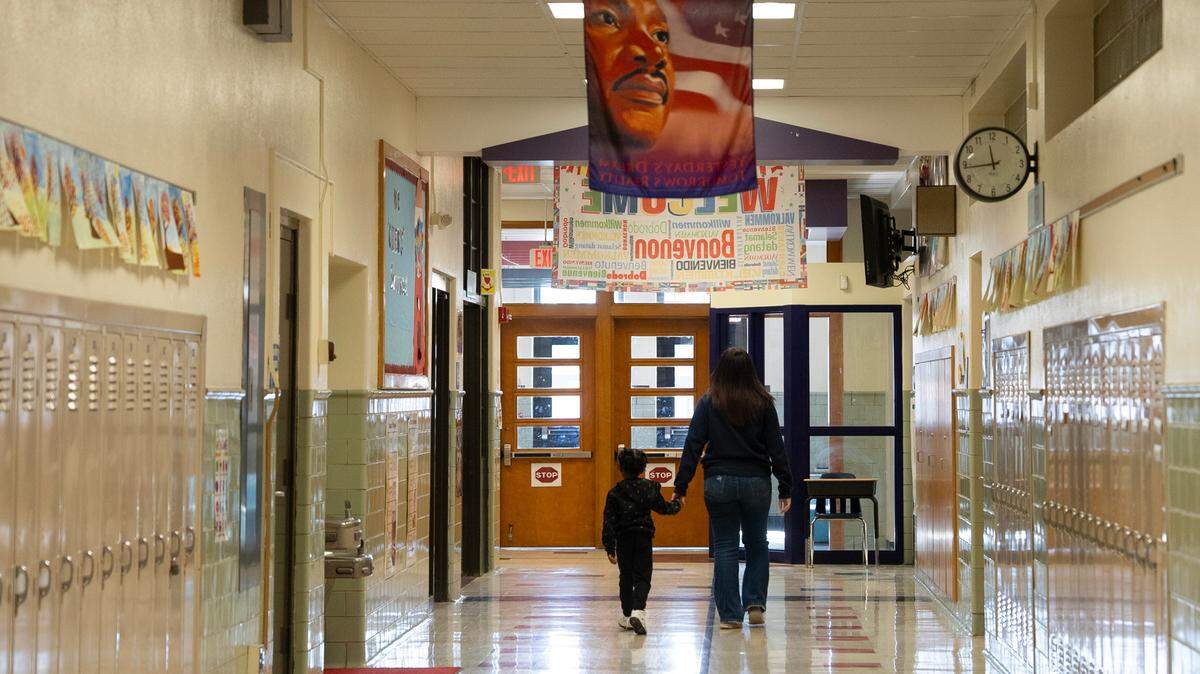
Public school enrollment has been falling in Wichita for years, following a national trend that has left many districts wondering how to best use resources going forward.
Since the 2014-15 academic year, Wichita Public Schools has lost nearly 10% of its students, and it’s projecting a similar drop over the next 10 years.
This past fall, enrollment sat at 46,154 students — 9.5% less than when it peaked during the 2015-16 school year, according to Kansas Department of Education data. Overall student enrollment in every grade in elementary and middle school, excluding preschool, is down compared to 10 years ago, with the largest drops in kindergarten, first and second grades, an analysis of the data shows.
Voters will decide this month whether to support a $450 million bond issue that would rebuild, close and make other changes to several schools in the Wichita district. The district has cited several reasons for the proposed changes, among them declining enrollment.
So what exactly has enrollment been like in recent years on the local, state and national levels? And how do Wichita’s student numbers compare to other school districts in the area? Here’s a look.
Falling enrollment
It’s been nearly a decade since the Wichita school district’s enrollment peaked at 50,988 students during the 2015-16 school year, according to an analysis of 33 years worth of headcount enrollment data available on the Kansas Department of Education’s website.
Wichita Public Schools says it lost 4,494 students between the 2014-15 and 2023-24 school years, an average of 450 students annually. And it expects the declines to continue at a similar rate, about 480 students per year for the next decade, according to the district’s facilities master plan.
The sharpest enrollment drop — more than 2,300 students — occurred in the fall of 2020, as schools wrestled with how to continue safely and effectively educating students about six months into the COVID-19 pandemic, an analysis of headcount enrollment data shows.
The Wichita district lost more students in 2021 (-286), gained some back the next year (179) then saw enrollment decline again in fall 2023 (-466) and fall 2024 (-260), according to The Eagle’s analysis of the KSDE data.
This academic year, enrollment in every grade in elementary and middle school, excluding preschool, is down compared to 10 years ago. In that time, kindergarten lost 1,215 students, first grade lost 1,150 and second grade lost 828 students, the data shows. Third grade lost 636 students, fourth grade lost 573, fifth grade lost 302, sixth grade lost 221, seventh grade lost 155 and eighth grade lost 73 students.
High school grades so far haven’t followed that trend. All have more students now than in 2014, the data shows: 111 more freshmen (3,551 total), 390 more sophomores (3,664 total), 246 more juniors (3,468 total), and 168 more seniors (3,234 total).
Headcount enrollment is the total number of students enrolled in a district and includes K-12, virtual and non-graded students and some preschoolers. It is different from full-time equivalency enrollment, or FTE, and weighted FTE, which is used to calculate a district’s funding levels.
The Wichita school district has cited falling birth rates, fallout from the COVID-19 pandemic and the state’s new school choice law as contributing to the enrollment declines, although it said in an October news release that there is “no indication” the new law impacted enrollment this year.
This fall, overall enrollment was down “due to declines in unique programs that serve special populations like adult virtual learners and a national diploma completion program that no longer serves Wichita.” But traditional prekindergarten through 12th grade enrollment had “increased for the first time in several years,” high school enrollment was at its highest in more than two decades and elementary enrollment “increased for the first time since COVID,” according to the release.
Wichita isn’t the only place losing students
Declining enrollment isn’t just a local issue. It’s happening state- and nationwide, and the trend is expected to continue.
Enrollment for all public, private and state schools in Kansas peaked at 521,208 students in 2014-2015 and has mostly been on the decline since, according to state department of education statistics. This year, there are 503,540 students, 3.4% fewer than 10 years ago. That’s a drop of more than 17,000 schoolchildren.
In the same time, statewide enrollment in public schools dropped by more than 16,000 students, or 3.3%, from its peak of 492,906 in 2014-2015. This past fall, 476,833 students enrolled. The number of students in private schools in Kansas peaked almost 25 years ago, during the 2000-01 school year, with 31,962 students enrolled. Private school enrollment is currently among the lowest of the past 33 years, sitting at 26,406 students, according to the KSDE statistics. The department does not track the number of students in home schools.
On the national level, public school enrollment is down from more than 50.7 million students in 2019 to 49.5 million in 2023, a decrease of 2.5%, according to the National Center for Education Statistics. Every region in the country saw declines during that five-year period.
Future declines are expected. Across the U.S., public school enrollment is projected to fall to 47.2 million students by 2030, according to the National Center for Education Statistics’ predictions. In Kansas, the number of students in public schools is expected to drop to 440,300 by 2030 — 7.7% less than current figures.
Wichita Public Schools expects its enrollment to decrease to just over 40,000 students by 2034. A study that looked at falling birth rates and future housing development plans was used to make the enrollment projection, Wichita Public Schools spokeswoman Susan Arensman said.
According to the Congressional Budget Office’s population outlook, current fertility rates in the U.S. aren’t keeping up with what’s needed for a generation to replace itself, absent immigration. For that to happen, the rate has to be 2.1 births per woman. But fertility rates dropped to a historic low in 2023, according to the National Center for Health Statistics, following the most recent peak of 2.12 in 2007. The U.S. fertility rate — currently about 1.62 births per woman — is expected to continue declining through at least 2035, according to the population outlook.
In 2016, more than 3.9 million live births were recorded in the U.S., or 12.21 for every 1,000 people, according to the Centers for Disease Control and Prevention. Fewer than 3.6 million births were recorded, or 10.74 for every 1,000 people, in 2023.
Kansas and Sedgwick County also recorded fewer live births, even though their populations grew by thousands during that same time.
Statewide, 38,053 live births were recorded — 13.09 per 1,000 people — in 2016 compared with 34,065 in 2023, or 11.58 per 1,000 people, according to the CDC data. Sedgwick County recorded 7,309 live births — 14.28 per 1,000 people — in 2016 but only 6,474 births — 12.25 per 1,000 people — in 2023.
Falling birth rates means fewer children to enroll in schools when they reach school age.
According to the Wichita School District’s facilities master plan, capacity was built for more than 62,000 students across 81 schools — thousands more students than are enrolled now and at the district’s peak. Last year, only 70% of available seats were utilized across the district, according to the plan. The optimal utilization is 80-100%.
Middle schools had the most “surplus capacity” with more than 5,500 empty seats (38% open), while elementary schools averaged 380 students and had more than 8,800 surplus seats overall (30% open). Twenty-four of 54 elementary schools had fewer than 350 students, with the lowest enrollment at 231. Each elementary school should be serving around 600 students “to have sufficient funds from the state to provide the staff, programs and interventions identified in a model elementary school,” according to the WPS facilities master plan.
If nothing changes, school building utilization is expected to fall to 64% by 2034.
“WPS schools were built for a population from a different era, and as the population steadily declined, the buildings largely remained. Given the recent state allocation of funding per student, the loss of 450 students per year has translated in over $2M dollars in lost revenue per year for WPS to educate their students,” the facilities master plan says.
How neighboring districts are faring
Most of the other large school districts in Sedgwick County have grown over the past 10 years as Wichita’s enrollment dropped off.
Goddard, Maize and Valley Center school districts have all seen double-digit percentage increases in enrollment from the 2014-15 school year to 2024-25, while Andover, Circle and Derby school districts have experienced single-digit percentage jumps, according to an analysis of KSDE data. The increases amount to more than 100 to more than 700 additional students, depending on the district.
Haysville was the exception, with 1.8% fewer students now than 10 years ago.
All of the suburban districts except Andover have experienced their enrollment highs in the past six academic years. Andover’s happened in the 2013-2014 school year, with 10,072 students, according to the KSDE headcount enrollment numbers.
The enrollment jumps didn’t carry over to other local districts, though.
A dozen smaller districts located completely or partially in Sedgwick County saw enrollment declines, or only slight increases, compared with 10 years ago. Percentage-wise, among the hardest hit were the Burrton School District, which lost more than half its students since fall 2014; the Conway Springs School District, down by nearly a quarter; and the Haven School District, down nearly 21%.
Enrollment in school districts close to Wichita that are in other counties also dropped.
Compared with 10 years ago, Augusta has lost 16.5% of students (-386); Newton lost 17.5% (-648); Douglass lost 18.9% (-135); Belle Plaine lost 11.2% (-71); Pretty Prairie lost 1.8% (-5); and Udall lost 13.9% (-48), according to an analysis of Kansas Department of Education statistics.
Enrollment by district
(Largest districts located all or part in Sedgwick County)
Wichita (USD 259)
- Highest enrollment: 50,988
- Peaked in: 2015-2016
- Current enrollment: 46,154
- Change from 10 years ago (2014): 4,818 students lost (-9.5%)
Andover (USD 385)
- Highest enrollment: 10,072
- Peaked in: 2013-2014
- Current enrollment: 9,586
- Change from 10 years ago: 711 students added (8%)
Circle (USD 375)
- Highest enrollment: 2,091
- Peaked in: 2024-2025
- Current enrollment: 2,091
- Change from 10 years ago: 126 students added (6.4%)
Derby (USD 260)
- Highest enrollment: 7,416
- Peaked in: 2019-2020
- Current enrollment: 7,385
- Change from 10 years ago: 316 students added (4.8%)
Goddard (USD 265)
- Highest enrollment: 6,316
- Peaked in: 2022-2023
- Current enrollment: 6,312
- Change from 10 years ago: 711 students added (12.7%)
Haysville (USD 261)
- Highest enrollment: 5,879
- Peaked in: 2019-2020
- Current enrollment: 5,410
- Change from 10 years ago: 97 students lost (-1.8%)
Maize (USD 266)
- Highest enrollment: 7,950
- Peaked in: 2023-2024
- Current enrollment: 7,912
- Change from 10 years ago: 776 students added (10.9%)
Valley Center (USD 262)
- Highest enrollment: 3,194
- Peaked in: 2022-2023
- Current enrollment: 3,191
- Change from 10 years ago: 360 students added (12.7%)
(Smaller districts located all or part in Sedgwick County)
Burrton (USD 369)
- Highest enrollment: 318
- Peaked in: 1994-1995
- Current enrollment: 109
- Change from 10 years ago: 135 students lost (-55.3%)
Cheney (USD 268)
- Highest enrollment: 827
- Peaked in: 2009-2010
- Current enrollment: 788
- Change from 10 years ago: 15 students lost (-1.9%)
Clearwater (USD 264)
- Highest enrollment: 1,347
- Peaked in: 2008-2009
- Current enrollment: 1,070
- Change from 10 years ago: 109 students lost (-9.2%)
Conway Springs (USD 356)
- Highest enrollment: 708
- Peaked in: 2003-2004
- Current enrollment: 437
- Change from 10 years ago: 143 students lost (-24.7%)
Halstead (USD 440)
- Highest enrollment: 834
- Peaked in: 2008-2009
- Current enrollment: 770
- Change from 10 years ago: 31 students lost (-3.9%)
Haven (USD 312)
- Highest enrollment: 1,242
- Peaked in: 1996-1997
- Current enrollment: 748
- Change from 10 years ago: 198 students lost (-20.9%)
Kingman-Norwich (USD 331)
- Highest enrollment: 1,348
- Peaked in: 1999-2000
- Current enrollment: 872
- Change from 10 years ago: 131 students lost (-13.1%)
Mulvane (USD 263)
- Highest enrollment: 2,014
- Peaked in: 1999-2000
- Current enrollment: 1,698
- Change from 10 years ago: 127 students lost (-7%)
Remington-Whitewater (USD 206)
- Highest enrollment: 592
- Peaked in: 1996-1997
- Current enrollment: 530
- Change from 10 years ago: 6 students added (1.1%)
Renwick (USD 267, includes Andale, Colwich, Garden Plain)
- Highest enrollment: 2,070
- Peaked in: 2003-2004
- Current enrollment: 1,969
- Change from 10 years ago: 31 students added (1.6%)
Rose Hill (USD 394)
- Highest enrollment: 1,897
- Peaked in: 1999-2000
- Current enrollment: 1,684
- Change from 10 years ago: 5 students added (0.3%)
Sedgwick (USD 439)
- Highest enrollment: 574
- Peaked in: 2009-2010
- Current enrollment: 516
- Change from 10 years ago: 14 students added (2.8%)
(Districts near Wichita in other counties)
Augusta (USD 402, Butler County)
- Highest enrollment: 2,378
- Peaked in: 2009-2010
- Current enrollment: 1,950
- Change from 10 years ago: 386 students lost (-16.5%)
Newton (USD 373, Harvey County)
- Highest enrollment: 3,770
- Peaked in: 2011-2012
- Current enrollment: 3,052
- Change from 10 years ago: 648 students lost (-17.5%)
Douglass (USD 396, Butler County)
- Highest enrollment: 949
- Peaked in: 1999-2000
- Current enrollment: 580
- Change from 10 years ago: 135 students lost (-18.9%)
Belle Plaine (USD 357, Sumner County)
- Highest enrollment: 888
- Peaked in: 1998-1999
- Current enrollment: 564
- Change from 10 years ago: 71 students lost (-11.2%)
Pretty Prairie (USD 311, Reno County)
- Highest enrollment: 345
- Peaked in: 1997-1998
- Current enrollment: 276
- Change from 10 years ago: 5 students lost (-1.8%)
Udall (USD 463, Cowley County)
- Highest enrollment: 449
- Peaked in: 1993-1994
- Current enrollment: 296
- Change from 10 years ago: 48 students lost (-13.9%)
(Statewide enrollment)
All schools in Kansas
- Highest enrollment: 521,208
- Peaked in: 2014-2015
- Current enrollment: 503,540
- Change from 10 years ago: 17,668 students lost (-3.4%)
Public schools statewide
- Highest enrollment: 492,906
- Peaked in: 2014-2015
- Current enrollment: 476,833
- Change from 10 years ago: 16,073 students lost (-3.3%)
This story was originally published February 16, 2025 at 3:53 AM.