
‘Anything to prevent a bond’: Some Wichita school board members skeptical of tax proposal
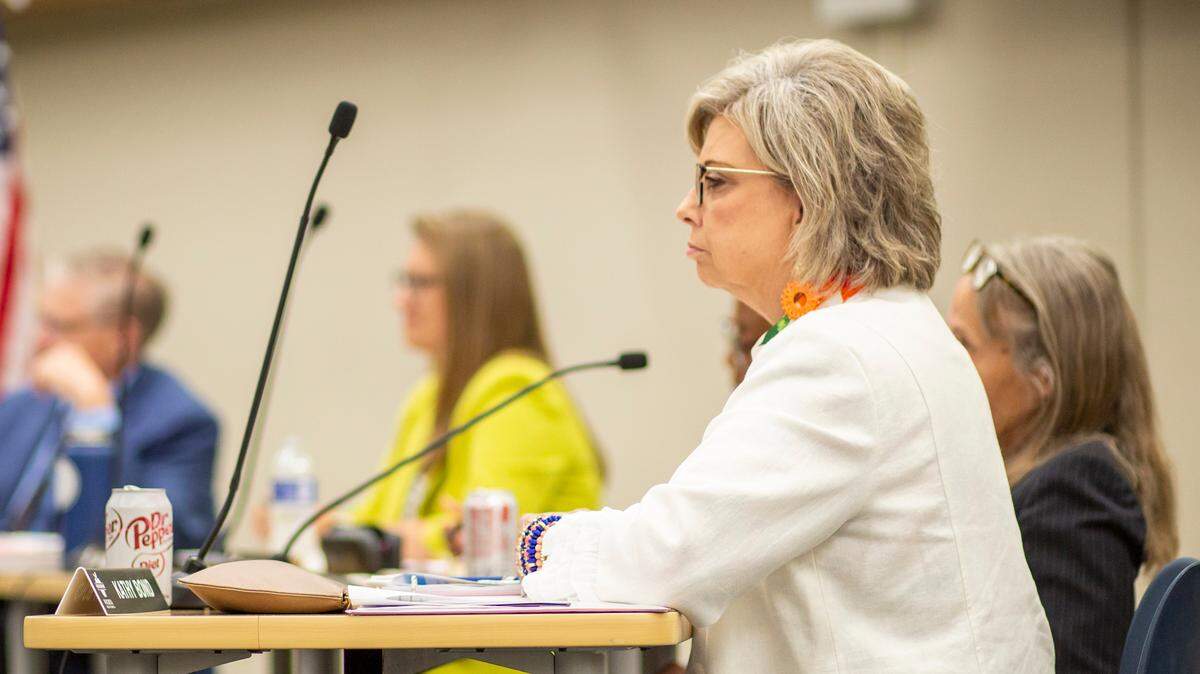
The Wichita school board likely won’t decide whether to take a bond issue proposal to the voters until August, Superintendent Kelly Bielefeld said Thursday.
At a facilities master plan workshop, the board’s three conservative members expressed misgivings about consultants’ $450 million bond issue recommendation, saying they’re not ready to commit to asking voters to support that or any major construction plan.
Getting a bond issue question on the ballot would require the approval of a majority of the school board’s seven members.
“I think the plan is great. I just don’t think it’s affordable right now,” Kathy Bond said of the recommendation, which calls for the district to completely rebuild eight schools, construct two new buildings and reduce its overall footprint by 11 buildings through consolidation of programs over the next five years.
“I think the timing is off,” Bond said. “I think if we can begin to do some of this plan without asking the community for a bond right now — because you say, ‘Well, it’s not going to raise taxes.’ Actually it will. You’re actually asking the community to extend the 2008 bond issue right now.”
The elevated mill levy rate associated with the 2008 bond issue is set to expire in 2029. That same rate would be renewed, likely for another 20 years, if voters supported a so-called “zero tax increase” bond issue. $450 million is the most the district could collect without raising the existing mill levy.
Without the new bond issue, tax rates would drop after 2029.
“While I like the plan, I do wonder if there’s ways to scale it back to meet the taxpayers’ needs and be fiscally responsible in that,” Vice President Diane Albert said.
Luke Newman, the school district’s director of facilities, said without a bond issue, the district’s $1.2 billion in deferred maintenance needs will balloon to an estimated $3.59 billion by 2033.
“No part of this plan is possible without a bond. We just don’t have the capital money to do any part of it,” Newman told board members. “All of our capital goes to addressing deferred maintenance needs like the structural issues and things that we’re dealing with currently.”
He said whether or not a bond issue is passed, the district will have to consolidate schools in the coming years to offset declining enrollment and phase out buildings that aren’t worth maintaining.
Julie Hedrick, who served as district facilities director before being elected to the school board, said the state funding model is not designed to support building upkeep.
“Our Kansas school finance formula is not set up to keep up or tackle our deferred maintenance issues. No matter how efficient we are, no matter how budget-conscious we are, there is not the funding available to Kansas schools to keep up with all of the maintenance and school improvement needs,” Hedrick said.
Alternate funding source?
Bond asked if rather than taking a bond issue to voters, district staff could instead focus on applying for grants to pay for capital projects. Bielefeld said staff routinely apply for grants but that funding $450 million of infrastructure upgrades that way would be impossible.
“I think if the community sees us trying to find resources elsewhere first before coming to them, they might be inclined to vote for it,” Bond said.
She suggested that USD 259 could refrain from pushing a bond issue by asking everyone in Wichita to give money voluntarily.
“If 300,000 people gave $5, that would get it over, and we wouldn’t even need to ask for a bond issue,” Bond said.
“Well no, 300,000 times five isn’t $450 million,” Bielefeld responded.
If all 396,192 Wichita residents contributed $5, that would amount to just under $2 million.
“But we can get there somehow,” Bond said. “If somebody could give like a one-time donation of — I’m just kicking things out so it doesn’t have to go to a bond issue. I’m just thinking outside of the box. I’ll think of anything to prevent a bond, even if it’s silly.”
Community survey
Hedrick said she doesn’t see a viable path forward without a bond issue.
“The needs are sizable. The monies are limited,” Hedrick said. “We are at a point right now that the board could approve taking a bond to the voters and not have to increase the mill levy.
“I think we’ve heard that maybe we might want to do some minor tweaks, but some sort of plan in order to find the efficiencies we need to provide the learning environments that we want to provide for our students.”
Hazel Stabler, who was elected on a conservative ticket with Bond and Albert in 2021, said the board should take its time evaluating the facilities master plan recommendations before seeking funding.
“It took our consultants, I think it was eight months to prepare this recommendation for us. And I hope as a board that we don’t rush our decision to vote to accept this,” Stabler said. “I think that we need some time to be able to really evaluate how we can actually tweak this.”
Consultants with Woolpert will present the results of a community survey seeking input on the facilities master plan at next Thursday’s board meeting, which is scheduled for noon at the Alvin E. Morris Administrative Center on south Edgemoor.
Bielefeld said over the summer, board members will determine how they want to proceed with the facilities recommendation and potential bond proposal.
“If we do want something smaller, the real decision is what does that mean? What comes out? So that’s what July would be is priorities,” Bielefeld said.
“August is probably our goal for an actual vote.”
The deadline to get a question on the November ballot in Sedgwick County is Sept. 2. Hedrick said she’s not worried about whether or not the board can settle on a proposal before then.
“I’m not in a hurry. I do want to respect the concerns of all my fellow board members.”