
It’s ‘going to be really hurtful’: Families to Wichita school board before closure vote
The fate of six schools, 322 employees and 2,213 students will be decided Monday, when the Wichita school board votes on a closure proposal that the district leadership team says would save $16 million.
It’s the culmination of a whirlwind process that began in late January, when the district’s chief financial officer first notified the public of a $42 million budget shortfall and presented board members with a choice between closing schools and laying off teachers.
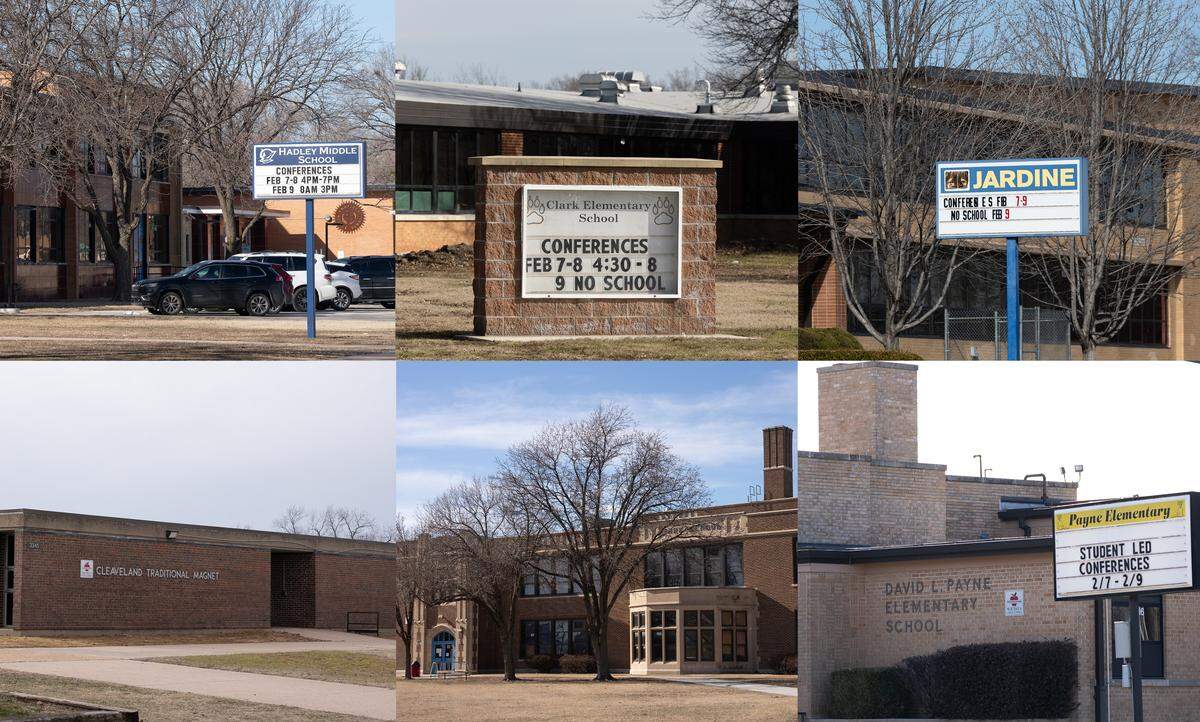
Emotions ran high Thursday as the district hosted a public hearing on the recommended closure of four elementary schools — Clark, Park, Payne and Cleaveland — and two middle schools, Hadley and Jardine Magnet. The buildings would be shut down at the end of the semester.
“School isn’t just learning. It’s relationships, personality building, character building. So much more than just books and reading,” said Mozart Padilla, a junior at Northwest High who went to Cleaveland and whose sibling is a student there.
“Closing these schools would save money for things that you could say are needed. But the money you save isn’t going to save the relationships that you’re breaking.”
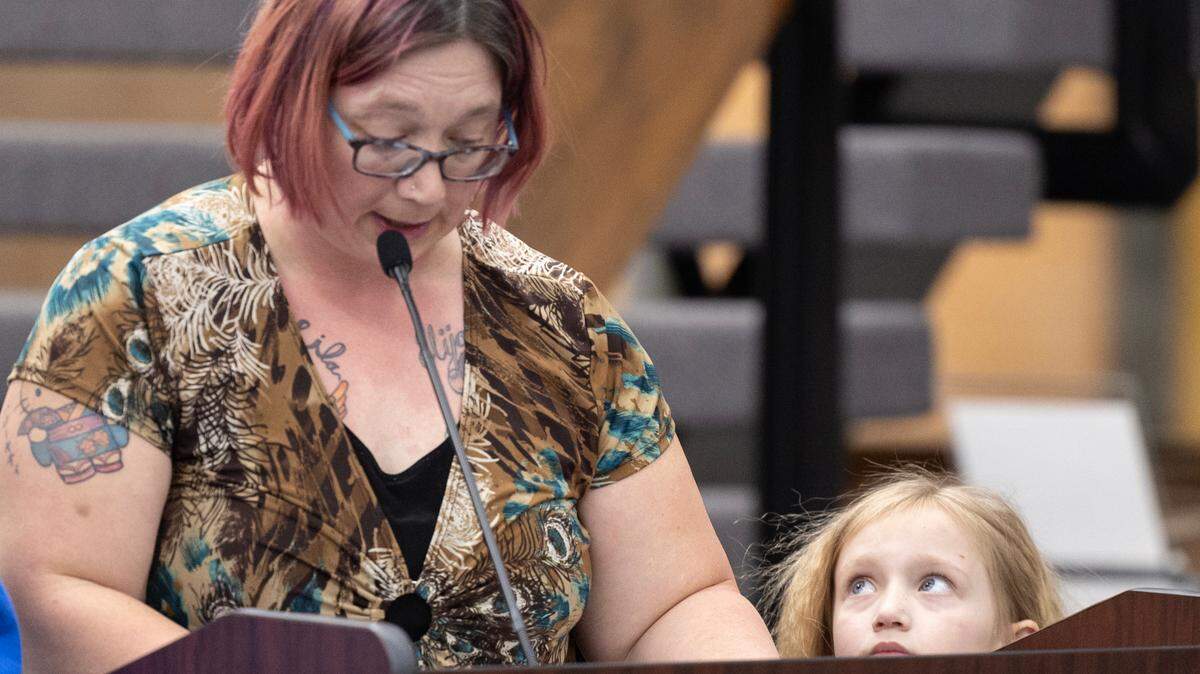
That’s one concern for Jamie Petitjean, whose daughter, Lila, and her two best friends who have attended Clark together since pre-K. They would be sent to three different schools under the district’s proposal.
She’s also worried about students who have no transportation and will have to walk further to get to school. Under state law, school districts provide busing only for students who live more than two and a half miles from their assigned building.
Decisions about providing special transport for students whose new walking routes are hazardous would be made on an individual basis by the board if closures are finalized.
“This school is in an area where it’s easy for children to walk to school. Now older siblings who can get out of school and walk a little bit to get other siblings safely can no longer do that because it puts them at an unsafe walking distance,” Petitjean said.
“Now parents are going to have to miss work to make sure their children can get to and from school safely.”
Thomas Montiel, who has five children attending Cleaveland, said he wants to see more hard data justifying closures before the board votes.
“Specific numbers associated with the 2024-2025 budget that demonstrate the $42 million deficit, an itemized savings list for phase one and two — i.e. how much every step is actually saving the district — and a calculated risk assessment that each decision carries, meaning projected loss of students, staff and funds that this decision will hold,” Montiel said.
“You were not voted in to rubber stamp district recommendations without asking publicly meaningful questions,” he told board members.
The district hopes to save $9 million from a variety of cuts beyond building closures, including trimming non-school program budgets (finance, HR, health services, etc.) by at least 5%, pausing an administrative intern program and scaling back the number of schools that participate in the Advancement Via Individual Determination (AVID) college readiness program.
Officials have not laid out a plan for plugging the last $17 million of the budget hole.
Tough decisions
Board member Kathy Bond said after the hearing that she needs time to think through what makes the most sense before Monday’s vote.
“From tomorrow through Sunday, I’m at home. I’m not answering the phone. I’m not going anywhere. And I’m just going to go look through everything slowly, methodically, strategically — not emotionally,” Bond said.
Fellow board member Julie Hedrick said she doesn’t take the decision lightly, given how painful school closures can be for everyone involved.
“We hire good teachers. We want kids to love their schools,” Hedrick said. “I believe that they’ll have great relationships with teachers no matter what school they go to but it’s just really sad.”
The district faces $1.2 billion in deferred maintenance needs. Hedrick, who retired as USD 259’s director of facilities before being elected to the board in 2017, said she doesn’t see a viable alternative to shuttering schools. She’s not interested in any proposal that involves laying off teachers and other employees who work with students daily.
“People would lose their paras. They’d lose their psychologists and their social workers,” Hedrick said. “No matter what happens, if we have a budget cut, things get cut.”
Staff at affected schools will have the option to be reassigned to another building, and teachers are being offered a one-time $2,400 retention bonus. Employees have to apply for positions but Superintendent Kelly Bielefeld has said there are enough vacancies that everyone who wants to remain in the district will have a job.
The school board meeting will be held at 6 p.m. inside North High’s lecture hall. Community members can sign up to speak for three minutes by calling 316-973-4553 before noon Monday or by signing up in person before 5:50 p.m.
The meeting will also be livestreamed online and later uploaded to the district’s YouTube page.
If a majority of board members approve closures, residents dissatisfied with the result will have 45 days to lodge an administrative review with the state board of education. To register an administrative review, petitions must be signed by at least 5% of registered voters within district boundaries.
Community outcry
Not a single one of the roughly 20 speakers at the hearing voiced support for the proposal.
Araceli Amador asked board members to reconsider alternatives that would not involve closing four schools south of Kellogg.
“The southside has been neglected for a long time, and taking away these schools is going to be really hurtful for my community,” Amador said.
“The poorest communities in our area have to take the brunt of your mistakes,” added Ruth Lehman.
Of the 94 schools in the district, Park in north Wichita has the highest poverty rate, based on the number of students who qualify for free and reduced lunch. The other schools recommended for closure rank 21st, 22nd, 29th, 45th and 54th on that list.
“It isn’t as though we picked the five poorest schools in the district. We really were strategic,” Bielefeld said at a news conference in February. “We went for least disruption to the system, trying to find places for those students and staff to go that had capacity.”
Numerous factors were considered by the district staff who created the closure list, including enrollment trends, building capacity, condition and location, classroom size and staffing levels.
If closures are finalized, average class size for elementary schools accepting new students will be 21 and average class size for middle schools accepting new students will be 24, according to estimates provided by the district.
Darin Smalls, who coaches track and works with students in in-school suspension at Hadley, said closing schools won’t address the underlying problem that enrollment has been shrinking since 2016.
“Parents are taking kids out of the school district and putting them into private schools and other schools, so I think you need to look at, why are people pulling their kids out first of all. And then how can you fix it another way without closing schools, because that’s not going to do anything,” Smalls said.
“You can’t sit behind a desk and look at the numbers and think you know what’s going on in the schools. You don’t.”
A new track was just put in at Hadley over the summer. Members of Hadley’s team who get reassigned to Hamilton won’t have a track to run on. Smalls said Hamilton’s track practices consist of running down Broadway, then up Harry to West High and back to Hamilton.
Other investments in recent years to schools recommended for closure include new walkways around Clark and a new playground and secure entrance at Cleaveland.
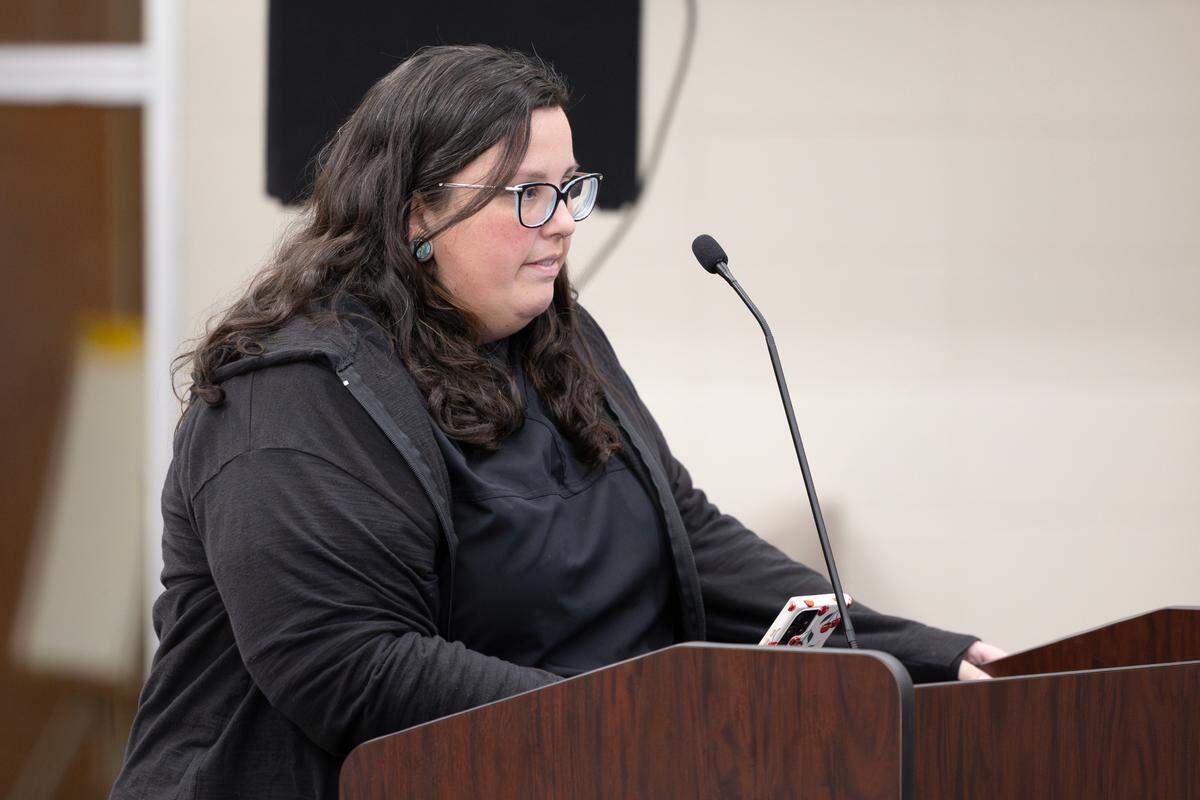
“Those aren’t cheap projects,” said Cleaveland parent Megan Buettgenbach, who lives across the street from the school and said she doesn’t want to see the building left vacant or sold and turned into apartments.
Buettgenbach said closures would be especially hard on fourth graders like her son, Oscar, who have to make the jump to middle school in two years.
“They’re expected to make two transitions to two new schools in two years. Make new friends twice. Be the new kid twice. Learn a new building, learn a new schedule twice,” she said.
“He and other fourth graders like him are getting punished the most in this situation.”
This story was originally published March 1, 2024 at 12:22 PM.