
Professor sues WSU, alleging president told her to ‘let go of’ harassment claims
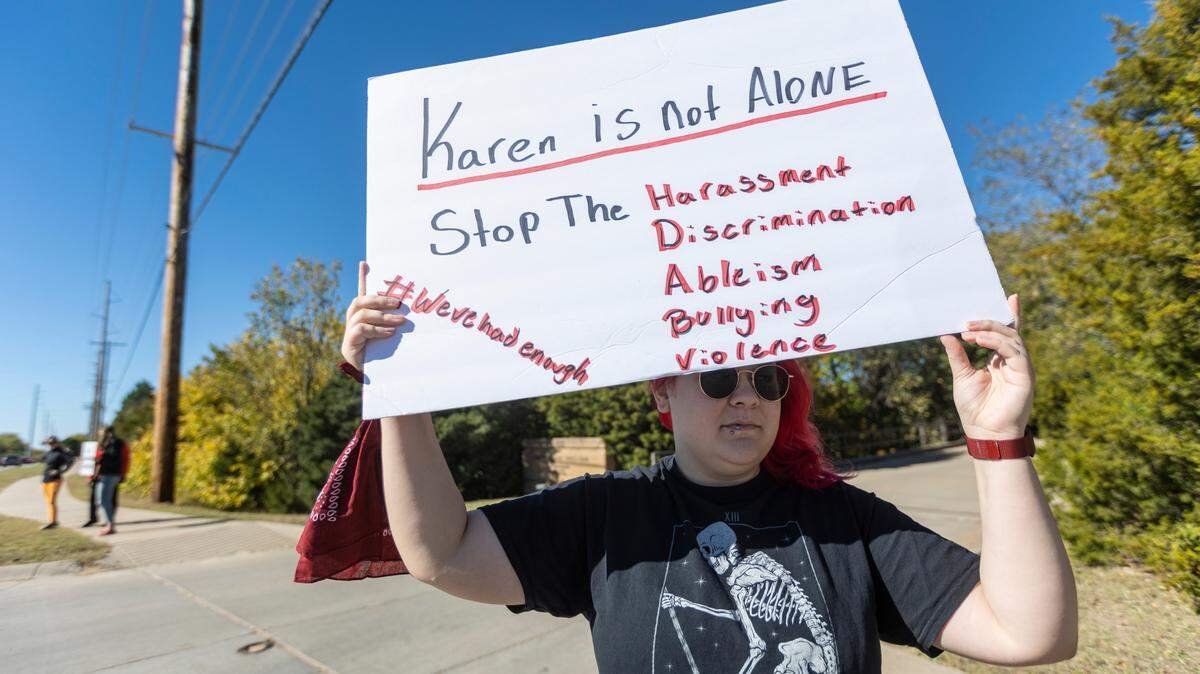
A handful of protesters demonstrated outside Wichita State University President Rick Muma’s inauguration ceremony Friday to draw attention to his role in a federal civil complaint filed earlier in the week by Karen Countryman-Roswurm, a tenured social work professor and founder of the Center for Combating Human Trafficking.
Countryman-Roswurm is suing the university and several top administrators, including Muma, for what she describes as nearly a decade of harassment and discrimination based on her sex, race and religion.
The Eagle first reported on the allegations by Countryman-Roswurm in February 2020 when she went public with her story during a presentation at Wichita State’s Eugene Hughes Metroplex.
On Friday afternoon, Countryman-Roswurm supporters returned to the Metroplex to protest Muma’s inauguration and draw attention to the lawsuit.
The 115-page civil complaint includes new details alleging which university officials were involved.
Among Wichita State’s co-defendants in the lawsuit are Muma, Dean Andrew Hippisley, Vice President Kaye Monk-Morgan, retired professor Fred Besthorn and social work program director Kyoung Lee. The lawsuit says all parties knew about the discrimination, harassment and retaliation but failed to put a stop to the behavior because of “evil motive or reckless indifference.”
Muma, Hippisley, Monk-Morgan, Besthorn and Lee did not respond to questions about the lawsuit this week.
University spokesperson Lainie Mazzullo sent a written statement, saying the university is “committed to preventing and eliminating misconduct, including all forms of discrimination, harassment and retaliation, within the university community” but plans to challenge Countryman-Roswurm’s lawsuit.
“We are reviewing the allegations and preparing to defend the case vigorously,” Mazzullo wrote.
The harassment allegations stem from a series of comments attributed to Besthorn, a retired professor in the WSU social work program. Countryman-Roswurm, a Native American woman, says in the lawsuit that Besthorn continually used racial epithets and falsely accused her of trading sexual favors for advancement at the university for six years.
Besthorn also continuously attempted to undermine the study of human trafficking, according to the lawsuit, by claiming women who say they are victims of human trafficking often are lying to cover up choices they made to engage in particular sexual acts.
Besthorn, along with Lee, was involved in annual reviews and her tenure committee. He tried to block promotions and submitted negative performance reviews multiple times, despite her national recognition as a leader in her field, Countryman-Roswurm’s lawsuit says.
Besthorn and Lee both voted against granting her tenure. But their decision was overturned, and Countryman-Roswurm was granted tenure.
Countryman-Roswurm, who filed the lawsuit Tuesday, said in it that when she reported the problems to Wichita State authorities — including Muma, who was the university’s chief academic officer and acting president at the time — her complaints were dismissed.
University officials warned her against reporting, botched investigations and attempted to get her to sign a non-disclosure agreement, the lawsuit says.
When she refused to drop it and went public with her accusations, Wichita State retaliated by cutting all funding to the Center for Combating Human Trafficking and slashing her salary, the lawsuit says.
Countryman-Roswurm is seeking a halt to the alleged mistreatment, along with back pay, attorney’s fees, damages and other compensation. She has asked for a jury trial in U.S. District Court in Kansas City, Kansas.
She declined to comment for this story.
Trivialized
The trouble started in 2013 when Countryman-Roswurm founded the Wichita State University Center for Combating Human Trafficking, the lawsuit says.
Countryman-Roswurm had been involved in similar work for years. After her mother died when Country-Roswurm was 13, she was placed into foster care. By 17 she was helping teen runaways, including some trafficking survivors, get off the streets as an outreach worker at the Wichita Children’s Home.
She earned three degrees at Wichita State, including a doctorate in psychology, and was hired at the university in 2010.
As executive director and founder of the center, Countryman-Rosworm helped lead a push to change a state law that previously treated child sex trafficking victims as criminals, instead of victims.
But when she tried to advocate for herself, the university failed her, she told The Eagle previously.
When she spoke to Ron Matson, the former dean of liberal arts and sciences, alleging harassment by Besthorn, he “attempted to trivialize, joke about, and make light of the comments.”
Matson, who retired in 2018, also encouraged her not to report the comments to anyone else because it “could have a negative effect” on her job and application for tenure, the lawsuit says.
When she spoke to Andrew Hippisley, who replaced Matson, he dismissed her complaints and told her she was “lucky” to have her job and salary “as a woman” so early in her career and should stop complaining about the harassing and discriminatory treatment she was experiencing, according to the lawsuit.
He also blocked her access to donated funds to attend a leadership conference at the Burren Institute in Ireland, referring to it as a “spa trip,” the complaint says.
Strong caution
When Countryman-Roswurm spoke to Muma, who was acting president at the time, he acknowledged “ongoing issues in the (Social Work) Department regarding women being mistreated,” that he had seen Wichita State “engage in negative employment practices with women in the (Social Work) Department” and “that he was aware of prior issues with Dr. Besthorn regarding women.” according to the lawsuit.
Muma “strongly cautioned” Countryman-Roswurm against pursuing her claims, the lawsuit says.
“You’re going to have to set it aside moving forward,” he told her, according to the lawsuit. “And Karen, it’s … it’s gonna be better for you if you can do that. … You’re gonna have to let go of it.”
During that conversation, Muma also “made comments that suggested that he believed (Countryman-Roswurm) had been having a sexual relationship with Dr. Matson.”
“Dr. Muma clearly articulated that Plaintiff’s concerns regarding discrimination and harassment were simply never going to be resolved by Defendant WSU,” the complaint says.
“In a subsequent email, Dr. Muma threatens (Countryman-Roswurm) that should she continue to assert that she has been subjected to discrimination/harassment, her comments could be considered ‘defamatory,’” it continues.
Countryman-Roswurm also claims in the lawsuit that Lee provided inaccurate information to Wichita State’s Office of Institutional Equity and Compliance.
Countryman-Roswurm next turned to Monk-Morgan, vice president for regional engagement and economic development, in July 2020.
“Monk-Morgan had previously expressed her own experiences of discriminatory treatment to (Countryman-Roswurm) and had listened to (her) complaints of discrimination and harassment,” the lawsuit says.
But when Monk-Morgan was interviewed by the Office of Institutional Equity and Compliance, she “was not fully forthcoming,” and expressed her own discriminatory comments about Countryman-Roswurm, the lawsuit says.
“You don’t get to tell me, as a white woman, what to do with whatever social capital I have,” Monk-Morgan is quoted in the complaint as telling investigators. “[I] really [don’t] feel sorry for her.”
After Countryman-Roswurm confronted Monk-Morgan over the statements she had reportedly made to investigators, Monk-Morgan told Countryman-Roswurm that the Center for Combating Human Trafficking, where Countryman-Roswurm received a portion of her salary, would no longer be funded by Wichita State University.
That move resulted in a “large salary reduction” for Countryman-Roswurm.
Wichita State University cut funding to the Center for Combating Human Trafficking in October 2020.
Countryman-Roswurm has since opened an independent nonprofit to help survivors under a new name, the Institute for Transformative Emancipation. But the new center’s work has been hamstrung by the university, the lawsuit says.
Wichita State has refused to release donor funds that were earmarked for the center and items that had been donated to the center or purchased with donor funds to the new 501(c)(3) organization.
“Among other things, said lack of funding and failure to transfer donated items has stalled (Countryman-Roswurm’s) career, damaged her reputation, and limited (her) ability to provide assistance to survivors of human trafficking,” the lawsuit says.
This story was originally published October 29, 2021 at 5:55 PM.