
Wichita State professor to build detector to study most elusive particle in the universe
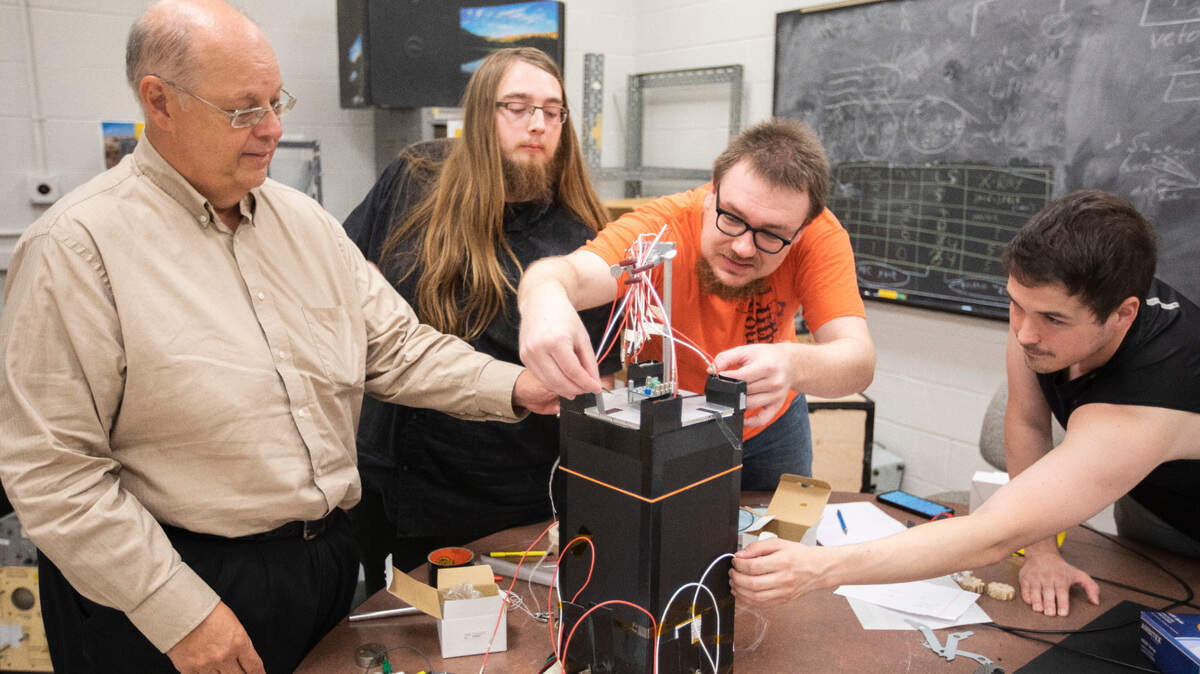
What began as hearing an incorrect statement has paid off for Wichita State University physics professor Nick Solomey.
He recently won a $2 million NASA grant to build a space-based detector to study one of the most elusive particles in the universe, the neutrino.
“It’s a great time to study neutrinos,” Solomey said. “This is a great time for looking at what kind of new science can be done in space.”
The grant comes from NASA’s Innovative Advanced Concepts program, which funds “innovative aerospace concepts that could enable and transform future missions.”
Solomey has previously won smaller grants from the program, but this grant will allow him to send the detector to space.
“It’s really a blue sky, take-a-deep-shot idea,” Tim Bolton, a physics professor at Kansas State University who also studies neutrinos, said. “It’s looking way down the road, but it’s quite intriguing.”
What are neutrinos?
Neutrinos are tiny, subatomic particles, having a mass half a million times smaller than that of an electron. Unlike electrons however, they do not have a charge.
What makes them unique is that they rarely interact with other particles.
Despite rarely interacting, neutrinos are extremely common in the universe and on Earth. They are produced through nuclear fusion, which powers the sun, and nuclear fission, which is how power plants like Wolf Creek in Burlington generate electricity.
“Trillions … of neutrinos are passing through you every second, and to a very good approximation, none of them interact with you.” Bolton said.
But their limited interactions create problems for scientists.
“Because they’re very weakly interacting, they’re very difficult to detect,” Bolton said. “That’s very difficult to study.”
Current methods of studying neutrinos require building giant detectors in the hopes that a neutrino will interact with one of the particles in the detector and scientists can detect that interaction.
“Because neutrinos, when they go through matter, usually miss, you need to put a lot of matter in front of them. So neutrino detectors tend to be very, very large,” Bolton said. “Basically these detectors are about the size of small naval warships.”
How did Solomey come up with his idea?
Solomey’s project with NASA could change that by building a much smaller, space-based detector. Much like his project, how he got the idea wasn’t the most conventional.
“The work with NASA got started in a very unusual way,” Solomey said.
He described attending a talk where the speaker made an “obviously wrong statement” about solar neutrinos limiting scientist’s ability to search for dark matter, an unknown quantity that is believed to make up nearly a quarter of the universe.
“I scratched my head and said that’s a stupid statement because the Voyager probe is 140 astronomical units [the distance between Earth and the Sun] away from the sun, and [the amount of neutrinos is a million times] less!” Solomey said. “The next morning I woke up and said, ‘Wow. Well, if I go the other way towards the sun, how intense do the solar neutrinos become?’”
After doing some calculations, he realized that at a distance of 3 million miles from the sun, where NASA currently orbits sun-studying satellites, the amount of neutrinos was 1,000 times higher than on Earth.
With so many more neutrinos available for capture, the size of the detector could be around 2200 lbs (1000 kg), much smaller than the 80 million pound Deep Underground Neutrino Experiment (DUNE) that Bolton directs.
“NASA could easily put up science packages in the hundreds of kilograms attached to a spacecraft,” Solomey said. “so I proposed that to NASA.”
What’s next for Solomey’s project?
Since then, Solomey and his team have shown the technology could work in space, developed a working prototype of the neutrino detector, and even drafted designs for a future spacecraft to carry the detector using a previous NASA grant.
Solomey, along with NASA scientists, will conduct additional tests to ensure the detector is working properly this summer.
With the new NASA grant, Solomey will be able to build a smaller version of his detector to launch into space on a Cubesat and test how well the detector works in space.
“We’re only planning to operate for a year,” Solomey said. “[We’ll] take data and show that it operates in space and record the background [neutrinos produced elsewhere in the universe]”.
If future tests continue to go well, Solomey may be able to send his detector toward the sun one day.
“I’m looking at probably 10 to 12 years before we could actually get a spacecraft close to the sun with a neutrino detector,” Solomey said.
NASA scientists estimated the cost of such a mission at $327 million dollars, about a quarter of the cost of the Parker Solar Probe mission launched in 2018 to study the sun.
“My take on that was, ‘Wow, that’s expensive,’” Solomey said. “NASA’s take on that is, ‘Wow, that’s cheap.’”
Why study neutrinos?
Because neutrinos hardly interact, they are useful tools for studying the sun. An atom produced via the sun’s nuclear fusion process will take thousands of years to move from the interior of the sun to Earth. A neutrino, in contrast, can make the same journey in under 10 minutes.
By putting a detector like Solomey’s near the sun, scientists can study these solar neutrinos easier.
“Neutrinos are a tool to ‘see’ inside stars, and a space-based detector could offer a new window into the structure of our Sun and even our galaxy,” said NASA Innovative Advanced Concepts (NIAC) Program Executive Jason Derleth in the statement announcing Solomey’s grant. “A detector orbiting close to the Sun could reveal the shape and size of the solar furnace at the core.”
Studying neutrinos could also help solve one of the biggest mysteries in physics.
“We don’t understand where all the matter came from. If the universe was created in The Big Bang with equal amounts of matter and antimatter, why is the universe now made of matter?” Solomey said. “The neutrino does play a role in that understanding someday.”
“Our [current] theory predicts we shouldn’t be here,” Bolton said. “There’s just one problem, we are here.”
Longer term, neutrino and other particle physics experiments might lead to technological advances that affect our daily life.
“You tend to have to push the state of the art in technology to do these experiments,” Bolton said. “Early applications and data sharing [in high energy physics] really did drive the development of the internet, for example.”
This story was originally published July 25, 2021 at 4:11 AM with the headline "Wichita State professor to build detector to study most elusive particle in the universe."