Emporia State hopes aquatic center will teach K-12 students statewide about nature
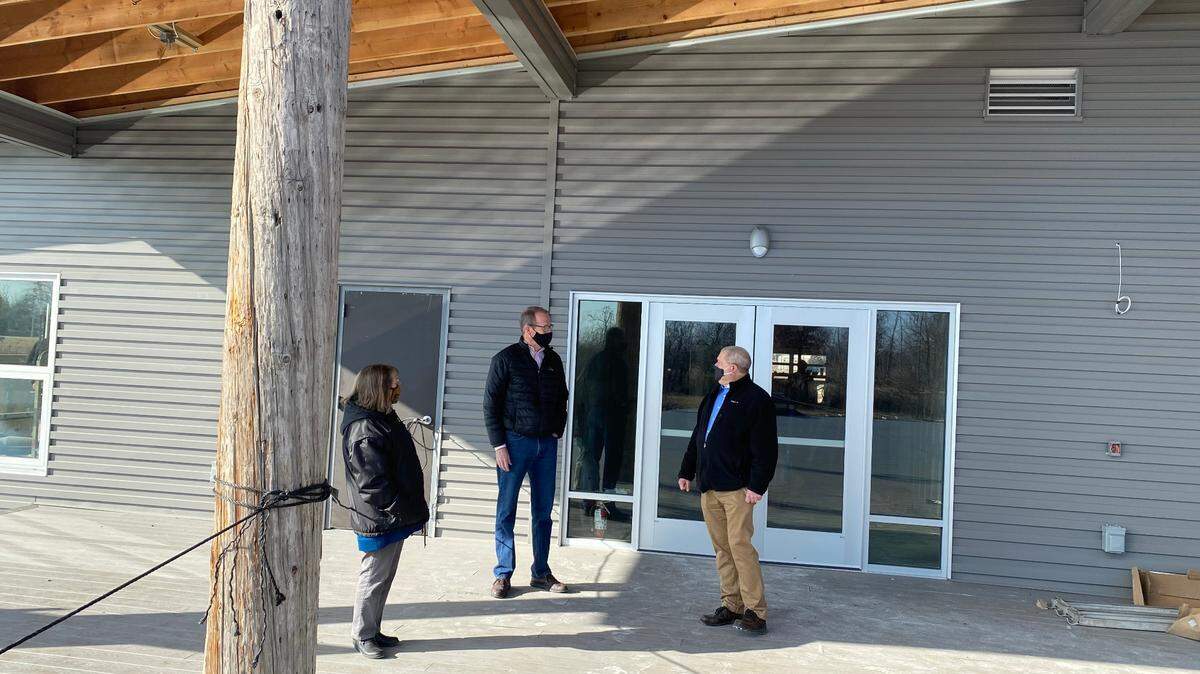
A group of Emporia State professors and alumni hope to make it easier for K-12 students statewide to learn about the creatures that live in the rivers and streams in their communities.
“If you drive over the Neosho River, it looks kind of muddy and like there’s nothing in there,” said State Representative Mark Schreiber, who said he was inspired by his time in Emporia State’s biology department where they taught about the correlation between fieldwork and conservation.
“If you get down there and muck around, there are mussels and fish and all kinds of life. But if you travel over the river in your car, you just don’t see it,” Schreiber added.
The Prophet Aquatic Research and Outreach Center, housed near Emporia State University, will also partner with state and federal agencies to monitor local aquatic creatures and habitats.
The center is expected to open in February and is primarily funded by donations from Emporia State alumni and the university’s foundation. Schreiber, who sits on the sits on the Trusler Foundation board, helped with the fundraising. The Trusler Foundation gave $200,000 to the $950,000 project.
“Probably one of the most important things we can do with conservation is to educate people to the natural world around them,” said Brent Thomas, Emporia State dean of liberal arts and sciences. “If you’ve never seen a Neosho madtom, how can you expect people to care about them enough to want to save them? This kind of facility gives people the opportunity to see the natural world around them.”
About the size of a minnow, the Neosho madtom is a threatened species of catfish whose habitat has been decimated by dams, according to the U.S. Fish and Wildlife Service. The little brown mottled fish, which average about three inches in length, are found only in Kansas in the Cottonwood, Neosho and Spring Rivers in nine south-central and southeast counties, according to Kansas Wildlife, Parks and Tourism.
In the past, Emporia State has partnered with the Kansas Department of Wildlife, Parks and Tourism and the U.S. Fish and Wildlife Service on applied research, such as fishery management or the effects of an oil company’s wastewater treatment on two rivers in southeast Kansas, but the work was primarily done out of a small mobile trailer, which has since been removed.
With an expanded location on the water near the Neosho River northeast of Emporia State’s campus, researchers will be able to work with K-12 teachers and students while broadening current projects with state and federal agencies, such as the wastewater project, which was started by the building’s namesake, Dr. Carl Prophet.
Prophet, who taught in the biology department for 37 years, was one of the first professors to emphasize field research at Emporia State.
The need for conservation
With the new center, the university researchers also will help elementary, middle and high school teachers create research projects for their students on local aquatic animals.
“The best way to learn biology is to do biology,” said Thomas, the dean. “We are always trying to think of ways we can teach better...and if you could inject the philosophy into K-12 learning, I think there’s a real hunger for that in Kansas.”
The center will feature an outreach classroom, which will have multiple cameras live streaming different angles. Students who can’t travel to Emporia can watch instructors teach about biology and interact with various creatures.
“We could be teaching 5th graders in Emporia in-person and simultaneously live streaming to 5th graders in Garden City,” Thomas said. “People can watch Natural Geographic and learn a lot about exotic plants and animals in our world, which is awesome, but we have a lot of great Kansas species here too,” Thomas said.
Additionally, the center will be outfitted with cameras that live stream on the water so Kansas students can watch aquatic creatures at any time.
With a little training, that the center plans to offer to Kansas K-12 teachers, students could identify the animals’ species while also using the center’s air and water temperature, wind speed and other environmental monitors to note variations in the creatures’ health and behaviors.
The building will have tanks of native aquatic species, such as fish, crawdads and turtles, that also will be live streamed.
Opportunities
This summer, the center is expected to hold the first annual Summer Institute for High School Teachers. Science teachers will work with Emporia State faculty to develop research projects for hands-on learning for the students.
These projects would allow students and kids to touch and experience wildlife, giving them an appreciation for conservation and nature, Thomas said.
The idea started when a Wichita teacher reached out to Thomas decades ago with a similar idea.
There was a river near the high school where the teacher taught science, where he regularly noticed a lot of turtles. Thomas showed him how to use turtle traps and taught him some basics about turtle biology.
With this knowledge, the teacher started a long term monitoring project of turtle populations. His students regularly gave presentations and updates at the Kansas Herpetological Society on the animals’ populations.