
Wichita schools will bring elementary students back, send middle and high to hybrid
Most elementary school children in Wichita will return to in-person classes this week while the majority of secondary students are set to start hybrid classes in two weeks.
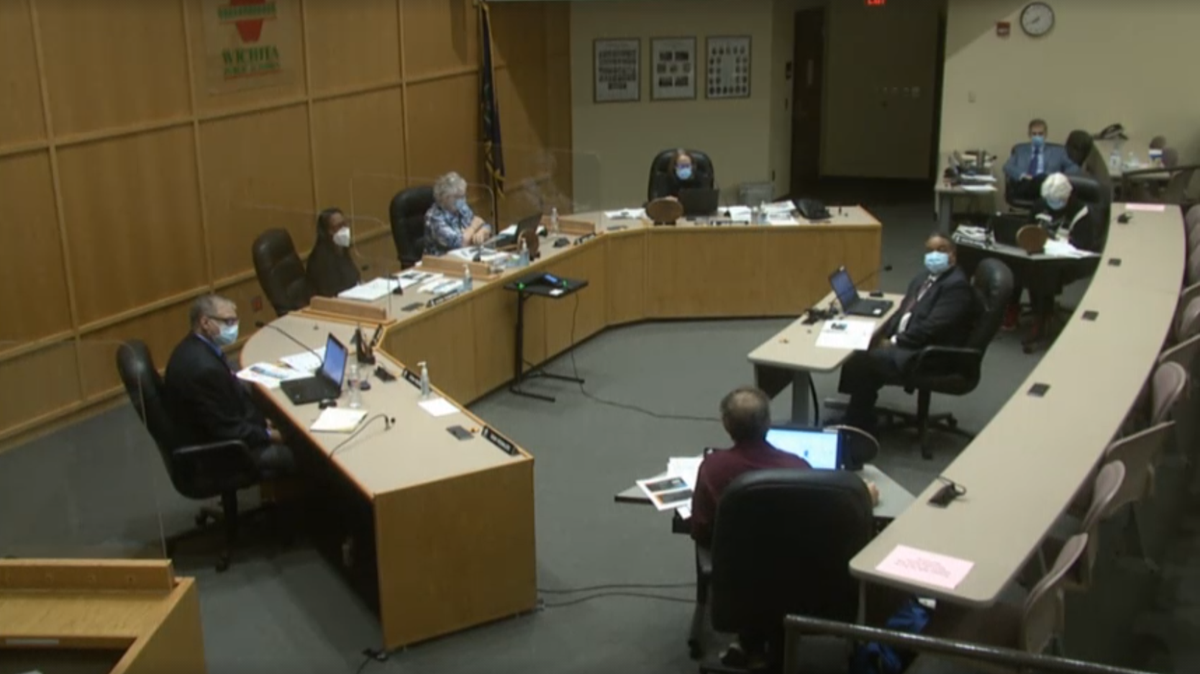
The Board of Education on Monday adopted the in-person classes proposal made by Wichita Public Schools administrators, citing educational equality concerns for students as suburban districts hold in-person classes.
The decision does not affect the approximately 40% of students whose parents opted for remote learning.
For parents who chose in-person classes for their children, elementary students will start attending school on Wednesday. Middle school and high school students are set to hybrid classes on Jan. 25, where they will alternate between in-person and remote learning.
Elementary school staff will return to in-person work on Tuesday while secondary staff return on Wednesday.
Athletes are apparently still required to choose between blended learning and quitting their sports as the board did not change their previous decision requiring athletes to remain remote.
The school board mostly ignored its own gating criteria and did not place the district in a color zone. The numbers presented by district officials showed one green indicator, two orange indicators and one red indicator. The positive test rate and the rate of new cases, which public health officials have said are the two most important indicators, are orange and red, respectively.
The district’s gating criteria calls for remote-only classes for secondary students when in the orange and red zones. Hybrid, or blended, learning for secondary students only appears in the yellow zone of the reopening guide.
“Yes, we are now starting to see our numbers come down concerning community spread, but many of our hospitals’ ICUs are still at a critical stage, and another 107 deaths were reported statewide over the weekend,” Kimberly Howard, the president of United Teachers of Wichita, told the board. “Again, we are so close, so let’s not mess it up now.”
Howard urged district leaders to delay their decision for two weeks to see whether a predicted post-holiday coronavirus surge materializes.
The district previously held elementary classes in-person before a surge in cases and quarantines among staff led to closures of schools. The board had approved a plan in the fall to start hybrid classes among secondary students, but scrapped the idea as pandemic indicators surged.
“If you bring staff back to our school buildings, our quarantine numbers will also rise,” Howard said. “We didn’t have enough substitutes when it was only elementary in-person. Add secondary, and the problem will be worse.”
Superintendent Alicia Thompson said “I am not going to promise anything” when it comes to staffing concerns going forward.
“I will not make any commitment that I feel more confident that we are going to have subs in the classrooms, because that’s not going to be accurate,” Thompson said. “I will say that we will do our best to do what we can. We know that bringing back secondary is going to make more obstacles.”
There was little discussion among board members about the 231 staff who currently have COVID-19 or the 602 staff who are out on quarantine, according to a USD 259 report. The latter number represents about 8.2% of the district’s approximately 7,308 employees.
Board member Ernestine Krehbiel had proposed postponing the return of in-person classes to be “honest with our COVID gating criteria.” She said she expected the positive test rate to improve from the orange zone to the yellow zone in the coming weeks.
The latest Sedgwick County Health Department data show the positive test rate is worsening.
The school district’s own testing data showed 106 positive results out of 304 total rapid antigen tests last week. That’s a positive test rate of 34.87%. The tests were used on symptomatic staff and family members.
The district’s saliva PCR tests used primarily for asymptomatic testing had 27 positives out of 298 tests last week. That’s a positive test rate of 9.73%.
Sedgwick County as a whole had a one-week positive test rate of 14.43% last week, the Kansas Department of Health and Environment reported.
“It really feels like us going remote didn’t necessarily prevent cases in our staff and students. It may have, but it doesn’t appear that it did. It appears like just general community spread,” said board member Ben Blankley, referring to data on students and staff continuing to test positive during the winter break.
As cases and quarantines led to school closures during the fall, school officials put the blame on community spread, claiming that most students and staff were infected outside of school.
But the district’s own data tells a different story.
An analysis by The Eagle of USD 259 case reports found that before classes started, staff had a case rate about 1% lower than that of the surrounding Sedgwick County community. While in-person classes were in session, school staff had a case rate that was 96% higher than that of the community. In the weeks after the transition to fully remote, the discrepancy improved to staff having a case rate 56% higher than the county.
Further, in-person elementary students were diagnosed with COVID-19 at a rate that was about 228% higher than the rate for remote elementary students.
Esau Freeman, a representative for the local Service Employees International Union, asked the board to delay in-person classes until after staff can be vaccinated. Phase two of the state’s vaccine rollout, which includes school staff, is expected to start later this month.
“Personally, I probably won’t be sending my child back to school for the rest of the year, just until at least the vaccines and stuff are done,” he said.
“I also find it ironic tonight,” Freeman said, “that we still don’t allow the public into these buildings for public comment (during school board meetings) because it’s not safe yet, but by the same token we’re considering asking the lowest-paid of all our workers to put themselves back in harm’s way and to service the children of the community when we’re this close to a vaccine.”
The school board received six public comments through email. Four of the letters asked the school board to return to in-person classes.
“Children deserve the routine and environment in school, with friends, and teachers who teach elementary classes, not a parent who is unable to figure out common core math, or is exhausted from working all day, or another sibling trying to help,” said Kasey Clyde, whose children are in kindergarten and third grade.
One letter asked to the board to keep teachers and students home, at least until teachers can get vaccinated.
Kimber Kasitz, the school health director, said the district is not mandating vaccinations. And while teacher vaccinations may start later this month, it would still take another month for teachers to receive their second shots.
Kasitz has received her first dose of a COVID-19 vaccine. Health workers are included in the first phase of the rollout.
The last letter urged the board to improve meal distribution. Durell Gilmore of the nonprofit Kansas Appleseed said school meals have been inaccessible for some families and suggested using school buses to deliver meals along established routes.
“A meal should be the least of things people must worry about, especially in a time like this,” Gilmore said.
This story was originally published January 11, 2021 at 9:42 PM.