
VP questions AD Eric Sexton’s dual role at Wichita State
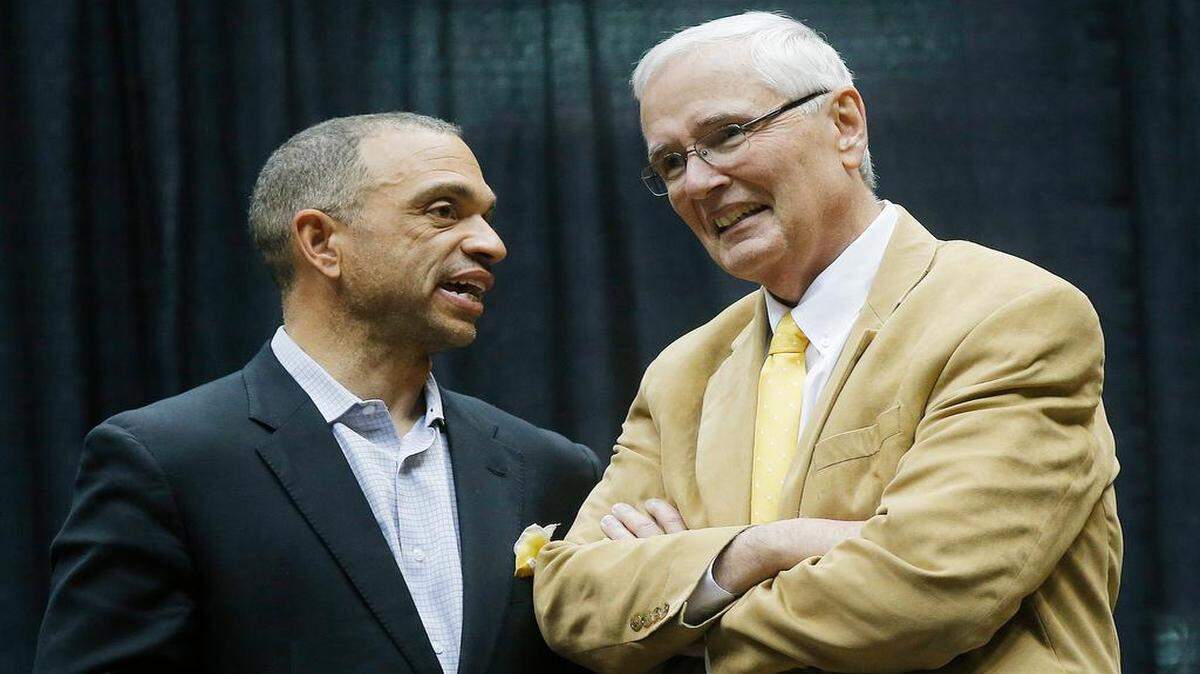
A vice president at Wichita State University says president John Bardo and senior university leaders have made decisions that threatened student safety and failed to follow federal guidelines governing student safety.
In a series of documents sent in April to the Kansas Board of Regents and shared with The Wichita Eagle, Wade Robinson, vice president for student affairs at WSU, details an allegation against Bardo and athletic director Eric Sexton. He said they delayed for four days notifying him in April 2013 that a WSU basketball player had been accused of rape and that the Wichita police department was investigating the case.
Under Title IX, a federal civil rights law that prohibits schools receiving federal funds from engaging in sex discrimination, universities are required to begin a prompt internal investigation, headed by the office of student affairs – Robinson’s office.
Lou Heldman, the vice president for strategic communications at WSU, said in an interview with The Eagle last week that there was no need for anyone to notify Robinson or his office about the rape allegation.
“We don’t think there was any role for Wade in this situation,” Heldman said.
But Robinson and interviews with authorities concerning rules about student safety indicate otherwise.
Robinson, who was hired at WSU in 2009, said he was told in January that his contract as vice president of student affairs would not be renewed. His employment ends June 30. He said he decided to make his complaints public because of the announcement April 21 that Sexton will replace him as vice president for student affairs while continuing to oversee Shocker athletics. The vice president of student affairs both disciplines students and protects students’ rights.
Robinson said he has several concerns, including what he sees as Sexton’s lack of qualifications. He is concerned about the combining of two complex jobs overseeing both athletics and student affairs. He is concerned that the job opening was not posted and no search was conducted for candidates for the permanent position.
He is concerned that the the administration was not forthcoming about the rape allegation. In an interview with The Eagle, he also was critical of Sexton’s athletic department for not taking seriously ongoing complaints from women’s basketball players and their parents who cited anger, isolation and insults from coach Jody Adams.
The regents, who govern the state university system, are making inquiries into the complaint by Robinson and will be visiting with Bardo, according to a regents spokeswoman.
Bardo said that he has not yet seen Robinson’s documents but that based on what the regents have told him, he’s confident he can answer all concerns and that WSU is run safely and well.
Bardo said he can’t talk about Robinson’s termination. “It’s a personnel matter,” he said, but Bardo said he wanted a “change in direction” in the student affairs office.
Until April 21, when Sexton’s appointment was announced, Robinson said, he was willing to leave quietly. After the appointment, Robinson said, he sought protection for his job and pay under the Kansas whistleblower act. He said speaking out may cost him $181,000 in severance pay, which is equal to one year’s salary.
“I could lose all that pay, but I don’t care,” Robinson said. “The safety of students has always been my chief concern.”
Delayed notification
In documents sent to the regents, Robinson wrote that he was notified of the rape allegation against the WSU player four days after it occurred. The notification occurred 19 days after the player had taken part in the Final Four in the NCAA basketball tournament.
The delay in notifying the university’s Title IX coordinator and the office of student affairs demonstrates a disregard for student safety and the university’s standing with federal Title IX law, Robinson said.
“The (four-day) delay in notification to me is a problem, as evidence may be lost or memories are not as good or other influences come into play,” he said.
Robinson provided to The Eagle an e-mail that Sexton sent him three minutes before Wichita police were to brief local media about the case. “Can you please give me a call – not an emergency, but it’s time sensitive,” Sexton wrote.
Sexton told The Eagle last week that he called WSU police chief Sara Morris immediately when he realized Wichita police had come to the athletic department, and they quickly established there were no threats involving student safety. After that, he notified Bardo, and after that, perhaps within a day or two, knowing there were Title IX issues involved, he notified Becky Endicott, senior woman’s administrator in the athletic department.
Bardo said he doesn’t recall the details of what happened during those four days in April 2013. “But, generally speaking, if any information like that had come to me, what I normally do, I would have contacted UPD (University Police Department) and not (Robinson).” It is the campus police, headed by Morris, who determine whether there is a situation of safety and “timely notice” to students, Bardo said.
Morris said she was notified immediately of the rape allegation by one of her detectives, who had been called by detectives from the Wichita police.
She said she, along with Robinson, are key decision makers responsible for assessing student safety. It was not necessary to call Robinson, she said. The woman involved was not a student. The alleged encounter between the woman and the player occurred off campus. The basketball player and his whereabouts at the time were known. Wichita police already had the case, and the safety of everyone, well in hand, Morris said.
Title IX
The athletic department did the right thing contacting the campus police immediately after the rape allegation, said Scott Lewis, partner at the National Center for Higher Education Risk Management Group and consultant to the Office of Vice President and the White House task force on sexual misconduct and Title IX.
“But (campus police) are not the ones that make the Title IX determination as to whether there will be a pursuit of an administrative investigation,” Lewis said.
Title IX says, among other things, that the university must begin a “prompt” investigation of any case of harassment of a sexual nature involving students. The WSU employee who would carry out that internal campus investigation works in the Office of Student Conduct and Community Standards – a unit supervised by Robinson in student affairs, according to the university’s policies and procedures manuel.
The conduct officer investigates potential violations of the Student Code of Conduct and is designated by the federal Title IX law to conduct any investigation of sexual harassment involving any student at the university.
“Four days is not ideal, particularly with something like that and particularly when it’s within the athletics department and they kind of keep it to themselves for awhile,” Lewis said. “The question that gets asked in an audit or a lawsuit is ‘Why did you wait? What was the point of waiting?’
“And the answer should not be ‘Well, we were conducting an internal investigation,’ because that’s not the role of the athletics department. ‘Why?’ That’s the question to ask.”
The Department of Education’s Office of Civil Rights has interpreted Title IX to say that schools have 60 days to resolve the investigation, but the expectation is that a mandatory reporter will report what he or she knows to the Title IX coordinator as soon as possible, Lewis said.
“If you read the most recent guidance, they’re very clear on this: Once a university employee knows, you need to tell the Title IX coordinator,” he said.
“The other situation with this speaks to the perception issue. A high-profile athlete gets accused of something, the police call the athletic department that calls the president, but the two people that oversee the students aren’t told. It starts to smell a little bit like maybe you didn’t want anybody to know. That’s what it ends up looking like. Whether that’s actually the case or not is less relevant in the public perception,” Lewis said.
Wichita police later ended their investigation of the rape allegation with no one charged, citing lack of evidence.
The player, who is no longer with the team, was never publicly identified by police or the university.
Upon learning of the allegations, Robinson said, he prompted an investigation outlining what happened, when reports were made and who made them.
In July 2013 – after the rape investigation – WSU changed its Student Code of Conduct policies on sexual misconduct to include: “If the University is informed of an alleged act of sexual misconduct, the University is obligated to investigate the occurrence and to proceed with the conduct process if the alleged individual is a Student,” Robinson said.
Robinson said his investigation showed that Shocker men’s basketball coach Gregg Marshall had immediately followed university rules as soon as he heard of the allegation on the same day the woman went to police, April 21, 2013. On the day of the alleged encounter, Robinson said, police contacted WSU players, who immediately notified an assistant coach, the assistant called Marshall, and Marshall immediately notified Sexton.
“Marshall did everything right,” Robinson said in an interview. “He did what everybody should have done.”
Dual roles
Under his new role, Sexton will combine two jobs, overseeing both the athletic department and student affairs. His pay will increase from the $192,000 annually he makes as athletic director to $210,000, said Anthony Vizzini, the WSU provost and senior vice president.
It’s unusual at a Division I university with about 15,000 students for one person to oversee both student affairs and athletics, said Lewis of the higher education risk management center.
But Sexton said he can do both jobs because of the staff members in place in both departments.
“We’ve had success in the athletic department, and in other places, athletic directors put all that together so they can go someplace else,” Sexton said. “But my father went to school here. My mother. My wife. And me. I’m committed to Wichita State. I’ve been on campus for 25 years now. I love the contact I have with students, our fans, our parents. I have had great mentors here and have tried to carry out what they taught me with a focus on students and a personal touch.”
Lee Bird, vice president for student affairs at Oklahoma State University-Stillwater, who served as the president of the National Board of Directors for the Association of Student Judicial Affairs and has been in student affairs for more than 30 years, says it’s not uncommon to have combined roles on campuses as budgets are cut. But from a professional standpoint, she said, it’s not ideal, and she has not heard of student affairs combined with athletics before.
“The complexity of the jobs has risen to a level where it’s desirable to have a singular focus on the services for students – potentially critical issues for students, diversity issues, support issues, mental health issues – all those things have increased over the years, not decreased,” Bird said. “So it’s good to have somebody that really has that background professionally in students affairs.”
Other university leaders at WSU also expressed concerns.
“This announcement was a surprise to me, that’s for sure,” said James Rhatigan, retired student affairs vice president emeritus at WSU. The job of student affairs chief is so nuanced and challenging that people, including him, get doctorates to learn how to do it right, he said. Sexton’s doctorate is in political science.
“I don’t know what was in the president’s thinking,” Rhatigan said. “But now that this decision has been made, the effort must be to make it work. And I can say that because I don’t have to be the good soldier here. I’m 80 years old.”
Deltha Colvin, the associate vice president for campus life who currently reports to Robinson, said she doesn’t think Sexton is qualified. Student affairs work, she said, is complex, directly affects student safety and potential legal problems and demands a high level of detailed knowledge.
“It’s nothing personal against Eric Sexton,” she said. “But he’s an athletic director, with a background in political science. So what does he know about housing? What does he know about student government?
“It’s going to take him years to learn all the things he’ll need to know. Maybe he went to them and said, ‘I could do this.’ But if he did, he was stupid.”
Bardo said those who question Sexton’s appointment don’t take into account three things: Sexton’s skilled leadership, evident in his long history with WSU; his record leading a successful athletic department; and the fact that no university leader, including any university president, ever takes over the job with all the qualifications to do it well.
“When I first became a university president, I had no experience whatsoever in the crucial areas of either finance or economics,” said Bardo, who studied as a sociologist. “I had no degree in administration, either, or in student affairs.”
Sexton had no experience in athletics when former WSU president Donald Beggs appointed him director, Bardo said, and yet Sexton’s tenure there included wildly successful basketball teams and innovations in how to educate and mentor student athletes.
Lewis, with the higher education risk management group, said the two roles have a potential conflict of interest, particularly if two students – an athlete and nonathlete – become involved in a dispute.
“An athletic director who now has direct responsibility for the overall student conduct process will have to be very careful for any perception of conflict that exists when a student athlete may be involved in an incident,” Lewis said. “So that perception of conflict could almost be as damaging as the reality. … From the outside looking in, that certainly will be a question that will be asked. So the more the AD can insulate themselves from that process, the better off they’ll be.”
Sexton thinks he can be fair in areas where students and student athletes conflict.
“Absolutely I can be fair, because, guess what? Ninety-eight percent of the student athletes are going to become something other than what they are in their sport. My point? If I am not holding them accountable, whether they are athletes or students in the general population, then that’s an indictment of my character ... and I would not accept that.”
Vizzini, who said he helped Bardo choose Sexton for the new job, said he and Bardo talked about that potential conflict of interest “from the beginning” of the deliberations about hiring Sexton. He said that’s a legitimate concern.
“And we decided that Eric won’t be involved in that kind of situation,” Vizzini said. “We haven’t yet worked out all the details, but we’re going to find a way to make sure Eric won’t be making those decisions.”
Vizzini said he does not regret hiring Sexton, who will report to him.
But he does regret the timing.
About the time that Sexton was selected for the new position, four members of the WSU women’s basketball team, including two starters, quit the team. The women and their parents complained about what they perceived to be Sexton’s lack of interest with their concerns over an atmosphere of anger, isolation and personal insults allegedly perpetuated by coach Jody Adams, according to a transcript of an interview by a WSU official with players and parents.
The four players aren’t the first to raise concerns about Adams’ coaching style. After the 2008-09 season, Adams’ first at WSU, four players quit. Five players quit before or during the season. All were recruited by the previous coaching staff. In interviews, they described persistent daily verbal abuse, a team segregated by race and practices that exceeded the NCAA weekly limit, the players said at the time.
Sexton, who has supervised the athletic department since 2008, described the problems at the time as ones common during a coaching change.
Later, in 2012, he reprimanded Adams and the coaching staff after they made the players do pushups on the court during halftime of a game.
In a statement released April 25, Sexton said: “I feel badly that there is a perception among players that their complaints weren’t heard and acted upon. Their complaints were taken seriously.” After the 2012 issue, the department made some staffing changes and closely monitored the program, according to Sexton.
“Now it appears there were issues under the surface that we didn’t know,” Sexton said in the statement. “As soon as we were made aware of them, we took them seriously and started the process to gather further facts.”
Vizzini said he wasn’t aware of the news from the athletic department when he helped Bardo make the decision to hire Sexton. Nothing about what he’s heard since has led him to regret it, he said.
“The timing was unfortunate” but not related, Vizzini said. “I can see how people can look at this and make a connection. But all that the timing shows is that we are bad at timing. The only thing that crossed my mind is that it was bad timing on our part. I wish there was a greater gap in time, but it is what it is.”
Hiring practices
Colvin, the associate vice president for campus life under Robinson, also objects to the way Sexton was hired.
In mid-April, Colvin said, she and other staff members in student affairs were asked to interview candidates from outside WSU to replace Robinson on an interim basis. The person would serve for about a year while a search for a permanent replacement was conducted. In response to a records request, WSU provided documents showing four candidates were scheduled to interview for the interim position.
One of the four candidates, who asked not to be named in this article, said they were all recruited for the WSU job in mid-March by a firm called the Registry for College and University Presidents, which recruits interim leaders for universities. It maintains a database of experienced administrators who are available to work in an interim role.
But the candidate said that on April 17, Bardo’s secretary sent an e-mail saying the university had hired an internal candidate for the job. The university agreed to reimburse the registry $2,804 for airline tickets. The university has not said how much was paid to the registry overall for the candidate search.
When Colvin and other WSU staff members showed up on April 21 to interview candidates, they were met by Vizzini, WSU’s provost and vice president for academic affairs. Colvin said Vizzini told them there would be no interviews and that Sexton would take over, not as an interim director “but the permanent vice president” while still overseeing the athletic department.
Setting up and then canceling interviews with candidates made no sense, Colvin said.
Giving two demanding jobs (athletic oversight plus student affairs) to one person also made no sense, she said.
Giving the student affairs job to Sexton without asking anyone in student affairs for an opinion was “an insult,” she said.
“It was all a slap in the face,” Colvin said. “No respect.”
In reality, the president doesn’t have to involve others in the selection process for Robinson’s replacement, said Heldman, WSU’s strategic communications vice president. “Unclassified professionals,” the professional staff, serve at the president’s discretion.
Bardo said there were good reasons it happened the way it did. Bringing in interim candidates made sense, but as that hiring process developed, he already felt drawn to the idea of appointing Sexton, an idea he said was suggested by Sexton himself months ago.
And Bardo said he was also bothered because he knew the student affairs unit was suffering.
Student affairs personnel knew Robinson was leaving, for example. Bardo decided, suddenly, that he did not want an interim student affairs chief, “because then we’d go another year before we found a permanent solution.”
Contributing: Gabriella Dunn of The Eagle
Reach Roy Wenzl at 316-268-6219 or rwenzl@wichitaeagle.com. Follow him on Twitter: @roywenzl.
This story was originally published May 2, 2015 at 7:09 PM with the headline "VP questions AD Eric Sexton’s dual role at Wichita State."