
Financial records helped shape case against Daniel Perez, detective testifies
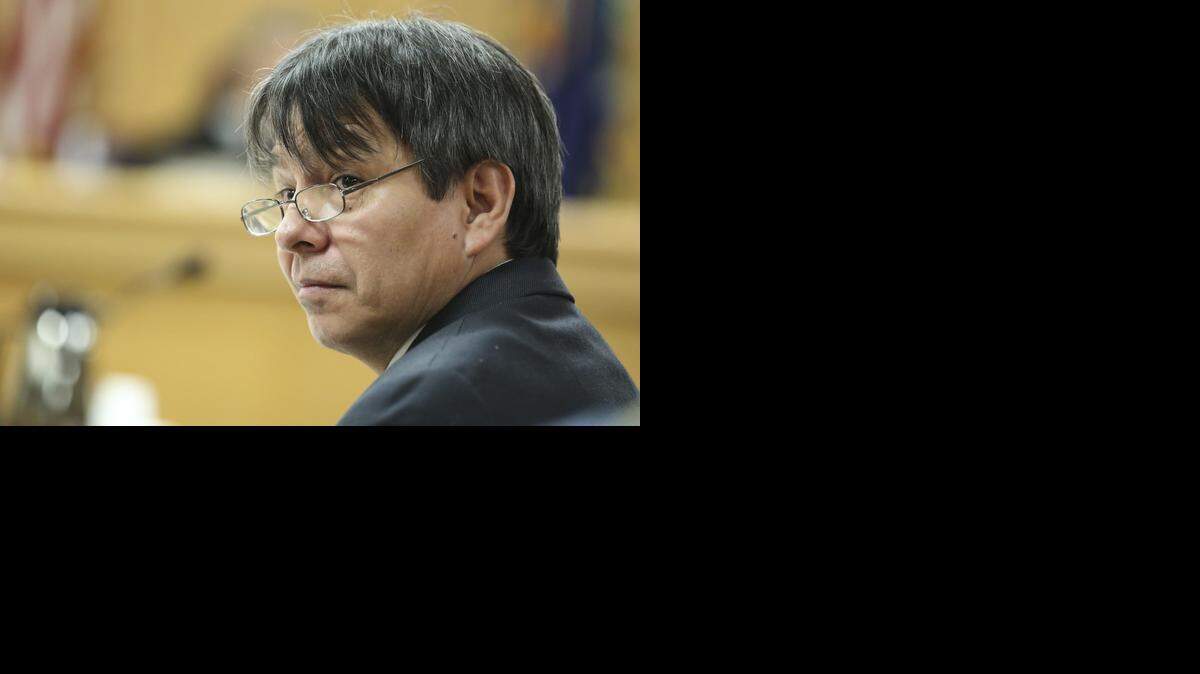
The Sedgwick County sheriff’s detective who worked for years to unravel a web of suspicious deaths, alleged sexual abuse and extravagant spending told a jury Thursday how he used financial records to piece together the case that eventually led to charges of murder and dozens of other felonies against Daniel Perez.
Detective Ron Goodwyn, in testimony that got underway late Wednesday afternoon, said he began to watch the 20-acre compound on North Oliver known as Angels Landing in 2003, around the same time 26-year-old Patricia Hughes drowned in the property’s pool.
He said he had received reports of possible suspicious activity and unexplained wealth surrounding a man named Lou Castro, who, it appeared, didn’t have a job.
“Wealth in vehicles, wealth in property,” Goodwyn said.
At first, he thought drug trafficking was involved.
“When that wasn’t uncovered, there was really no crime to investigate,” he said.
But questions remained about how the communal group paid for new vehicles, expensive homes and lavish toys, like 4- to 6-foot remote control airplanes.
Goodwyn testified he would spend the next several years years tracing the group’s bank records and other information in a search for who Lou Castro really was.
Perez, who used aliases including Lou Castro while he lived in Kansas and other states, is facing trial this week in Sedgwick County District Court on 37 charges, including first-degree premeditated murder of Hughes, sexual assault of children, and fraud crimes.
Prosecutors say Perez manipulated the communal “family” who traveled from state to state with him, convincing them he was a “seer” who could foretell the future in an elaborate scheme to collect life insurance benefits and feed his sexual appetite for children without coming under scrutiny.
Perez’s defense attorney, Alice Osburn, by contrast, characterized her client in court as a welcoming man, who enjoyed consensual open relationships with women of legal age and got blamed when authorities started scrutinizing the financial records of the so-called Angels Landing commune.
Thursday marked the second day of testimony in Perez’s trial. It resumes at 9 a.m. Friday.
Searching for Lou Castro
Goodwyn spent about six hours on the witness stand Wednesday and Thursday, recounting how after the drug trafficking angle faltered, he continued looking into the Angels Landing group and noticed they were all connected to a man named Lou Castro.
Goodwyn told jurors he started tracking the group’s financial records starting in 2006 after Hughes’ husband, Brian, was crushed to death by a car in an another apparent accident.
Goodwyn said he noticed a series of large life insurance policies that had paid out in the deaths of people Castro knew and lived with. Castro was never listed as a beneficiary himself, but other people he lived with were.
The beneficiaries’ bank accounts were mostly depleted when the payouts – usually hundreds of thousands of dollars – came in, Goodwyn told jurors.
But the money was gone within about 2 1/2 years.
“It was about the same length of time between the deaths,” Goodwyn said.
Still, there was no obvious crime. He said once he took garbage from the curb of the Angels Landing property in an effort to uncover more information about Castro.
In 2008 Goodwyn approached Castro and tried to get his fingerprints. He handed Castro a set of photos, but Castro was careful to avoid letting his fingertips touch the glossy surfaces, Goodwyn said.
That day Castro gave authorities a fake Social Security number. He later would be convicted on federal charges of aggravated ID theft and Social Security fraud.
Goodwyn continued to trace Castro’s steps from Kansas to South Dakota, Missouri and eventually to Tennessee, where the communal “family” moved in March 2009.
Goodwyn told jurors his next break came in 2009. The FBI called, saying it had received an e-mail from a man dating a woman associated with Castro that described the communal family and the deaths.
The sender claimed Castro had “gone to great lengths to avoid the government,” Goodwyn said. It called Castro a “suspicious character” who “needs to be investigated.”
It did not mention any sexual abuse.
Goodwyn said it wasn’t until May 2010, a month after Castro’s arrest in Columbia, Tenn., in connection with the federal charges, that he first heard the name “Danny Perez.”
Goodwyn said he had contacted Patricia Hughes’ mother at her Beeville, Texas, home in an effort to learn more about Lou Castro. In 1997 he fled the state after being convicted of child sex crimes.
He asked about the mother about her daughter’s boyfriends when she was a teenager. She mentioned several names, then remembered a boyfriend “who had been in trouble with the law” but had been killed in Mexico, Goodwyn said; a wallet with Perez’s ID was found on the body.
“It seemed to be more of a tale,” Goodwyn told jurors Thursday.
“Several people told us they didn’t believe it was true and that he was still alive,” including Patricia Hughes’ sister, who claimed she saw Perez in a nightclub.
Goodwyn said he took Perez’s name to local authorities and requested his criminal history and mugshot.
When he received the photo, he compared it to the image on a South Dakota ID card found in one of two wallets Castro turned over when he was arrested in Tennessee.
Prosecutor Kim Parker asked Goodwyn: “Did you recognize that photo to be anyone that you’d seen before?”
“Yes. Lou Castro,” was the reply.
During her cross examination, Perez’s lawyer asked Goodwyn when he looked at bank records of the Angels Landing group, whose names were written on the checks and other financial documents that bought the properties, cars and other items.
Goodwyn named several women associated with Perez.
“So the women in the house controlled the money?” Osburn, the defense attorney, asked.
Goodwyn said he didn’t agree with that characterization but conceded that Perez’s name never appeared on any financial documents.
‘Uncle Lou’
Also on Thursday, jurors heard from the man who sent the e-mail to the FBI, questioning the members of Angels Landing.
He said he became concerned about the lifestyle at the property after he witnessed the man his girlfriend called “Uncle Lou” cuddling with and stroking the inner thigh of what appeared to be an underage girl at a restaurant.
He also said his girlfriend recounted stories of sexual abuse that he concluded were perpetrated by Lou Castro. She was too terrified to go to police, the man testified.
The Eagle is not naming the man or his girlfriend because she is an alleged victim of sexual assault.
After the man was sworn in Thursday afternoon, Osburn asked for a mistrial because he was dressed in full military garb. She told the judge the man’s dress was “inappropriate for civilian court” and an obvious attempt to bolster his credibility with jurors.
Parker, the prosecutor, dismissed the claim, saying military personnel usually go to formal events dressed in their uniforms.
Judge Joseph Bribiesca, who is presiding over the case, sided with the state.
After refusing to grant a mistrial, he said: “I just want to point out that law enforcement officers come into my courtroom every day in uniform and that’s not seen as a problem.”
Reach Amy Renee Leiker at 316-268-6644 or aleiker@wichitaeagle.com. Follow her on Twitter: @amyreneeleiker.
This story was originally published February 5, 2015 at 10:32 PM with the headline "Financial records helped shape case against Daniel Perez, detective testifies."