‘Heinous & horrific crimes’: Nearly all KS death-row inmates ask for clemency
Eight of the nine men currently on death row in Kansas have applied for executive clemency, including Wichita murderers Jonathan and Reginald Carr.
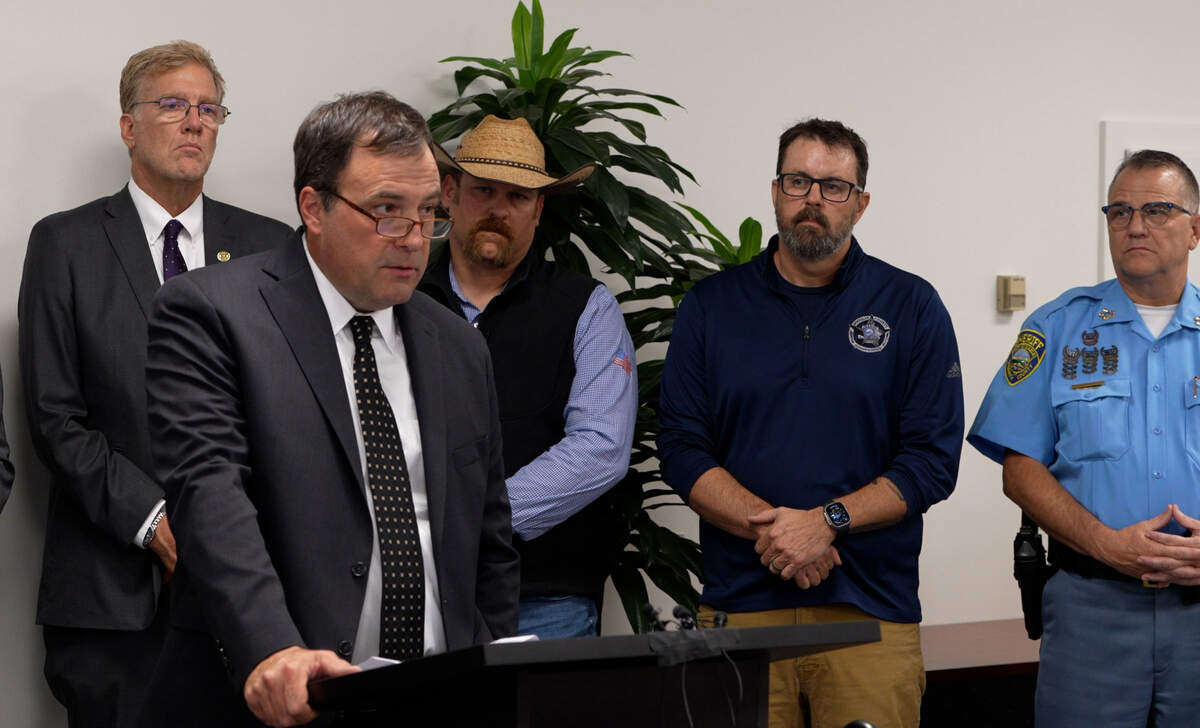
Kansas Attorney General Kris Kobach says that the men want their death sentences thrown out by the governor so they can’t be executed. At a press conference in Wichita on Tuesday, he urged the community to speak against their requests in letters, emails and phone calls to the Kansas Prisoner Review Board and Kansas Gov. Laura Kelly’s Office while the public comment period is still open.
Members of the public can send letters voicing their opinions about the requests to the Kansas Prisoner Review Board at 714 SW Jackson, Suite 300, Topeka, KS 66603 or email kdoc_victim_notification@ks.gov. Comments can be shared with Gov. Kelly’s office at Kansas Statehouse, 300 SW 10th Ave., Suite 241S, Topeka, KS 66612 or by calling 785-296-3232 or 785-368-8500.
“These murderers are the worst of the worst, guilty of the most heinous and horrific crimes imaginable,” he said during the press conference, where he also called on Kelly to deny the applications.
“These individuals are asking that their death penalties be converted to life sentences, and we do not believe that that is appropriate. ... I am emphatically urging the governor to not grant clemency. The governor must leave these death penalties, these sentences in place,” he said.
Kobach said that all of the men submitted their applications to the Kansas Prisoner Review Board on various dates last month, triggering a 30-day period where the public can weigh in.
The Kansas Prisoner Review Board gathers and reviews comments and other information after receiving an application then makes a recommendation to the governor, who ultimately decides whether grant or deny the clemency request.
There is no timeline for the governor to make a decision.
Kelly’s office did not immediately respond to a request for comment Tuesday afternoon.
Kobach said he doesn’t recall another time when Kansas death row inmates have asked the governor for clemency individually or simultaneously.
Kansas juries have given 15 men death sentences since the state legislature reinstated capital punishment, by lethal injection, in 1994. Nine remain on death row. Two died while appealing their cases. Four others had their death sentences overturned and are now serving life in prison, some with parole eligibility.
Sedgwick County District Attorney Marc Bennett said during Tuesday’s press conference that clemency is “simply the latest step” in the judicial process these death cases are working through and “represents a fail-safe in the system for rarified circumstances.”
“I trust that Gov. Kelly will allow this process to continue until the judicial system brings these matters to a conclusion,” he said.
The men who submitted clemency requests are:
- Jonathan and Reginald Carr, 46 and 48, who were sentenced to death in 2002 in Sedgwick County for four execution-style shooting deaths in Wichita during a December 2000 crime spree. The Carrs were found guilty of invading a home, sexually abusing the five residents and forcing them to withdraw money from ATMs. Before the night was through, the brothers shot the group in a snowy soccer field on Dec. 15, 2000. Jason Befort, Brad Heyka, Heather Muller and Aaron Sander died. One woman survived to testify. The brothers also were convicted of the first-degree murder of Ann Walenta four days earlier during an attempted robbery.
- John E. Robinson Sr., 82, who was sentenced to death in 2003 in Johnson County for the murders of Izabel Lewicka and Suzette Trouten, whose bodies were found in barrels on his property in rural Linn County. Robinson was also sentenced to life in prison for killing Lisa Stasi, who disappeared in 1985 and was never found. He also pleaded guilty in Missouri to five killings, receiving sentences of life without parole for each.
- Sidney Gleason, 47, who was sentenced to death in 2006 in Barton County for the shooting deaths of Miki Martinez and her boyfriend, Darren Wornkey, on Feb. 24, 2004. Prosecutors said the killings happened because Gleason and his cousin worried that Martinez would tell police about their involvement in the stabbing and robbery of a 76-year-old man.
- Scott Cheever, 44, who was sentenced to death in 2008 in Greenwood County for the January 2005 shooting of Greenwood County Sheriff Matt Samuels during a drug raid at a home near Virgil, where authorities found a suspected methamphetamine lab.
- Justin Thurber, 43, who was sentenced to death in 2009 in Cowley County for the January 2007 abduction, sexual assault and killing of 19-year-old college student Jodi Sanderholm. Her body was found in a wooded area near where her car had been sunk in a lake.
- James Kraig Kahler, 63, who was sentenced to death in 2011 in Osage County for the November 2009 murders of his estranged wife, 44-year-old Karen Kahler; her grandmother, 89-year-old Dorothy Wight; and the Kahlers’ daughters, Emily, 18, and Lauren, 16. Kahler, who shot them to death with an assault rifle, was reportedly upset that his wife had filed for divorce.
- Kyle Trevor Flack, 40, who was sentenced to death in 2016 in Franklin County for the May 1, 2013, shotgun slayings of Kaylie Bailey and her toddler, 18-month-old Lana Bailey, at an Ottawa-area farmhouse. He also killed two other adults, 30-year-old Andrew Stout and 31-year-old Steven White. The adults’ bodies were found on the farm property. The toddler’s body was discovered stuffed in a suitcase floating in a rural creek.
The death-row prisoner who did not submit a clemency request is 70-year-old Gary Kleypas, who beat, raped and murdered 20-year-old Pittsburg State University student Carrie Williams in her apartment on March 30, 1996.
The last state executions in Kansas occurred in 1965, by hanging.