Jury awards millions in damages over 17-year-old CJ Lofton’s in-custody death
Jurors on Wednesday awarded $8.3 million in compensatory damages to the estate of 17-year-old Cedric “CJ” Lofton after finding five Sedgwick County juvenile corrections officers liable in the teen’s in-custody prone restraint death in 2021.
Jurors found three officers who held down the Wichita teen’s arms and midsection — Brenton Newby, William Buckner and Karen Conklin — subjected Cedric to a prolonged prone restraint and put weight on him after he stopped meaningfully resisting.
Four of the officers — Newby, Buckner, Conklin and Jason Stepien — used excessive force, the jury determined.
All five of the officers — Newby, Buckner, Conklin, Stepien and Benito Mendoza — failed to intervene to stop the others from violating Cedric’s right to be free from excessive force, jurors found.
The $8.3 million award includes $1 million for the physical pain and suffering Cedric experienced before his death, $1 million for his mental and emotional pain and suffering, $1.3 million in lost future earnings, and $5 million for his loss of ability to enjoy his life.
Jurors deliberated for around 13 hours across three days.
Several people dabbed at tears as the verdict was announced in court. Marquan Teetz said later the decision held the five corrections officers accountable for his brother’s death, especially since none faced criminal charges.
Cedric, who was in foster care, died two days after he was held face down on the concrete floor of the county’s Juvenile Intake and Assessment Center for 39 minutes by the five juvenile corrections workers. He was delusional and in the throes of a mental health crisis when he was taken there instead of a hospital by Wichita police on Sept. 24, 2021.
“The jurors see they were guilty obviously of their actions,” Teetz said.
“It proves what I’ve always known ... that the five officers actually killed my brother. The jurors seen that. They verified it to the community.”
“This is a long time coming in terms of getting some measure of accountability against JIAC (Juvenile Intake and Assessment Center) and JDF (Juvenile Detention Facility) and the respective defendants,” Brian Eldridge, one of the lawyers who represented Teetz, said.
He said he hopes law enforcement and the corrections community take notice of the verdict and only use prone restraints as a temporary control measure going forward.
Sedgwick County, who employed the corrections officers, said in a written statement after the verdict that it respects the judicial process and is “reviewing the verdict, awaiting the finalization of court proceedings and discussing next steps.” It did not comment further.
Initially, Teetz and his lawyers sought punitive damages against the five corrections officers.
But the lawyers told the court Wednesday they were withdrawing that request after the officers testified that they received no training on how to safely use a prone restraint, had no idea Cedric was in danger and didn’t know it could be deadly.
“Nobody ever told us,” Buckner said.

Original story and daily updates
A civil trial involving the in-custody death of a Wichita teen who became unresponsive while restrained face down on the concrete floor of a local juvenile facility for 39 minutes is underway in federal court.
The older brother of 17-year-old Cedric “CJ” Lofton and the deceased teen’s estate have sued five juvenile corrections officers who worked at the Juvenile Intake and Assessment Center and the Juvenile Detention Facility in Sedgwick County, alleging use of excessive force and failure to intervene in violation of the teen’s Constitutional rights.
Marquan Teetz and the estate are also alleging intentional infliction of emotional distress under Kansas law, according to the lawsuit.
Cedric, a foster child, was in the throes of a mental health crisis when he was taken to the Juvenile Intake and Assessment Center, or JIAC, on Sept. 24, 2021, by Wichita police after he spit at and battered officers who tried to take him to a hospital for a mental evaluation. Lawyers for Cedric’s family say the 135-pound teen was physically fine and walking around at JIAC after he was left there by Wichita police, but soon resisted an employee’s efforts to convince him to participate in the intake process. He was shackled around his legs and placed face down on the concrete floor of a holding room for 39 minutes before corrections officers noticed he was not breathing and started CPR.

He died two days later from “complications of cardiopulmonary arrest sustained after physical struggle while restrained in the prone position,” according to his autopsy report. The medical examiner determined his death was a homicide, although no criminal charges were filed against any officer.
Lawyers for Cedric’s family say the teen was restrained too long, including after he was no longer struggling, and would be alive if corrections staff had immediately handcuffed him and sat him upright. They plan to ask jurors to award millions in damages.
Lawyers for the corrections officers — Brenton Newby, Jason Stepien, Karen Conklin, William Buckner and Benito Mendoza — say their clients were in “extraordinary circumstances” that morning with a super strong, resistant and combative teen who never tired and made them fear for their lives.
An eight-member jury will decide the case by a “preponderance of the evidence,” the standard of proof that means something is more likely true than not. It is less strict than the “beyond a reasonable doubt” standard used in criminal court.

The trial is expected to last three weeks. Testimony began Jan. 21 following more than a day of jury selection.
The plaintiffs and the defendants each have a team of three lawyers, who are expected to call the corrections officers, police, experts and others to testify. U.S. District Court Senior Judge Eric Melgren is presiding.
The Eagle will be in the courtroom daily for the duration of the trial. Check here for periodic updates on what’s happening in court. The most recent dispatches appear first.
Tuesday, Feb. 3: No verdict yet
Jurors headed home without reaching a verdict following a full day of deliberations Tuesday.
The jury began discussing the case around 9 a.m., deliberated through lunch and stopped for the day at about 5 p.m. They will continue Wednesday.
Monday, Feb. 2: Jury begins deliberating as lawyer asks for millions in damages
Jurors began their deliberations late Monday afternoon after the defense rested and lawyers gave their closing arguments.
The jury must now decide whether any of the five Sedgwick County juvenile corrections staffers who have been on trial for the last two weeks used excessive force against 17-year-old Cedric “CJ” Lofton and whether any of them failed to intervene to stop others from doing so.
If the jury answers “yes” on either claim, they will then consider how much in compensatory, or actual, damages to award Cedric’s estate.
Jurors would decide later whether to award punitive damages — which punish a defendant for their conduct — if they find that any of the corrections officers violated the teen’s constitutional rights.
The verdict must be unanimous.
During his closing arguments, lawyer Brian Eldridge suggested jurors award between $22.9 million and $33.6 million in compensatory damages. Those amounts include at least $1.125 million to $1.8 million for the teen’s lost future earnings, $3.9 million for physical pain and suffering, $3.9 million for mental and emotional pain and suffering, and $14 million to $24 million for the loss of Cedric’s ability to carry on and enjoy life.
In doing so, Eldridge called on jurors to “consider what he (Cedric) went through” being pinned down for 39 minutes when he was delusional and already afraid that people were trying to hurt or kill him.
“The very fear he had was being realized in those ... minutes,” Eldridge said. “What an absolutely horrific way to die.”
Defense lawyer Jeffrey Kuhlman called $33.6 million in compensatory damages “an absurd number” that is the result of figures “plucked off the highest shelf” rather than being tied to the facts of the case.
He argued that the corrections officers had “acted reasonably” in response to the teen’s exceptional strength and endurance and therefore should not be held liable in his death.
“They were ordinary people who found themselves in an extraordinary situation,” Kuhlman said. “... They did the only thing they knew how … and they acted reasonably.”
The jury went home at 5 p.m. Monday. They will continue deliberating Tuesday.
Friday, Jan. 30: Experts say no national standards for juvenile prone restraint, ‘excited delirium’ caused death
Jurors on Friday heard from two of the three expert witnesses defendants plan to call to the stand, including a doctor who disagreed with 17-year-old Cedric “CJ” Lofton’s official cause of death.
Dr. Robert Bux testified that, in his opinion, the 39-minute prone restraint had nothing to do with Cedric’s death and that the teen instead died from excited delirium, a pseudoscientific condition first diagnosed in psychiatric wards in the 1800s and later applied to stimulant drug users who refused to comply with law enforcement commands. Symptoms attributed to the condition include delirium, agitation, hallucinations, aggressive and violent behaviors, superhuman strength, elevated body temperature, exceptional endurance, removing clothing and failing to comply with law enforcement commands, according to trial testimony.
Bux said to reach his conclusion he relied heavily on deposition testimony given by the corrections officers after the lawsuit was filed denying that they had used weight or pressure to keep Cedric on the floor.
He recalled only one excited delirium death case that didn’t involved illicit drug use in his decades-long career performing thousands of autopsies. Cedric’s would be the second, he testified in a video deposition that was played for jurors.
A cardiologist and a forensic pathologist who testified as expert witnesses for the plaintiffs earlier in the trial told jurors that diagnosing excited delirium has been banned by prominent medical associations over questions of its legitimacy and because it has been used to explain away police-involved and in-custody deaths that often involve restraint use.
Sedgwick County Chief Medical Examiner Timothy Gorrill, who performed Cedric’s autopsy, determined the teen’s cause of death to be “complications of cardiopulmonary arrest sustained after physical struggle while restrained in the prone position.” He listed Cedric’s manner of death as homicide, which Bux also challenged.
The other defense expert who took the stand Friday was limited to testifying that there is no national standard for using the prone restraint in juvenile corrections settings. Richard Hough, a use of force expert and former law enforcement officer who now teaches college courses, said no national standards exist obligating juvenile corrections staff to move a resisting youth out of a prone restraint, even after they are handcuffed.
He added that the duration of a restraint is “based on resistance” and the perception of an officer in the moment rather than time.
Thursday, Jan. 29: Defendants call to stand cop, intake worker who interacted with teen
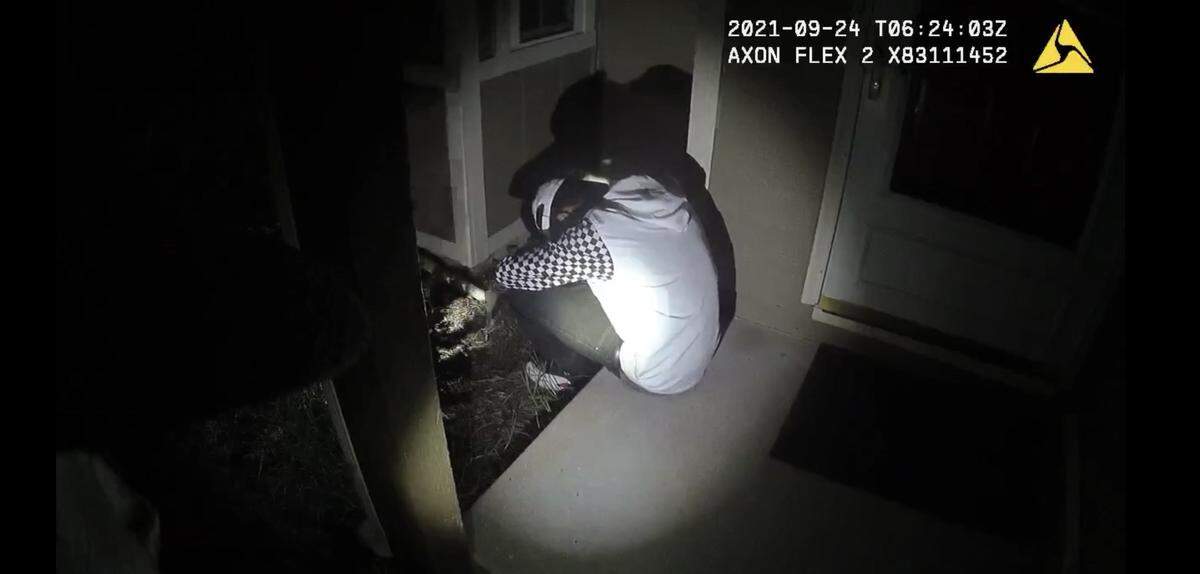
A former Wichita police patrol officer who responded to Cedric’s foster home and helped put him in the wrap restraint device that was used to transport him to the Juvenile Intake and Assessment Center testified that he used some pain compliance techniques to subdue Cedric enough for handcuffs to be applied after he refused to follow verbal commands.
The former officer, Jordan Clayton, described the interactions with Cedric at the foster home as “pretty tense” at times and said the teen continued to resist and pull away from police officers even after he was cuffed.
But, he told jurors, he thought the situation was under control at that time. Officers briefly placed Cedric in the prone position at the house to secure the handcuffs before placing him in the wrap restraint.
Jurors also heard additional testimony from former JIAC intake specialist Jason Stepien, whose cross-examination was postponed last week due to the winter storm. Stepien reiterated his earlier testimony that Cedric was unusually strong and resilient and didn’t stop struggling against the corrections officers until he began making snoring sounds, which everyone thought meant he had fallen asleep but was actually agonal breathing.
He also repeated claims that he initially saw nothing of concern in Cedric’s behavior and wasn’t worried when a Wichita police officer changed answers on a release form that would have required Cedric be taken to a hospital first. Newer police officers sometimes didn’t understand the questions on the release form and would alter their responses after talking with senior officers, he testified.
Stepien told jurors that in his time working at JIAC he had participated in probably fewer than five restraints and only two of those had involved putting a child on the ground, including Cedric’s.
The other child stopped fighting almost immediately, within seconds, he said, so he was not prepared for Cedric’s lengthy struggle.
Stepien told jurors again that he feared for his life and safety during the entire encounter but backed off a little from last week’s testimony, saying Thursday that he “was just afraid of what could happen” and that Cedric was “a danger to himself.”
The defendant’s case continues Friday with testimony from two expert witness. The defendants plan to call another expert witness on Monday before wrapping up. Lawyers will then give their closing arguments before jurors start deliberating.
Wednesday, Jan. 28: Brother testifies about bond with Cedric, plaintiffs rest
Lawyers for the estate of Cedric Lofton and his older brother, Marquan Teetz, rested their case Wednesday afternoon after jurors heard testimony from four more witnesses, including Teetz himself.
The courtroom was packed with family and supporters when the 24-year-old took the witness stand to testify about his younger brother’s personality and dreams — and what life has been like without him.
Every day for a year after Cedric was killed, Teetz said, he watched the security video from the Juvenile Intake and Assessment Center lobby that recorded his brother’s last conscious moments.
He told jurors he watched the recordings over and over because he felt he needed to experience everything that Cedric went through as he was fatally restrained.
“As his big brother that’s my responsibility. ... I just needed to know everything I could,” he said.

He told jurors the 17-year-old captured in the police and JIAC video that’s been played repeatedly during the trial wasn’t the brother that he knew. Cedric had never been delusional before, he testified — although he had been especially distraught following the recent death of their maternal grandmother in Houston, Texas.
Five days before Cedric was restrained by the corrections officers, the brothers had returned to Kansas after attending her funeral.
The last time he saw Cedric conscious was on the front porch of his brother’s foster home. Teetz testified that he had made plans to visit again the following weekend for his brother’s 18th birthday. Teetz lived in Junction City and would drive to Wichita to see his brother every weekend or every other weekend, depending on the season, while Cedric was in foster care.
Instead, he got a phone call on Sept. 24, 2021, saying Cedric was unresponsive in the hospital.
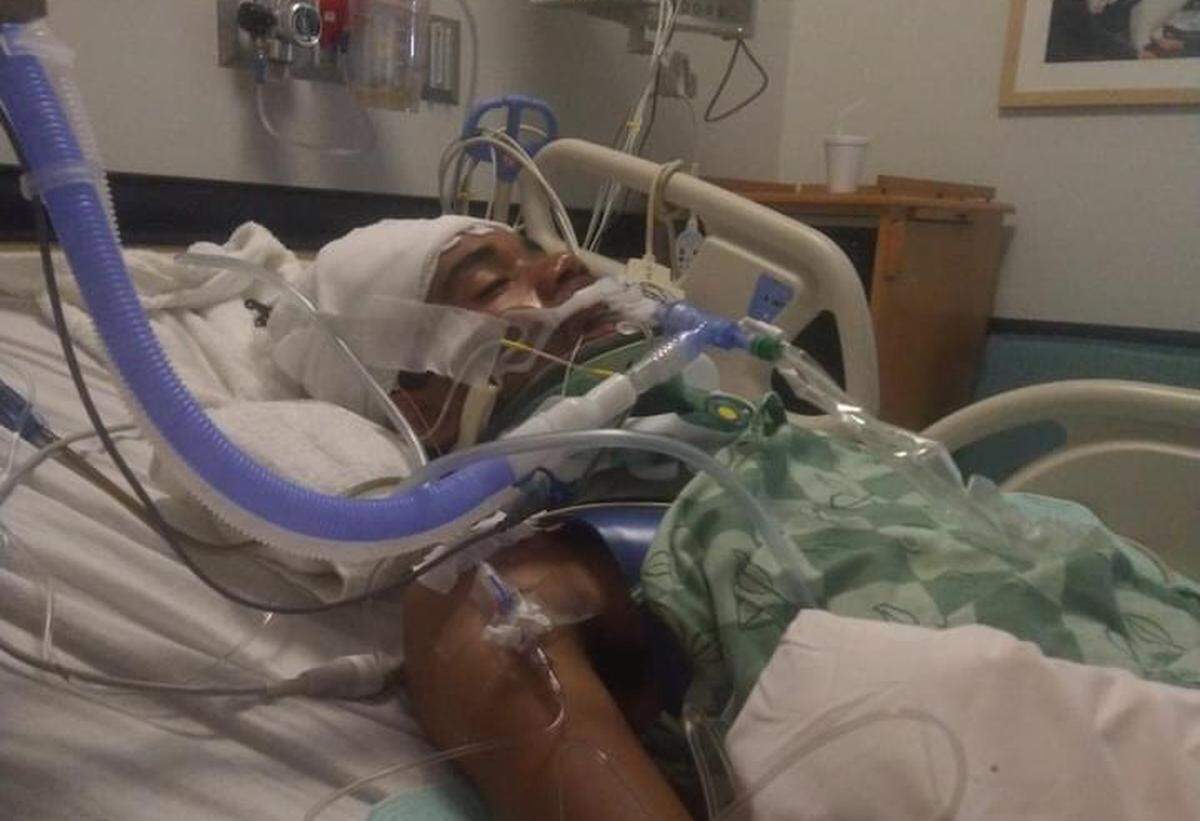
Teetz said when he finally got to see his brother after waiting for hours, it looked like Cedric had been beaten to near death.
Initially, he thought Cedric was just in a coma and might recover. But then medical staff told him his brother was brain dead from lack of oxygen and ushered him out of the room after 10 minutes.
He didn’t get to say goodbye before Cedric died after two days in the hospital, he said.
“I’ve had millions of emotions in the span of four years. I didn’t understand grief until this,” he told jurors.
“Even now I feel like a dead man walking.”
Teetz testified that he and Cedric grew up together and had never separated until he became emancipated at 16 and Cedric ended up in foster care at 14 because their mother wasn’t stable.
When they were younger, they had lived in group homes or with relatives and learned to rely on one another for support, he said. They bonded over anime and playground games like basketball, tag and four square.
“No matter where we went, it was always just us two.”
Their eventual separation “was one of the most major adjustments that we ever had to make,” Teetz testified.
But Cedric handled it fairly well, under the circumstances, he said. His brother was an outgoing, outspoken, affectionate, aspiring musician who used comedy to help him cope with tough situations, Teetz recalled.
“We laughed about our pain, often made jokes about it,” he said.
Cedric would also sing and rap to himself to get through.
“He got so good that he would just find a beat and record over the phone,” Teetz said.
Teetz testified that Cedric seemed to be doing well in his Wichita foster home. His grades in school were improving and he spoke highly of his foster father.
“I was ultimately proud of him. I feel like he beat the odds up until that moment,” he said.
Teetz said he still feels depressed hearing and seeing the way the police and corrections officers interacted with his brother on Sept. 24, 2021.
It’s obvious from the videos that Cedric was in the throes of a mental health crisis, he told jurors.
“I just know I’m traumatized.”
Earlier Wednesday jurors watched pre-recorded video testimony from Cedric’s foster care case manager, Donald Holliday, who talked about the teen’s “easy-going” personality and music career aspirations, and heard from Sedgwick County Chief Medical Examiner Timothy Gorrill, who performed Cedric’s autopsy and determined his cause and manner of death.
Jurors also heard Wednesday from a police practices and corrections consultant, Michael Lyman, who testified that at the time of Cedric’s death, there were national standards within the corrections field that called for immediately handcuffing then rolling over or sitting upright a detainee who had been placed in the prone position.
The five corrections officers who fatally restrained Cedric for 39 minutes testified earlier in the trial that an early effort to handcuff the teen was abandoned because the cuffs were “double locked” and that no one thought to unlock them or use a different pair.
Cedric was eventually handcuffed at the request of police who were on their way to JIAC to take the teen to the hospital but was left face down for several more minutes until the corrections officers noticed he wasn’t breathing, according to testimony.
Court reconvenes on Thursday.
Monday, Jan. 26: More officers, pathologist take the stand
Jurors heard Monday from a third corrections officer who helped restrain Cedric “CJ” Lofton, as well as a Wichita police officer who interacted with the teen before he was taken to the Juvenile Intake and Assessment Center and a forensic pathologist who examined the 17-year-old’s body about a month after he died.
Corrections officer Benito Mendoza took JIAC intake specialist Jason Stepien’s place holding down Cedric’s shackled feet several minutes into the hold so Stepien could call 911 to ask police to return to the facility.
Like the other corrections officers who pinned Cedric to the concrete floor on Sept. 24, 2021, Mendoza testified that the teen was so out of control and combative it prevented them from maintaining secure holds on his body.
Mendoza told jurors he had no idea how long Cedric had been in the prone restraint when his supervisor, Karen Conklin, radioed a “10-19,” a signal for him to come to her location.
But he said Cedric was talking and breathing, responsive and conscious when he arrived.
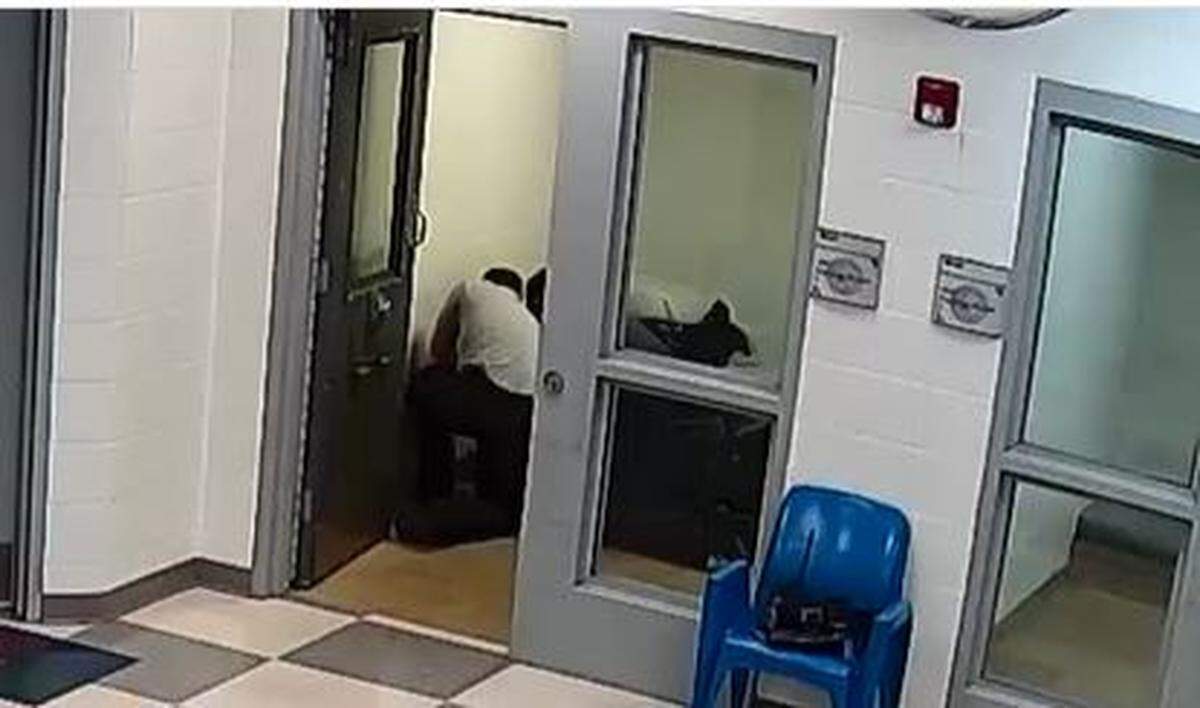
Like the others, he said he never told anyone to sit Cedric upright, didn’t retrieve any handcuffs and didn’t put any of his body weight on the teen or see anyone else doing so — although he told the KBI in a recorded interview played for jurors that Conklin “was kind of laying” on Cedric’s buttocks and upper thigh area. Mendoza later testified that his report of Conklin’s positioning was a “bad description.”
Mendoza was about 5-foot-10, weighs around 190 pounds and had about five years of experience as a corrections officer when Cedric died, he told jurors.
He testified that when he got Conklin’s radio call, he didn’t run to the JIAC lobby because the 10-19 code didn’t indicate an emergency.
He also said at no time did corrections officers have control over Cedric until the teen started making snoring sounds that he thought meant Cedric had fallen asleep — but were actually agonal breathing.
Mendoza testified that at that time he loosened his grip and monitored Cedric in case he awoke and became combative again. Cedric was handcuffed at that time.
He told jurors that before becoming unresponsive, Cedric had struggled and kicked, rolling from side to side and lifting his stomach and chest periodically off the floor, although he acknowledged that none of the officers had been bucked off by the teen’s movements.
He claimed Cedric would only pause long enough to “huff and puff” to build up energy, then “explode again.”
“He wouldn’t stop resisting for very long times,” Mendoza said, making their attempts to deescalate the situation fruitless.
Mendoza said Cedric talked about “weird” things while he was restrained, such as killing them and saying he was Satan or God.
Mendoza said he also heard the teen tell officers to get off of him. But he said they couldn’t risk letting him go in case Cedric hurt himself or them.
He agreed that using restraints on juveniles in the facility was rare and told jurors he had used a “reasonable amount” of force on Cedric, as he had been trained. At least three officers and a supervisor were supposed to participate in a ground restraint, he said he had learned in training. “But it’s safer if it’s more.”
Jurors also heard Monday from Cory Bennett, a Wichita police patrol officer who responded to Cedric’s foster father’s home and helped put the teen in a wrap restraint device when he refused to go to the hospital willingly.
Bennett told jurors Cedric was calm for most of the 50 minutes he and other officers tried to talk him into seeking help voluntarily but showed clear signs of mental distress. Bennett said physically, Cedric appeared to be “a normal teenage boy.”
But he said he needed protection and asked Bennett to point his gun at people in the yard and sky that weren’t there, Bennett said.
Bennett described Cedric as confused, paranoid, sad, emotional, unfocused and unsure but not combative or aggressive until police officers tried forcing him into a police car. He said it took three officers and putting Cedric in a prone restraint for a little more than a minute to get him handcuffed, but at no time did officers lose control over the teen while they were in his front yard.
Police put Cedric in the wrap restraint device after that and took him to JIAC instead of the hospital. They returned to JIAC after Stepien’s 911 calls.
Dr. Jane Turner, a forensic pathologist, testified that nothing Wichita police officers did before taking Cedric to JIAC caused a series of prominent, severe hemorrhages she discovered in the muscles covering his back when she examined his body about a month after his autopsy.
She told jurors internal bleeding like that was most commonly caused by blunt trauma and that the prone restraint corrections officers used on Cedric “was of significant force to cause those hemorrhages.”
She agreed with autopsy findings that Cedric died from cardiac arrest during the prone restraint and that his death was a homicide. She also told jurors that during her examination, she found no broken fingernails or injuries on Cedric’s hands that “would be consisted with being an aggressor.”
Testimony continues Tuesday.
Friday, Jan. 23: Cardiologist, corrections professional testify about risks of prone restraint
A longtime cardiologist and a retired New York City corrections professional hired by the plaintiffs’ lawyers testified Friday about the risks associated with restraining a person face down — and what the corrections officers who held down Cedric “CJ” Lofton on Sept. 24, 2021, should have done instead.
Alon Steinberg, a California-based medical doctor and cardiologist who has studied hundreds of prone restraint deaths and made recommendations to law enforcement, told jurors that Cedric would still be alive had corrections officers rolled the teen onto his side or sat him upright at any point before he became unresponsive.
Steinberg explained that prone restraints conducted on hard surfaces, such as concrete floors, are dangerous because they restrict a person’s breathing and blood flow.
When those vital functions are restricted, especially after a struggle, a person’s bodily fluids can become too acidic, causing a Ph imbalance that can have a life-threatening impact on the heart and other organs, he testified.
Steinberg told jurors that Cedric’s medical records from Wesley Medical Center, the hospital where he was taken after being restrained face down on a concrete floor for 39 minutes, showed the teen was suffering from metabolic acidosis, an excess of acid in the body.
Steinberg explained that when a person’s acid levels increase through exertion, such as exercise or a struggle, the lungs and blood work to expel excess carbon dioxide by adjusting the speed of breathing and circulation. That process can return a person’s Ph to more normal levels within minutes, he said.
But when breathing and blood flow are restricted, the body can’t get rid of carbon dioxide fast enough.
And that can impact heart function and lead to sudden death, he testified.
Steinberg told jurors that Cedric’s body likely became overly acidic during his struggle with corrections officers a few minutes before they placed him face down on the ground.
Being restrained on the concrete by four strong and heavy adults worsened the condition because Cedric’s lungs and diaphragm couldn’t expand enough and a vital vein in his belly was compressed, he testified.
Steinberg told jurors that people held in a prone restraint can die from metabolic acidosis quickly — within a minute in some cases — and that the chance of death increases the longer a person is in that position.
Cedric had a normal, healthy heart for a 17-year-old boy and had no pre-existing medical issues that would have been concerning for sudden death, Steinberg said.
The corrections officers caused his death, he told jurors.
“He needed the ventilation and cardiac output. He wasn’t able to get it because he was in this position,” he said.
Steinberg told jurors the length of Cedric’s prone restraint was a record, at 39 minutes. Before this case, the longest he had seen was 18 minutes, he said.
Under cross-examination, Steinberg acknowledged that people lie face down in the prone position every day in bed without risking death but said the difference is that beds are soft so they don’t restrict breathing and blood flow like a concrete floor does.
He also said that Cedric likely didn’t fully understand what was happening when the correction officers restrained him because of his mental state and that he probably struggled against them because his body was telling him that he needed to breathe.
When corrections professional Jerome Davis took the witness stand, he also said that the prone position is dangerous because it restricts a person’s ability to breathe.
Davis spent 30 years working with adult and juvenile inmates at the department of corrections in New York City, one of the country’s largest, until his 2011 retirement as supervising warden. He also spent time serving as deputy commissioner of the city’s juvenile justice department, where he was responsible for day-to-day facility operations, and also oversaw use of force investigations. He now teaches criminal justice courses at a community college.
Davis testified that the dangers of prone restraints have been known for more than 25 years and that an adult should never put their weight on a child’s back because of the impact it has on their ability to breathe.
He said there is “absolutely not” a reason to keep a person in a prone restraint for a prolonged period of time nor is there a reason to do it after a person is handcuffed.
Davis testified that in his decades working in corrections, he never had a situation where he couldn’t successfully handcuff a person who was prone.
The reason to put a person in that position is to make applying handcuffs easier, he told jurors.
Once a person is face down, putting on handcuffs “should take no more than a minute,” he said.
After that, “you get them up and get them out.”
The trial continues Monday.
Thursday, Jan. 22: Officers testify that they feared for lives during 39-minute restraint
Brenton Newby took the witness stand again Thursday morning to continue his testimony. Again, he insisted that Cedric was so combative that corrections officers never gained enough control over him to end the restraint.
He feared for his life the entire time, he testified.
He told jurors he had been trained to maintain holds on juveniles “until they calmed down” and to “wait it out until the youth is ready to comply.”
But he said he never leaned or put his body weight on Cedric’s back or shoulders as he held down the teen’s left arm and instead supported his weight on the floor or wall. The lawyer questioning him, Brian Eldridge, suggested that claim didn’t match what the JIAC video showed.
Newby testified that when he heard a snoring sound coming from Cedric more than 30 minutes into the restraint, he wasn’t concerned because the teen “was still being combative and trying to fight.”
He told jurors he had never heard the term “agonal breathing,” a type of life-threatening gasping- or snoring-like breathing pattern that happens during cardiac arrest and other medical emergencies.
Asked if Cedric was lifeless when corrections officers rolled his handcuffed and shackled body over, Newby said he didn’t know. He also said he didn’t provide any aid to the teen when one of the other corrections officers started chest compressions.
When he was cross-examined by his lawyer, Newby said restraining juveniles at the facility was maybe a monthly occurrence on the day shift but was “not very common at all” at night. He said corrections staff used a variety of techniques to get youth to comply with orders, including talking, before taking physical steps.
He referred to physically restraining a youth as “going hands on” and “going downtown” and testified that physical restraints ranged from a gentle guiding or escorting to putting a youth on the floor if they were being combative. Ground restraints were used when other avenues hadn’t worked, he said.
He testified that he had used ground restraints at the juvenile detention facility “no more than five or six” times during the two years he worked there and that they sometimes lasted up to 10 minutes or longer. He told jurors youth would usually let him know when they were ready to cooperate and that’s what would end the restraint.
He testified that he only used the force needed on Cedric “to try to be able to . . . have my hold secured” and never released it because “I didn’t know what else could possibly happen.” He also said that Cedric never told him that he couldn’t breathe.
Also taking the witness stand Thursday was Jason Stepien, the juvenile intake specialist at JIAC who was responsible for determining whether the facility could accept Cedric or if he needed to be seen at a hospital first.
Stepien told jurors that when Cedric was brought into JIAC, Wichita police had described the teen as combative, aggressive and extremely strong. But he said he had no reason to think that Cedric was suffering from a mental health crisis at that time and relied on police officers’ assessment about the teen’s physical and mental state.
Stepien told jurors he didn’t protest when police decided to remove Cedric from a full-body wrap restraint device even though he initially thought the teen wasn’t ready.
He testified that he didn’t question a Wichita police officer who changed his answers from yes to no on a release form that asked whether Cedric had an illness, impairment or injuries after the officer talked to another officer about how to fill it out. Any yes answers would have required police to take Cedric to the hospital for an evaluation before he could have been left at JIAC, he told jurors.
Stepien said when police were still in the building, he saw Cedric exhibiting some strange behavior but saw no overt signs of mental illness.
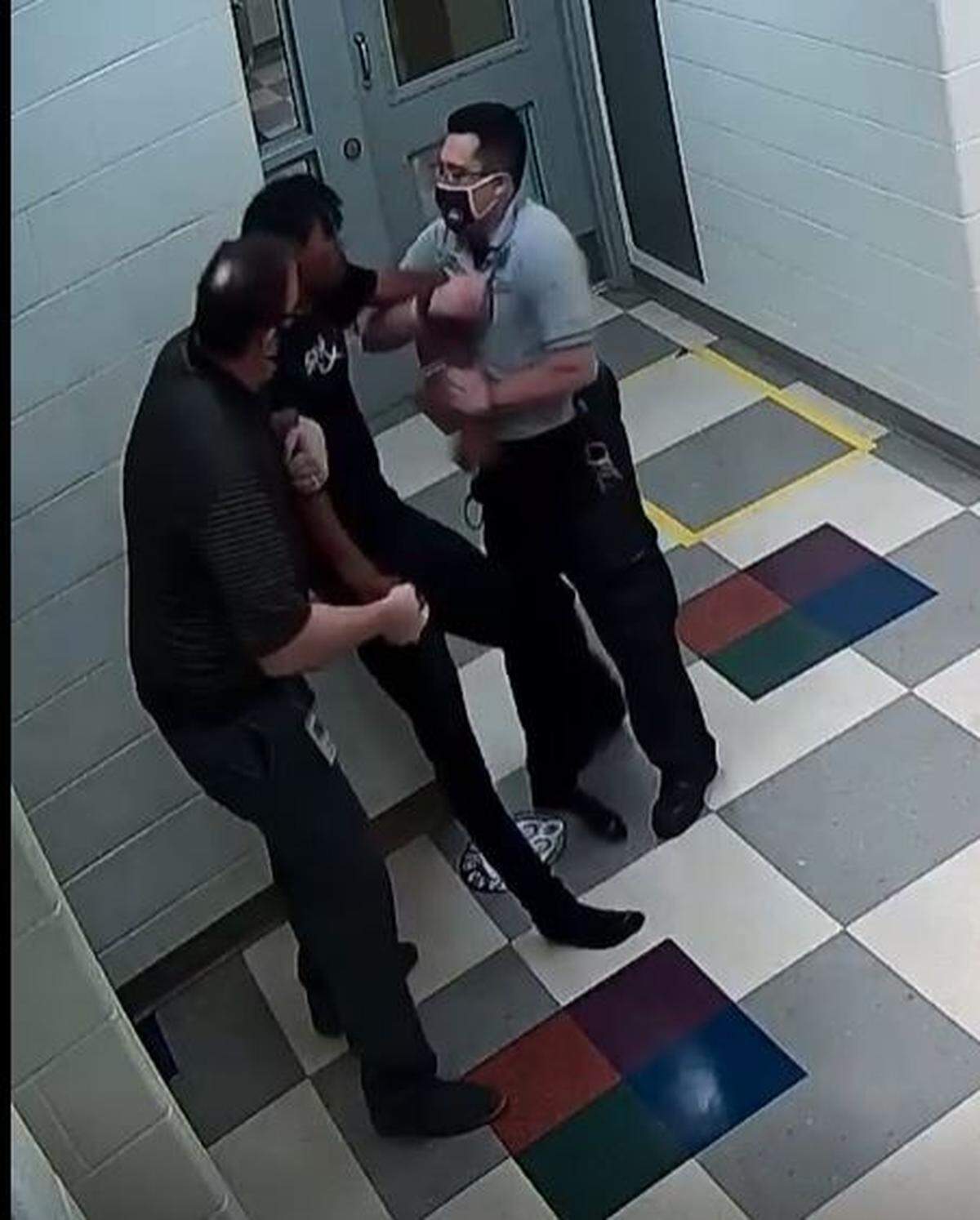
After police left, Stepien let Cedric walk around the JIAC lobby and tried to convince him to participate in the intake process. But Cedric was unreceptive and tried to break a computer monitor, so he told him to return to the holding room, he testified. He and Newby forced Cedric into the room after their interaction became physical, video shows.

He testified that corrections officers didn’t have control of Cedric because “he was still breaking our holds and struggling” and said he “never saw anyone put a forearm or force on Cedric’s back” at any time during the 39-minute restraint. He held Cedric down by the feet after the teen was on the floor, he testified.
He said corrections staff tried to handcuff Cedric early on but abandoned the effort because the cuffs were “doublelocked” and couldn’t be opened without a key. He and others had handcuff keys with them — and some also had other sets of handcuffs — but Stepien said he never thought to use them or ask anyone else for help at any point.
He told jurors that even after Cedric was handcuffed he never told other corrections officers to sit Cedric upright and said he didn’t do it even though he was physically able to because “I don’t think that was the training.”
He was afraid for his life the entire time, he said, including after Cedric was both shackled and handcuffed.
Stepien testified that he didn’t know Cedric’s exact weight — 135 pounds — he helped hold him down but agreed that the teenager was “skinny.” Stepien is 6-foot-3 and weighed 275 pounds at the time.
Stepien’s lawyers did not immediately cross-examine Stepien and will instead question him when they present their case to jurors. That decision was made to ensure court would end early Friday afternoon so jurors didn’t have to drive home in snowy weather.
Wednesday, Jan. 21: Opening statements, first officer takes the stand
Following about a day and a half of jury selection, the court seated its eight-person jury Wednesday morning.
Attorneys then presented their opening statements, where lawyers tell jurors what they think evidence in the case will show.
During his openings, an attorney for the plaintiffs told jurors that the five corrections officers who pinned 17-year-old Cedric face down for 39 minutes “went far beyond what is reasonable” to subdue him.
Cedric was a physically healthy 135-pound teenager when he was brought into the facility that morning, John Marrese said.
By the time he left, he was unconscious, unresponsive and basically dead.
“That young man didn’t get to live. No birthdays, no weddings, no relationships, no children, no job. His life was lost at 17,” Marrese said.
“There is a line between what is reasonable and what is excessive. ... This is not a close call.”
Marrese told jurors that Cedric ended up at JIAC that morning after his foster father called 911 so Wichita police could take him to the hospital for a mental evaluation. Cedric was in the throes of a mental health crisis exacerbated by his grandmother’s recent death and had run away the previous day, he said.
Marrese told jurors that Wichita police tried to convince Cedric to voluntarily go to the hospital but changed course and took him to JIAC after he fought and battered police officers who forced him to comply.
When Cedric was removed from a full-body restraint device police had used to transport him to JIAC, he was calm, walking around and uninjured, Marrese said.
But after a scuffle, corrections staff shackled his ankles and moved him into a prone position on the concrete floor of a holding room for more than a half hour.
Corrections staff “had control” over the teen early on, Marrese told jurors. But instead of handcuffing him and immediately sitting him upright, the five corrections officers “used force and weight to keep Cedric down” until he “goes unconscious underneath the defendants and dies,” he said.
Collectively, the staff members weighed more than 1,000 pounds, he told jurors.
Prone restraints are dangerous and sometimes deadly, he said.
“Every reasonable officer in Kansas and elsewhere knew that at the time.”
In the defendants’ opening statements, lawyer Jeffrey Kuhlman told jurors his clients are “ordinary people” whose day-to-day job involves acting more like counselors than corrections officers. They’re not law enforcement officers, he said.
Restraining youth in the facility was rare, Kuhlman told jurors. But the morning police brought Cedric into JIAC, staff “dealt with something extraordinary,” he said.
Cedric was so “aggressive, strong and combative” that the corrections officers never gained control over him, even after he was on the ground, he said. The teen’s fighting was like nothing they had encountered before and the officers couldn’t let go because the teen never tired, he said.
At the time Cedric was restrained, Kuhlman said his clients weren’t familiar with the term “prone restraint” — they called it a “ground restraint” or “safe hold” — and were trained to use multiple staff members to conduct it for safety. But no one put their body weight on Cedric’s back or shoulders at any point, he said, contrary to claims.
He told jurors that even though video footage typically answers questions in cases alleging excessive force, here only the defendants know exactly what happened with Cedric because there is no close-up recording. The video footage that exists was shot from across the facility’s lobby and has no audio.
“Make no mistake, this is a tragedy,” Kuhlman said.
But the question is not whether Cedric’s death was tragic or whether the corrections’ officers use of force was the best course of action he said; jurors must decide whether the restraint used on Cedric was lawful.
“They weren’t trying to take anybody’s life. All they were trying to do was keep everyone, including Cedric, safe.”
After opening statements, the first of the five corrections officers who restrained Cedric took the witness stand.
For half a day, an attorney for the plaintiffs, Brian Eldridge, questioned Brenton Newby about his interactions with Cedric while playing a series of video clips of the restraint for jurors.
Newby testified that he and other corrections officers were never able to gain control over Cedric because the teen “was constantly fighting” for the entire 39 minutes he was pinned, even though video shown in court appears to contradict that claim.
He insisted he never put his body weight on Cedric’s shoulders or back, despite Wichita police body camera video that show him telling an officer that he had. Asked about the contradiction, Newby told jurors he hadn’t explained himself well to the officer that night. In a later law enforcement interview, he also denied applying weight, he said.
Newby testified that he was taught not to apply weight to someone’s back but said he might not have known that it could compromise person’s ability to breathe.
Newby was working his last shift as a senior corrections officer at the Juvenile Detention Facility, which is adjacent to the Juvenile Intake and Assessment Center, when Wichita police brought Cedric into the building on Sept. 24, 2021. He said he saw Cedric walking around the lobby after JIAC staff member Jason Stepien let Cedric out of a holding room.
He testified that he tried convincing Cedric to participate in the intake process after Stepien’s attempts failed.
Newby testified that Stepien told Cedric to return to a holding room after he reached over a partition and that they forced Cedric into the room and shackled his legs after Cedric punched Stepien’s head and held Newby in a chokehold.
Newby said that after Cedric was moved to the floor, he pinned down Cedric’s left arm, while Stepien, William Buckner, Karen Conklin and Benito Mendoza held other parts of his body.
At the time, Newby weighed between 160 and 170 pounds and was a longtime athlete who had played soccer in high school and college, he testified. He also had worked as a corrections officer at the maximum-security prison in El Dorado.
At times, Newby seemed confused, claimed no recollection or gave evasive answers when Eldridge asked specifics about his encounter with Cedric, including who shackled the teen legs, who decided to move him to the floor, and how long he laid on his chest and stomach.
Asked why corrections staff didn’t handcuff Cedric immediately after applying the leg shackles, Newby said they were “trying to deescalate him” and that they’d been trained to use handcuffs on a youth only as a last resort.
He insisted repeatedly that Cedric “was constantly fighting” and “breaking free of the holds,” preventing their efforts.
Asked how much time elapsed before Cedric became unresponsive, Newby replied: “I’m not sure. There was no clock in there.”
When the lawyer asked Newby if he knew Cedric’s heart had stopped beating, Newby said he didn’t know.
Didn’t you check his pulse?
“I did at one point, yes.”
And you didn’t find a pulse?
“That I don’t remember,” he replied.
Newby claimed he received some bruises on his side and back from Cedric pinching and grabbing at him but said he never told law enforcement about them.
He did have redness on his right elbow that was photographed and shown to jurors.
He was given a Band-Aid to treat it, he testified.
Newby’s testimony continues Wednesday.
Tuesday, Jan. 20: Judge, lawyers question prospective jurors about backgrounds, biases
Court opened Tuesday morning with jury selection. The pool of prospective jurors included dozens of residents of Wichita and other areas in Kansas, 18 and older, with a wide range of professional, educational and familial backgrounds. Lawyers and the judge spent the day questioning them extensively about their lives, work, education, family and biases to determine whether they could be impartial jurors in the case.
U.S. District Judge Eric Melgren quickly eliminated several people who were college students at risk of missing too much class, caregivers for children or the elderly and those with medical or transportation difficulties that might make a three-week commitment a hardship. People who were already familiar with the case or who had strong ties to law enforcement or correction officers were also dismissed.
Several other jurors were eliminated after expressing strong opinions about the use of restraints or police.
Those who said they didn’t think they could be objective were also let go.
Of those that remained, the judge told lawyers the court would ask about 22 people to return Wednesday morning. From that group, the final panel would be chosen.
Civil trials in federal court are tried before an eight-person jury, instead of the 12 customarily seen in criminal trials
This story was originally published January 27, 2026 at 10:16 PM.