
Police are targeting gun crime hot spots in Wichita. Here’s where and how
AI-generated summary reviewed by our newsroom.
- Wichita police use data-driven modeling to identify gun crime hot spots in the city.
- Preliminary data shows a 43% gun crime drop in Patrol East using RTM software.
- Police aim to foster community engagement and cross-agency collaboration.
In part of east Wichita, a gun crime was 9.4 times more likely to happen at or within 300 feet of a gas station. It was 5.2 times more likely within 300 feet of a bar and 3.6 times more likely within 300 feet of a phone store.
That’s what Wichita police learned from one of the department’s latest strategies to curb gun violence, the risk terrain modeling program.
Risk terrain modeling software, from a company called Simsi, looks at the underlying factors of an area that might lead people to go there to commit crime. Wichita police are focusing on gun crime now.
“What they are designed to do is to make sure that we are focusing not on what we think, but what the data says,” Wichita Police Chief Joe Sullivan said at an Aug. 19 District 1 Advisory Board town hall, speaking about risk terrain modeling and another program.
Gun crime data from Aug. 14, 2024, to Feb. 20 this year helped show police hot spots to target in one area in each of its four bureaus: patrol north, south, east and west. The software used publicly available data and data entered by crime analysts to show what types of buildings, such as gas stations or bars or abandoned buildings, most correlate with gun crimes in each of those areas.
“Risk terrain modeling itself looks at, first, what are the commonalities behind this area that has high crime,” police Capt. Aaron Moses said. “Now, we look at what are the risk factors in that area that may be driving that — hotels, motels, in one community they identified there’s a bus stop that’s connected to this crime.”
The $12,000-a-year software didn’t reveal anything unknown to the police department, crime analyst supervisor Geoffrey Vail said in April. But it allows the department to show data about why that crime might be happening.
“So it’s not just community members or officers saying that something is bad in this area, it’s the data, and it’s actually being able to attribute a number to how bad something potentially is, or how bad it has been recently,” Vail said. “It allows us to get more buy-in from other partners that maybe we wouldn’t have received buy-in from.”
Risk terrain management is “not a silver bullet for anything,” Vail said. ”It’s just a diagnostic tool.”
So far, the effort seems to be working. Although the department is waiting for data analysis from Wichita State University, Moses said, “the preliminary data is encouraging and does show statistically significant decreases in gun crime in the Patrol East RTM area.”
He said police saw a 42.9% decrease in gun crime compared to 2024, a 22.6% decrease compared to the five-year average and a 49.2% decrease compared to the forecasted rate based on past years.
‘They want crime to go down as well’
Since April, police have worked with city agencies, community members and businesses in those crime hot spots to try to address the problems identified by the software. They say the effort won’t be used to push out businesses but to work alongside them. Police are doing foot patrols, handing out fliers and documenting lights that are out and working with Evergy to get them fixed.
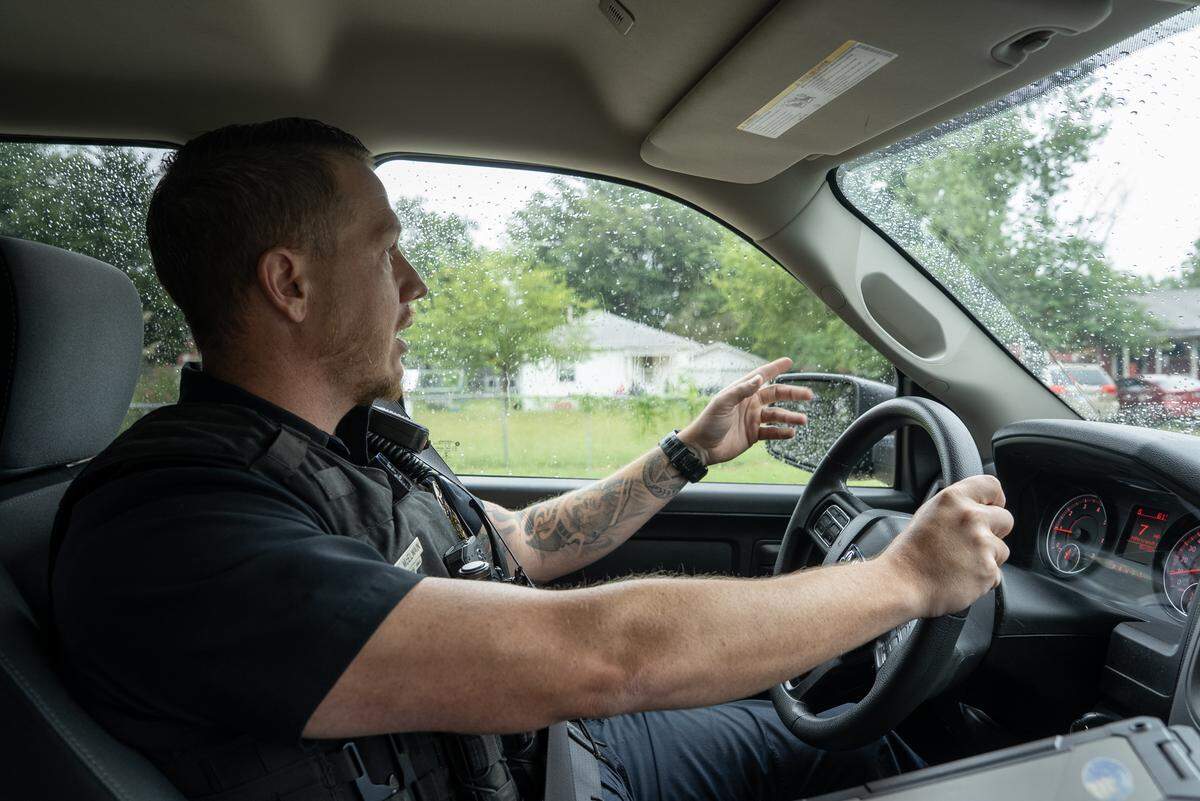
In August, officer Blake McElwain drove through the patrol east RTM area with an Eagle photographer.
“Our biggest asset is the people who live in this community,” he said. “Because I don’t live in this neighborhood, so I’m not here 24/7 like the constituents of this neighborhood are, so they’re constantly seeing things that are going on. And 99% of the people in this neighborhood, they want crime to go down as well.
Jerry McGrew, a District 3 Advisory Board member, heard an east bureau police presentation on the program on April 2. He told The Eagle then that he was happy police were going to give extra attention to the district’s hot zone, which is shaped like an “r” and runs from Morris south to Harry and from Bluffview (which turns into Broadview) east to Oliver. It then goes north to Lincoln and then goes east to Edgemoor. The area includes the Hilltop neighborhood.
That area saw 18 gun-related violent crimes from Aug. 14 to Feb. 20. It is about 1% of the 42 square miles in patrol east, but gun crime was 717% more likely to happen there than in the rest of patrol east, police said.
“I appreciate the presence,” McGrew said. “My comment to them is one they’re already aware of. If you’re in the area, just stop in front of anyone’s house, turn your lights on, which they said they’re going to do, and just have their presence seen. When they’re here and people see them, the elements seem to move on.”
The presentation in District 3 was more detailed than one in council District 1 on April 7. That district falls mostly under the north bureau. Joseph Shepard, a District 1 board member who is running for City Council, said that while data aggregation and analysis are valuable for predicting and identifying crime hot spots, strategies must be tailored and methodical to reduce the risk of over-policing.
“What I don’t want to happen is that we allow this technology to put out data that is going to maybe increase policing in those communities that already are struggling with having a sense of trust in the police,” he told The Eagle.
He said ensuring there are continued conversations between law enforcement and the public will be essential to achieving safety while honoring transparency.
“I don’t have any concerns as of now,” Shepard said. “... (But) our community clearly has an appetite to learn more about a lot of the technology that is being utilized by law enforcement.”
In patrol north, the focus area goes from 15th Street on the north to 12th on the south and from Madison on the west to around Vassar on the east.
“Everything that I just talked about really isn’t groundbreaking,” Capt. Travis Rakestraw told the District 1 Advisory Board in April. “It’s traditional policing, leaning heavily on community policing and building those relationships within the neighborhoods.”
Patrol west’s focus area is an L-shape, going from 3rd to around Maple from north to south and Millwood to Seneca from west to east. Seneca goes down to Texas before cutting over to Sycamore.
In patrol south, RTM is being used in an area from Lewis on the north to Lincoln on the south and from Main on the west to Saint Francis on the east. It includes part of south Broadway.
Lewis Street Glass falls close to the western border of the targeted area in patrol south. It is south of Kellogg and a little more than a block west of Broadway.
Office manager Jani Byers said in July that they don’t have any problems operating their business. Most of the problems in the area happen at night and farther to the east.
Still, Byers said, she has noticed more police presence lately.
‘It’s not a lot, but it’s enough to know they’re there. Whatever they’re doing, they are doing a good job,” she said, adding the extra patrol is “definitely appreciated.”
Concerns about the technology
Nationally, as well as in Wichita, this type of technology is met with both eager anticipation to reduce crime and concerns about it leading to overpolicing.
Over three months, risk terrain modeling dropped motor vehicle thefts by 33% in a targeted area of Colorado Springs, gun violence by 35% in a targeted area of Newark, New Jersey, and robberies by 42% in a targeted area of Glendale, Arizona, according to a 2015 study by the Rutgers Center for Public Security. All the surveys were conducted in 2013 or 2014. Two of the authors of the study are founders of RTM. The other two cities in the study, Chicago and Kansas City, Missouri, either weren’t able to collect good data or had a result that wasn’t statistically significant enough to be valid.
Another study done over a year in Kansas City, Missouri, between March 2019 and March 2020, showed a 23% reduction in violent crime. The study’s authors also included the founders of RTM.
In Atlantic City, RTM is credited with dropping homicides and shooting injuries 26% in 2017 compared to with the year before and robberies by 37% in that same time.
“We like that philosophy (of RTM) and we think that goes along well with our community policing policy,” Atlantic City police chief James Sarkos said on riskterrainmodeling.com. “Not to target people because they’re in a specific location, but to target that location itself.”
Critics of such programs say it justifies over-policing certain areas because police staked out in one area are more likely to see crime that will reinforce the data.
“This is a mathematical way of justifying a type of policing in certain people and neighborhoods that police have already wanted to surveil,” said Matthew Guariglia, a senior policy analyst at civil liberties and data security organization Electronic Frontier Foundation.
ACLU staff attorney Kunyu Ching said the idea of surveilling neighborhoods will be self-reinforcing.
“Well, we are spending all of our time policing this one area,” she said. “We see a lot more problems in this area and if you are in that area, then you are more likely to offend just by virtue of living there or working there.”
Police say RTM “is place based, not person focused. Less susceptible to bias and it promotes positive engagements with communities,” according to slides WPD showed during presentations at town halls in 2024.
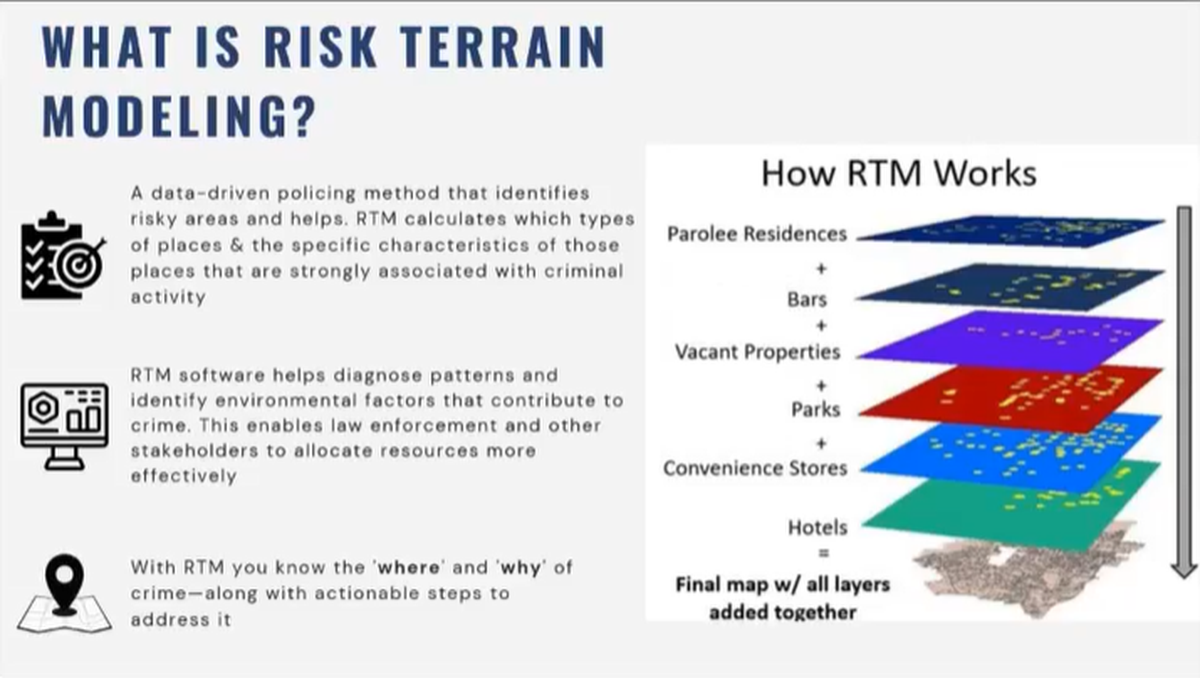
During the District 3 advisory board meeting, a slide about how RTM works included different layers that would be added together, and overlaid with crime, to show different factors within a hot spot. It included parolee residences, which would be using people, not just places.
“That’s just a graphic that we used from multiple years ago, and we just never took that out,” Vail said. “But when it comes to parolee addresses, probation addresses, anything like that, like none of that’s put into the model.”
A report in the Florida Law Review says place-based policing is less controversial than people-based policing. “It appears that place-based programs tend to be more accurate, less controversial, and carry slightly less risk of racial discrimination claims than their person-based counterparts,” the January 2023 article says.
“It is one thing to patrol high-crime-targeted areas frequently; however, it is another thing entirely to conduct frequent visits with a high-crime targeted person. But even place-based predictions carry risks associated with discrimination.”
What comes next for RTM in Wichita?
At the District 1 Citizens Advisory Board town hall earlier in August, Moses said the department has seen “strong engagement and acceptance” by field officers as well as those in other city departments.
Police expect to receive data analysis on the first several months from WSU by the end of September. They also have begun running new models to determine if the RTM focus areas need to change.
Moses said the only difficulty so far has been assigning officers from an understaffed department to spend more time in the risk terrain focus areas.
“The biggest thing, like Chief (Joe Sullivan) said, the way our team works is it generates calls for service for officers to go out to specific areas at specific times,” Moses said. “It doesn’t work if we don’t have officers available at that time to go, so that’s one of our biggest hurdles when it comes to RTM.”
Capt. Chad Beard, who is over the east bureau, told the District 3 Advisory Board at the April 2 meeting that “this isn’t just an enforcement, take everyone to jail.”
Beard said he is “really hopeful” to see a reduction in gun violence. He assured the advisory board this isn’t a one-time deal, but will be a continuing and refining effort that will be tinkered with and moved to other locations in the bureau.
“We know (RTM) works. It’s based on data,” he told the board. “Hilltop is very large. It does have its issues. It has ongoing problems that have always been there, but we are going to make a really good effort, in my opinion, and I got the officers excited about it.”
Contributing: Allison Campbell and Jaime Green of The Eagle
This story was originally published August 29, 2025 at 1:05 PM.