
Wichita deputy police chief: Previous admin’s gunshot detection program ‘was a joke’
Wichita police recently announced it will adopt gunshot sensors and put them in areas with a high number of shootings. This won’t be the first time the largest police department in Kansas has used the technology.
The previous time was funded with $100,000 in federal dollars but ended with little to show.
When WPD and city officials announced a pilot gunshot detection program in December 2018, it was touted as a way to lower violence and ensure police response to all shootings – including those not reported to 911.
While several major cities were using Shotspotter for gunshot detection, city and police officials chose to go with a California-based associate professor and entrepreneur.
City and police officials said the one they chose would be much more affordable — about a third of Shotspotter’s price.
The plan was to one day expand the program across Wichita.
But it ended after four years, having never helped in an investigation or led to an arrest. During the time it operated, Wichita experienced a record number of homicides, mostly from gun violence. The city spent about $100,000 in federal money on the effort and at least $18,000 in staff time.
“That was a joke,” Paul Duff, who became a deputy chief in April 2023, said about the pilot program during a police town hall meeting in June attended by WPD leadership and about 25 community members to introduce a different gunshot detection system it has been testing since 2022.
“Nobody here had anything to do with that — but we are not in the business of repeating mistakes.”
The pilot program ran from January 2019 to March 2023 and was an initiative under former Police Chief Gordon Ramsay.
The failures of the program have not been widely known. Many details of those failures only came out during two different meetings, one in early 2023 and another in June.
Here are the details:
The police department abandoned the program between late summer 2022 and early 2023. The city’s technology department then carried the torch until the California-based developer told them he was calling it quits in March 2023.
City officials said the data from the program could be used by someone else, but it doesn’t appear to be any good. None of the 400-plus alerts police responded to were verified gunshots, which were needed for the system’s machine learning to flourish.
Unverified shots and technology struggles
The program had one technological struggle after another.
In its grant application, the WPD said it “initially looked at a form of technology called ShotSpotter,” a well-established gunshot sensor company, but decided against it because of the “hefty price tag.”
ShotSpotter uses analysts to verify when its sensors detect a potential gunshot.
Wichita officials said the pilot program would rely solely on machine learning, making it about a third the price of ShotSpotter, which costs between $65,000 to $90,000 a year per square mile.
Verified gunshots would allow the program to learn.
But with the sensors in the pilot program, there are no records showing that any of the reports were verified, according to the data from 417 alerts The Eagle obtained in an open records request from Sedgwick County Emergency Communications.
Emergency communications director Elora Forshee said police may have updated the data in a document kept in-house. However, city and police officials said they don’t have any documents with that data.
Jason Isaacs, a California State University Channel Islands associate professor who developed the sensors, did not respond to multiple requests for comment.
Launching the program
During a Dec. 7, 2018, news conference, the city and police department said the gunshot detection program would launch the following week.
Three phases, each with improved technology, would launch by the end of 2019 — though the third phase didn’t end up launching until summer 2022.
“Usually these types of projects are on the east or west coast, in larger cities, so to have this actually in Wichita is a big deal,” Wichita Chief Information Officer Mike Mayta said during the news conference.
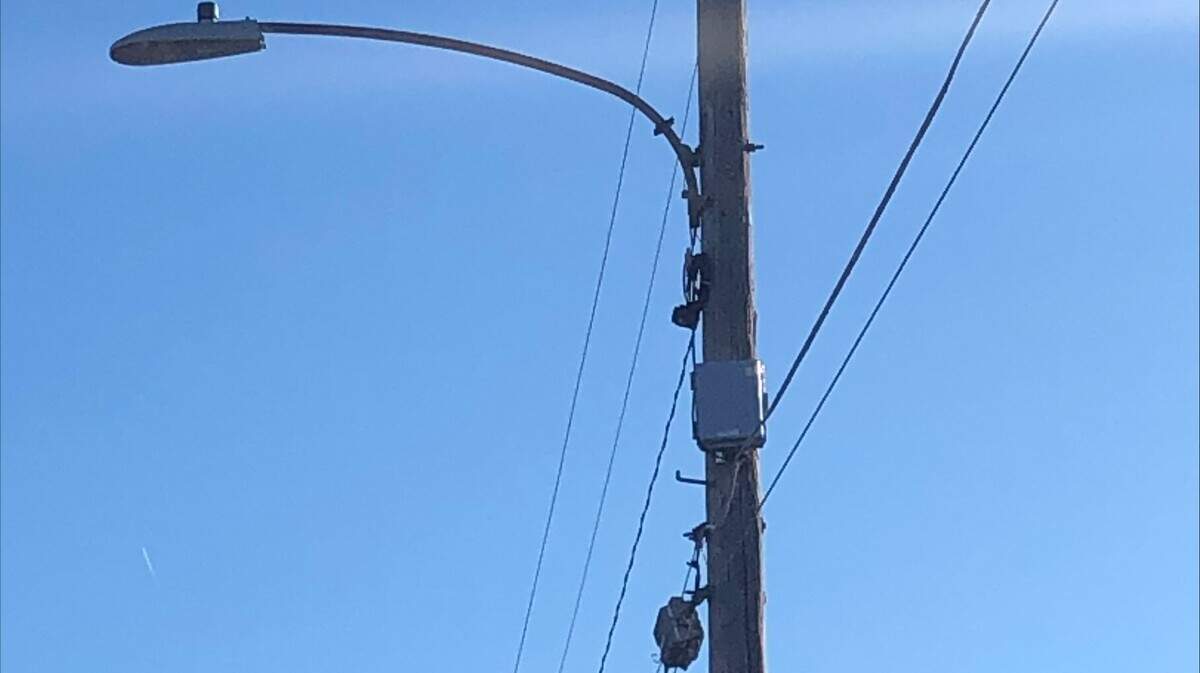
The sensors, placed on utility poles around a square mile, were expected to narrow down a gunshot to a small area — the more sensors that detect the shot, the smaller the area that could be zeroed in on.
Officials cited a Brookings Institution study, which looked at data in Washington, D.C., between 2011 and 2013, that showed only around one-fifth of gunshots were reported to 911.
The sensors were intended to notify police about shootings that weren’t reported.
Wichita’s pilot program recorded one second at a time.
The recording would be deleted if it didn’t detect a gunshot. If it did, it would communicate with the other area sensors to coordinate a location and alert 911, according to Wichita Smart City Coordinator Michael Barnett.
A detection would be recorded and kept for 30 days under a military-grade encryption, Barnett said, adding humans never had access to the recorded data.
Part of the federal grant required the city to submit regular reports about the progress of the pilot program. When The Eagle filed an open records request for copies of the reports to see how the money was spent, the city responded that it would charge $840 to provide them. The Eagle declined.
Phases of the gunshot technology in Wichita
The first phase of 20 to 25 sensors went up in January 2019 in the Hilltop area, from Kellogg to Harry and from Bluff to Oliver.
The first gunshot wasn’t reported until Oct. 15, 2019, data shows – at 11:32 p.m. in the 500 block of South Yale. A police officer reported that it was a false detection, the data shows.
One of the problems was that the sensors were not able to communicate with each other. The city tried to use an open frequency, instead of paying to use a network.
“If they’re not talking to each other, the rest of it doesn’t matter right, you can’t triangulate,” Mayta told The Eagle.
Nearly a year into the pilot program, the sensors were reconfigured and connected through a network that cost about $8 a month.
The sensors started working better, Mayta said, but there was still the problem of getting verified gunshots.
Then COVID hit.
“We kind of, I don’t say we had two years of we didn’t worry about it, but we were doing a lot of other things, like making sure people could work from home,” Mayta said.
Phase two launched in August 2020. Sensors went up between Ninth and 17th streets and I-135 and Hillside.
“There were still a lot of issues,” police Capt. Ronald Hunt told the Citizen’s Review Board during a February 2023 meeting. “It wasn’t working properly.”
“Almost immediately,” only 18 of the 26 sensors were working, he said.
It’s harder for the system to zero in on a location when that happens.
Still, the system was reporting possible gunshots. But those didn’t make any sense, Hunt said.
Hunt said Isaacs, who developed the system, once sent data showing gunshots 1 mile and another 2.5 miles outside of where the sensors were. The sensors are supposed to pick up gunshots within the square mile.
“Not a lot of great data was being recorded,” he said.
Hunt also said the developer was not responsive.
A breakthrough in Cowtown?
Hunt, who took over the program after the July 2021 death of Capt. Clay Germany, told the CRB he didn’t know if the sensors were bought or leased or who they belonged to now that the department abandoned the program.
When Hunt spoke during the Citizen Review Board meeting, one member said the sensors probably belong to the city.
“Well if they are, it’s probably junk,” former board member Jay Fowler said.
Even though the city stepped away from the program in March 2023, alerts were still going to 911 until June 2023 when the sensors were turned off.
After explaining to the CRB all the problems they had through phase two, Hunt went on to talk about phase three.
The city partnered with Groover Labs to retrofit the sensors from phase one. Those sensors were moved to Cowtown in summer 2022, where alerts picked up by the sensor could be cross-referenced with reenactments.
“In terms of a lab … I don’t know why we didn’t think of this before, we just didn’t, but (Cowtown) provided us with all the opportunities that we need for that computer learning to happen,” Mayta told The Eagle in February 2023. “It really is going to jump that model to make it happen quicker than we could ever do in a live environment.”
The city got three months of data before the developer said in March 2023 that he was stepping away.
Tweaking the sensors’ algorithm
Barnett said the sensors in Cowtown had to be recalibrated for blanks since they made a different sound than a real gun.
“We had to tweak the algorithm, which then brought questions: if we are tweaking the algorithm is that still an accurate test for a live (environment)?” Barnett said.
Still, Barnett said, “I think there is value in the data collected for a motivated firm to use if they wanted to, to be able to refine the algorithm and maybe come up with a better system.
“It’s not what we hoped. We wanted a fully functional system, but that’s not what the grant was for.”
In the grant application, police said “we hope that the technology works perfectly and we can phase it out throughout the entire (city),” but they also noted that “technology does not come without its issues” and the”sensors may need to be refined and worked on.”
Evergy took down the last of the sensors mounted on its poles in the third quarter of last year, Barnett said. They were then recycled.
The cost
According to an eight-page draft contract, the city or the WPD could have requested for Isaacs, the associate professor who developed the sensors, to pay back the federal dollars spent.
Different refund levels would be available depending on how accurate the sensors were, according to the draft contract with Isaacs’ company, Hueneme Technologies.
But that contract was never finalized and signed, according to documents viewed by The Eagle.
The final contract with Isaacs is a purchase order. The one-page document looks like a receipt. The only signature on it is from city purchasing manager Melinda Walker, according to documents viewed by The Eagle.
Isaacs was given the contract without it ever going out to bid.
The city or police department has not requested any refund, the city said.
Mayta said the cost is minimal when considering the potential that it could have had — a more affordable product that could lower violent crime in Wichita and other cities.
Before the project was abandoned in 2023, city manager Robert Layton told The Eagle about the potential upside:
“We don’t get involved in a lot of beta testing, but when we do it’s because we are looking for lower cost, more effective technology,” Layton said. “You’ve got folks out there that are developing that technology but they have to test it in the field. I don’t know that we’re going to get any financial benefit other than, if it proves to be effective and then goes on the market, we’re all better off from that.”
This story was originally published July 27, 2024 at 4:36 AM.