
Wichita police chief finalists talk plans, transparency, controversies
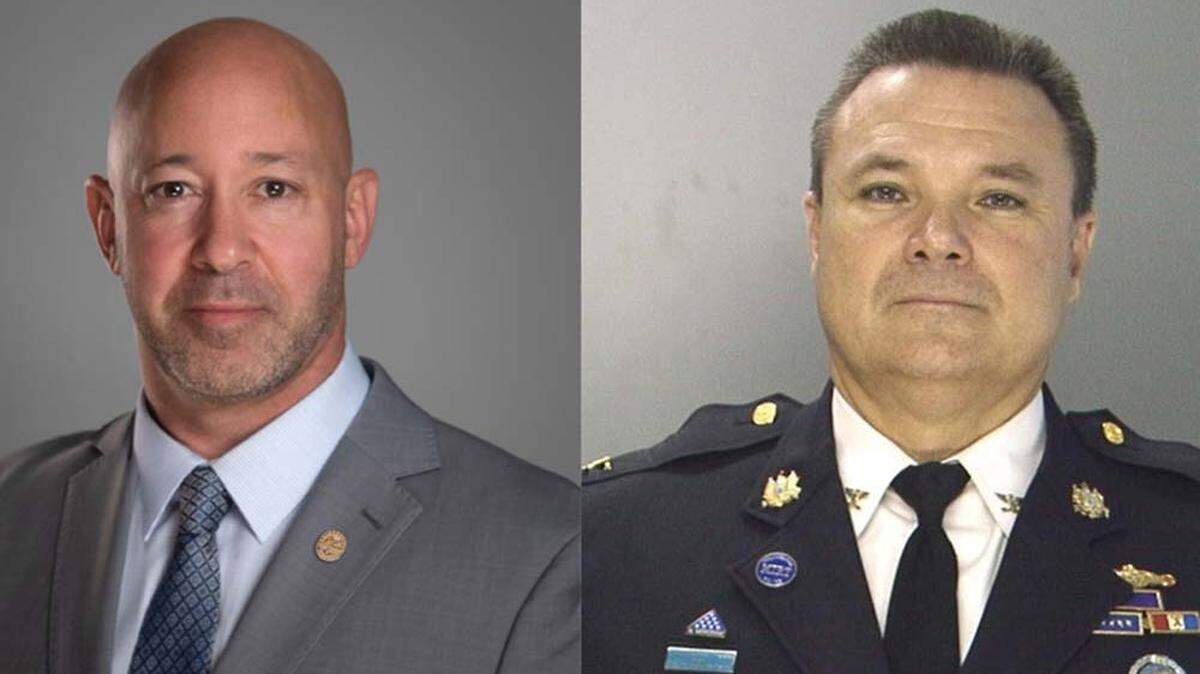
Changing the culture of the Wichita Police Department is a top priority for both candidates for the city’s top law enforcement job. But the two chief finalists have different plans for how to achieve that goal.
The city of Wichita had placed a gag order on the two police chief candidates — Mario R. Knapp and Joseph P. Sullivan — but lifted it the day after an Eagle column criticized the city’s lack of transparency.
In exclusive interviews with The Eagle, the two candidates fielded questions for more than an hour each about their visions for the police department, troubles within the Wichita Police Department, transparency and their own controversies.
Wichita’s next chief of police will take over the state’s largest police department amid accusations of corruption, racism, mismanagement, cover-ups and missing evidence.
Knapp, 48, worked his way from a street cop for the Miami-Dade Police Department to the fifth-highest rank — major — in the eighth-largest police department in the nation. He retired last year after 27 years in law enforcement and worked for WRAP Technologies, a company that produces restraints used by police, for just over a year.
Before Knapp retired, he ran the Special Patrol Bureau, one of the most complex divisions in the Miami-Dade department, which includes everything from criminal investigations, the motor unit, marine patrol to SWAT and the bomb squad. He also trained officers and helped update the department’s use of force policy.
“My pitch is going to be that I want Wichita to embrace a culture of public service by means of public trust,” Knapp said. “The main thing that I want to do is increase relations with the public, fortify that public trust, and that is going to pay dividends all across the board, I think even in the crime reduction field.”
Sullivan, 60, climbed the ranks of the Philadelphia Police Department over 38 years to the second highest rank — deputy commissioner — in the fourth largest police department in the United States. He resigned in 2020 as part of a leadership shake-up and went to work for MES Lawmen, a law enforcement equipment company that produces body armor, uniforms and other tactical gear.
Sullivan joined the Philadelphia Police Department in 1982 at the age of 19. He resigned in early 2020 after he was passed over for the top position. The job went to Danielle Outlaw, the first Black woman to lead the department.
During Sullivan’s 38-year career, he successfully oversaw police response to massive demonstrations — the Occupy Movement and responses to police killings in Ferguson, Missouri, and Baltimore — with minimal violence between protesters and police, a 3-day NFL draft, a visit by the Pope Francis and the 2016 Democratic National Convention.
In Philadelphia, he’s known as a fair, blunt and well-respected law enforcement leader — a “cop’s cop,” as one officer put it during a 2016 award ceremony, where he received the most prestigious honor given each year to a city worker.
“To be quite honest with you, I think overall Wichita has a good police department, but it has some challenges,” Sullivan said. “And I enjoy challenges. I think I’m well suited to tackle some of those challenges that are currently going on.”
The city of Wichita is hosting a public candidate forum at 5:30 p.m. on Tuesday at Botanica’s Lotus Hall, 701 Amidon.
The Eagle has condensed its interviews with the finalists by subject.
Vision for WPD
Both candidates said they want to improve transparency and build public trust in the police department.
But they said some of the specifics would depend on what they find out if they become chief.
Knapp said he would focus on educating the public on what police do and building relationships with different communities and community organizations within Wichita.
Enforcing the law, such as arresting people, is a small slice of the work police officers do, Knapp said. The most time should be spent doing public service such as building relationships withing communities, he said.
“Talk to them about how we approach force incidents and what the options are, educate them, but let them hear it from us,” he said, adding Miami Vice is “not the best representation of what we do.”
Crime levels are directly impacted by the amount of community trust, he said.
“There’s a reciprocal relationship between public trust and every other aspect of policing, and that included crime reduction,” he said.
“Police work right now is — the industry itself is kind of flipped on its head, and rightfully so,” Knapp said. “I feel like I can come back and help lead the recovery effort.”
Sullivan also talked about tapping into community organizations, while stressing the importance of garnering feedback from hearing from within the police ranks.
“I want to spend a whole lot of time doing a lot of listening, asking a lot of questions and getting some very diverse perspectives,” he said.
Both candidates said they saw good things based on their initial impressions of the department. Knapp, based on social media posts and the police podcast, said, “It seems like they’re doing a good job.”
They both spoke to the need for increased transparency following multiple scandals within the department, but Sullivan was more specific.
Sullivan said he was disturbed by the text message scandal that involved Wichita’s SWAT team. He said the texts they send were “very racially offensive” and “divisive.”
“They also concern me about the culture within the team,” Sullivan said. In one message thread, SWAT team members who had all shot civilians talked about, liked and loved a comment about them being the “Ultimate De-Escalators.”
“That that would be something that is joked about — that has to be addressed,” Sullivan said.
The job of SWAT is to save lives, he said, adding that should be their measure of success. Sullivan, who formerly worked on and oversaw the SWAT team in Philadelphia, said he received one of the first de-escalation medals when the department started giving those out. He said officers who prevent things from escalating should to be rewarded to encourage good policing.
“You know, you give people medals for shooting someone, and I’m not saying that that’s not appropriate in a situation where an officer displayed valor and bravery, but we need to equally reward officers when they use good judgment and they use restraint and they recognize the sanctity of human life and do everything possible within their power to prevent a confrontation,” he said.
Officers who shoot civilians
The Wichita Police Department investigates its own officers when they kill a civilian.
Both finalists said they would be in favor of an outside agency taking over those investigations.
“Do I see a problem with us investigating it? Not really,” Knapp said. “I don’t have a problem with it personally but I do understand the community concern and, you know, need for transparency.”
“When there’s a fatal police shooting, it’s always helpful if that investigation is done by an outside agency,” Sullivan said. “An independent, outside agency, at least, to do the criminal investigation. Internally, (Wichita police) can do the administrative investigation. That’s something I’ll be looking at and considering.”
More important, Sullivan said, is oversight of the investigation.
“That’s why I support a competent oversight board that can do a parallel investigation because when you do a parallel investigation, and you come to a different conclusion, that requires someone to justify the outcome to the mayor and to the city manager why there was a discrepancy, and ultimately that’s how you hold the police chief accountable,” Sullivan said.
Under former Chief Gordon Ramsay, who resigned in March, the Wichita Police Department refused to release the name of officers who shot or killed civilians. The department would also selectively release bits and pieces of body-camera footage, if it released any at all.
State law allows the chief of police to decide when and whether to release body-camera video.
Both candidates said they would eventually release names of officers and footage but gave slightly different answers on when they would release the video.
When it comes to body cam footage, Knapp said he would release video if it didn’t affect the outcome of the investigation. An Eagle reporter asked how it could impact the outcome, since the video shows what happened.
“I don’t know of a scenario that I can think of right now,” he said. “I want to have the opportunity to start addressing the problem before the video was released.”
Knapp said he also wouldn’t do it while interviews were still ongoing, since it could influence what a witness remembers seeing. Some scenarios, he said, would warrant more time.
And about naming officers, Knapp said: “I think we need to let the investigation play its course and see where we are in the investigation and we will release information as it becomes necessary to release it.”
Knapp said he doesn’t see a problem with releasing names once investigations are finished but not during an active investigation. Those can take years to complete.
“I believe in the process. I believe in explaining where we are in the investigation, but not necessarily releasing names because these officers have families, these officers have homes, and so I’m not in favor of that. But, depending on where we are in the investigation, as long as it doesn’t obstruct anything, and once we get our findings, then I think it should be public, whether it’s a negative or a positive out of that shooting.”
Sullivan said the public has a right to know the names of officers who shoot civilians.
“I support the release of the names of officers, but after a threat assessment is done which includes a scrub of social media to first confirm that there is no credible threats against the officer’s safety. That would be the only thing that would preclude me from releasing those names. That should be a written policy that the department follows on a consistent basis.”
“I do believe that is information that the public has a right to know,” Sullivan said.
Regarding body-camera video, Sullivan said he would consult the family involved in the incident first. He would also consult with the district attorney before releasing it and take into consideration any objections.
“(The DA) would really have to make a strong case, because I do believe in order to ensure public confidence and to demonstrate true transparency and accountability that they have a right to see that body-cam footage,” he said.
Releasing video would take days and weeks, not months, Sullivan said.
FOP relations
Three current and former Wichita deputy police chiefs have recently accused the Fraternal Order of Police, the officers’ union, of wielding undue influence over officer discipline.
Both candidates agreed with the need for a union to protect officers’ employment rights and that it was better to have an open dialogue with the group than fight publicly.
Knapp, a union representative in Miami while he worked as a police captain, said “the union is a necessity.”
“I’m not going to say that we always agreed,” Knapp said. “But I’m not going to say we always disagreed. Their responsibility is to try to protect the rights and the interests of the officer. My position is to protect the rights and interests of the department and the city. So sometimes they don’t agree.”
Sullivan said the proper relationship between the chief of police and police union should be “professional and communicative.”
“But when it comes to a situation involving the impropriety committed by a police officer, the FOP has their job to do, and I have my job,” Sullivan said. “I’m not going to tell them how to do their job, you can be sure they’re not going to tell me how to do mine. I’m not saying that I won’t listen to them. I’m gonna listen to everyone.”
“I’m a very strong leader,” he said, “I’m not the type of person who can be intimidated or bulled, so decisions of the police department will be independent of the FOP.”
Controversies
Neither finalist is a stranger to controversy.
Since Knapp’s name was announced, some Wichitans have taken issue with his use of social media. What they have taken issue with is his “liking” several politically charged tweets by right-wing figures such as Marjorie Taylor Green, Lauren Boebert, Candace Owens and Marco Rubio.
Knapp said he didn’t realize his likes were being recorded on Twitter and that he doesn’t agree with all of the things he liked on the social media platform.
He also liked a tweet earlier this year, after billionaire Elon Musk expressed interest in buying Twitter, that claims “Now that we have Free Speech on Twitter / Joe Biden stole the 2020 Election.”
“I could give a crap about the election,” Knapp said. “I’m not a political guy. So what I found comical about that was the creativity of now that Twitter is free, and then drop your line, I would have found anything that was there funny. . . . What I was appreciating was the use of the fact that Twitter was being re-bought and that entire narrative is what I found comical. It had nothing to do at all with the election.”
Knapp told The Eagle he does not believe the 2020 election was stolen.
“No,” Knapp said. “There’s no reason for me to believe that. . . . How can you steal an election, and how many people have to be involved for that to happen? The argument doesn’t make sense to me. The election occurred. The guy that won, won. The guy that lost, lost, and everybody needs to get over it.”
Knapp said he didn’t recall liking or seeing some of the posts, including a post by Owens making fun of a Black Lives Matter activist for crying on an Instagram video after Owens visited her house with a camera crew.
“I can tell you that I like Candace Owens because I like her,” Knapp said. “I find Candace Owens very pretty.”
“There’s no political affiliation,” he said. “This is very passive to me and it’s meaningless. It’s not like I posted it. It’s not like I re-shared it. It’s not like I commented on it. It’s passive content that I swipe through and never think anything else of it.”
“I’m very passively entertained by social media,” Knapp said. “I’m not a social media guy.”
However, Knapp has spent time trying to launch a social media platform.
His social media profiles show he is an advocate of a drinking game called the Buffalo Club, where members are supposed to drink exclusively with their left hand so their right hand can remain free to draw a gun — if needed. If a member is caught drinking with the right hand, they have to chug the drink and order another.
Knapp told The Eagle he planned to use the game to bring people to a social media platform where bars, restaurants and liquor companies could advertise their products. In 2015, he co-founded Stardam LLC. The social media app never launched and is currently tied up in litigation.
“Basically, the whole thing is designed to become an advertising and marketing platform for bars and restaurants and spirits,” Knapp said. “And that was the whole idea. We were leveraging the use of a game to called Buffalo to start the community, to establish the market for these bars and restaurants and spirit companies.”
Sullivan’s controversy is older.
Sullivan used excessive force against another Philadelphia police officer 20 years ago.
In 2006, the city of Philadelphia was ordered to pay more than $1 million in an excessive force lawsuit brought against Sullivan and other officers by fellow officer Charles Bucceroni, who claimed he was retaliated against for reporting corruption in the police department and Philadelphia district attorney’s office.
Sullivan said he was sitting, reading a newspaper outside Bucceroni’s disciplinary hearing for leaking information to the press about a rape suspect when Bucceroni began screaming and cursing at him.
“I had had no bad interactions with him (before this),” Sullivan said. “I gave him an order to return to the room, and then he punched me twice and a scuffle ensued, which went to the ground, and he was handcuffed.”
Sullivan allegedly punched Bucceroni in the face, choked him, slammed him against a wall and then caused him to fall on the ground, where he stuck his finger in Bucceroni’s eye while several other officers joined in the beating, according to Bucceroni’s lawsuit.
“I think the whole thing was a shock to everyone that the outcome was what it was, and that’s really all I can tell you about that,” Sullivan said. “It was many years ago, and it was a shocking experience.”
A jury later acquitted Bucceroni of assault charges stemming from the incident and found Sullivan used excessive force against Bucceroni during the scuffle. Bucceroni was fired, and Sullivan stayed on the force.
“There was a detailed internal affairs investigation and it determined that I had done nothing wrong,” Sullivan said.
Sullivan again made headlines after he reported a Philadelphia District Attorney Seth Williams to the FBI for favor peddling, which ended with Williams serving a federal prison sentence.
“I think that’s indicative of what people can expect of me,” Sullivan said. “If I find wrongdoing, regardless of who the person is, I won’t hesitate to take the necessary action.”
This story was originally published October 7, 2022 at 8:19 PM.