
Domestic violence a red flag for officer safety
When the Newton police officer first arrived at the mobile home last month, there was no hint of the danger that loomed.
It was a woman standing alone who said her husband had gotten drunk and hit her two or three times before she escaped outside.
Within moments, however, the Aug. 14 incident turned into a life-or-death situation, Harvey County Sheriff T. Walton said, demonstrating why law enforcement officials consider domestic violence cases the most-dangerous calls officers and deputies face on the job.
“When she left the trailer and called the police, he went back to the bedroom and got that knife,” Walton said of a large hunting knife retrieved by Sonny Wagner at his residence at 2107 Singletree Drive.
Wagner was brandishing the knife when the Newton police officer opened the door to the mobile home.
“She’s screaming and yelling, ‘Put the knife down!’ ” Walton said. “His focus wasn’t on the officer, it was on her.”
The officer moved between Wagner and his wife, demanding that he drop the knife. Wagner jabbed the knife into the floor, retreated to the couch and sat down, burying his head in his hands, Walton said.
Moments later, Wagner uttered a profanity, picked up the knife and started coming at his wife and the officer. Wagner was about six feet away when the officer fired, killing him.
Domestic violence calls are “so unpredictable,” Walton said. “You’re dealing with such raw emotion. You don’t know which side is going to be the more dangerous.
“A lot of calls are dangerous, don’t get me wrong, but this one in particular — red flags should go up every time a domestic (call) goes out.”
Less than a week after Wagner was shot to death by a Newton police officer, a Haysville police officer shot and killed Chad Leichhardt as he held his girlfriend at knifepoint at an apartment complex on the north side of Haysville, authorities said. Leichhardt, 40, had already cut the woman several times during an ongoing domestic disturbance, police officials later said.
“Abusers see their victims as their personal property,” said Joyce Mahoney, program and outreach director at Catholic Charities Harbor House, which provides shelter for people who have left abusive relationships.
“When law enforcement is called, the abuser feels threatened and exposed. When that power and control is threatened, that incident becomes very emotionally charged and much more volatile.”
At least one of the 29 law enforcement officers in Sedgwick County who have died in the line of duty was killed while responding to a domestic violence call. Deputy Ken Snider was stabbed to death during a domestic disturbance on April 18, 1997.
It has been less than a decade since Harvey County lost a law enforcement officer in a domestic violence incident. Sheriff’s Deputy Kurt Ford was shot and killed April 9, 2005, in Newton.
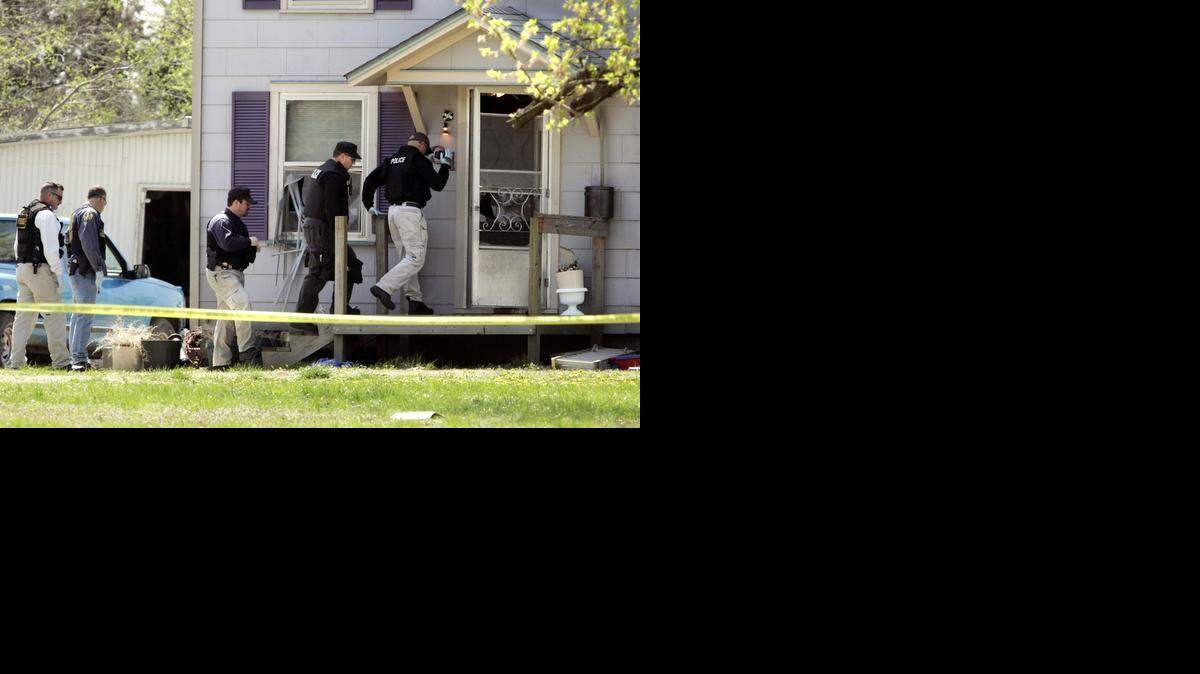
Ford, 38, was working as part of the Harvey County Emergency Response Team when officers entered Greg Moore’s house in Newton after seeing an hours-long standoff turn explosive.
Moore’s girlfriend testified at his trial that he raged for hours, fueled by methamphetamine, the night he killed Ford. She burst out of the house just as the emergency response team was about to go in, knocking the officer with the shield off to the side.
Moore opened fire, killing Ford and wounding Hesston police Detective Chris Eilert.
“Twelve rounds came through that front door while I was standing next to it,” Walton said.
Training tactics
Of the 771 law enforcement officers killed in the line of duty nationwide between 1996 and 2009, 106 — or 14 percent — died handling domestic violence cases.
That’s “a significant number,” Wichita police Capt. Troy Livingston said, and it’s why instructors at the law enforcement training academy stress certain tactics when handling domestic violence cases.
The tactics include sending at least two officers to every call so they can separate the people involved in the dispute. It’s important to separate the people in conflict so the victim doesn’t feel pressured by the abuser to lie about what’s going on, Livingston said.
But the officers have to figure out a way to remain in view of each other so they can respond quickly in the event one of them is attacked.
“Where there’s violence, rational thought and communication has broken down,” Livingston said. “Their coping mechanisms, their rational thought processes, their communication skills have diminished.”
Harvey County law enforcement officers employ similar tactics, Walton said. Although he doesn’t have hard data to back it up yet, he’s convinced domestic violence cases are growing in number.
“I think it’s worse, and I’ve been doing this for many, many years,” Walton said.
He blames it on a variety of factors.
“When I was a young cop, it was mostly alcohol,” he said. “Now it’s a combination of drugs and alcohol.”
Also, computers and cell phones make it easier for people to communicate — and cheat on each other — discreetly, Walton said. But they also leave electronic evidence of interactions that may anger a spouse or significant other.
In addition, Walton said, younger adults who have grown up with computers and cell phones may have become so reliant on the use of instant messages or texts to communicate that they struggle to say what they mean with spoken words. That can lead to confusion, broken trust and frustrations that quickly escalate.
The issue of poor verbal skills “routinely comes up from the audience” in a class he teaches on generations in the workplace, Livingston said.
Increasing numbers
Harbor House has seen the number of people it has had to turn away due to a lack of space increase this year, Mahoney said.
The shelter turned away an average of 51 women a month last year. That number has nearly doubled this year, to an average of 98 a month. The shelter turned way 89 people in July and 152 in August.
“I think the reason you’re seeing that” increase “is because there’s more awareness,” she said.
Videos showing Baltimore Ravens running back Ray Rice knocking out his then-fiancee on an elevator and then dragging her limp body out into a casino lobby have received widespread play on the Internet, though Mahoney said she’s not sure those videos specifically are responsible for the leap in numbers.
Mahoney said she, too, wonders whether society’s increasing use of text messages and social media to interact harms relationships.
“Healthy relationships rely on good communication,” she said.
The increase in people seeking shelter at Harbor House has been large enough and persistent enough to spark fresh conversations among Catholic Charities board members — who operate the shelter — about finding additional space for abuse victims, she said.
“We are always looking for ways to expand and serve more women and children,” Mahoney said. “Hopefully, that will come to fruition at some point.
“It is really hard to turn away a woman who’s in a dangerous situation because we don’t have room.”
Reach Stan Finger at 316-268-6437 or sfinger@wichitaeagle.com. Follow him on Twitter: @StanFinger.
This story was originally published September 22, 2014 at 12:07 AM with the headline "Domestic violence a red flag for officer safety."