
Changes playing out at Union Rescue Mission
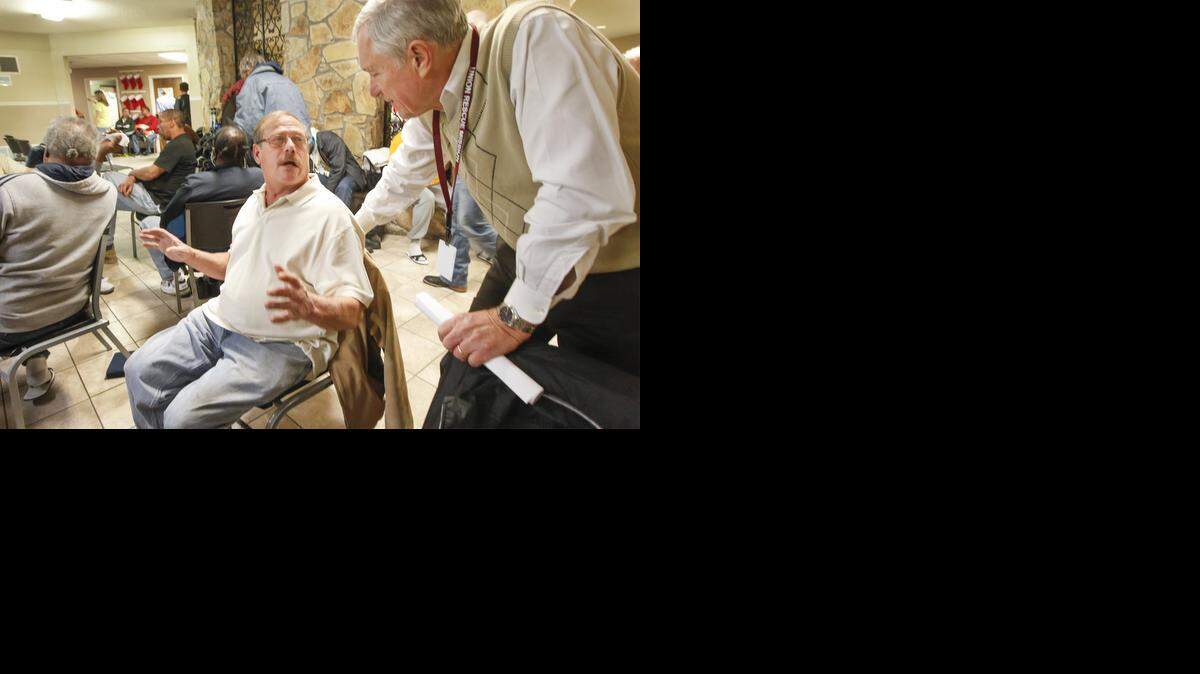
Eight months ago, the Union Rescue Mission announced it was going to phase out decades of no-strings-attached compassionate help for Wichita homeless men.
From then on, there would still be plenty of compassion, director Denny Bender said. And strings.
So far, the program doesn’t have a lot of impressive numbers showing progress, Bender said. But that is partly a manifestation of how hard it is to help the homeless help themselves and the result of a new software program for record-keeping that hasn’t worked efficiently yet, Bender said.
For example, Bender doesn’t think the move cut by much the mission’s population of about 120 men a night.
“Cutting the population was never the real intent,” he said.
But 21 men so far are now in various stages of obtaining housing rather than just staying nightly at the mission at 2800 N. Hillside.
One man, Calvin Cartwright, who has stayed at the mission for 30 years fussed about the change at first but later agreed to help the mission obtain his birth certificate, Social Security card – and the Social Security payments he was entitled to.
“Calvin was the classic case, staying here for 25 to 30 years and on a pace to keep doing that,” Bender said. “Now he is more willing to work with us.”
Helping the homeless is hard, as many local advocates will point out. The United Way is the lead agency in Wichita for a coalition addressing homelessness called the Wichita-Sedgwick County Continuum of Care.
It has an annual meeting about how to help the homeless; the meeting this year is Tuesday. The United Way also does an annual count of homeless people and submits proposals for grants to help them.
Union Rescue Mission has been trying to help homeless men with a nightly meal and a bed for 65 years and began soul-searching last year after revealing that some of the men asking for meals and a bed every night had been doing so for more than three decades – no questions asked.
Bender and his board pondered for months whether the charity might be doing some harm by enabling some people.
It’s not simple to sort out, because, Bender said, many of these men really do have medical or behavioral problems.
“And some of these men are not even sure how to ride the bus or how to get from here to there,” Bender said.
The mission decided to experiment with programs designed to get them out, if possible, but there was never any intent to shut doors. Many of these men, he has said, suffer from chronic health or mental health problems or disabilities. The experimenting will continue, he said.
“We haven’t seen as much progress as we’d like to see,” Bender said. But the moves the mission made freed up just enough room that it was able to allocate 10 beds a night for a new program.
That program provides a place to stay for men who work but don’t make enough money to avoid homelessness.
The mission for a long time had wanted to do more to help that class of men and got to do it with those 10 beds, Bender said. The men in that program typically have jobs of some sort, “but they are usually minimum wage or maybe $10 an hour.”
These men often also have wages garnished for child support, court fines or repayment of loans by court order.
“For a modest fee (about $5), they get an assigned bunk, meals, a sack lunch,” Bender said. “We do that for them and then re-evaluate after 30 days to see how they are doing.”
Those men are required also to save about 40 percent of their income, making out money orders payable to themselves that are then held for them by the mission.
Reach Roy Wenzl at 316-268-6219 or rwenzl@wichitaeagle.com. Follow him on Twitter: @roywenzl.
This story was originally published December 7, 2014 at 9:26 PM with the headline "Changes playing out at Union Rescue Mission."