
Remains of Kansas man shot down in World War II finally accounted for
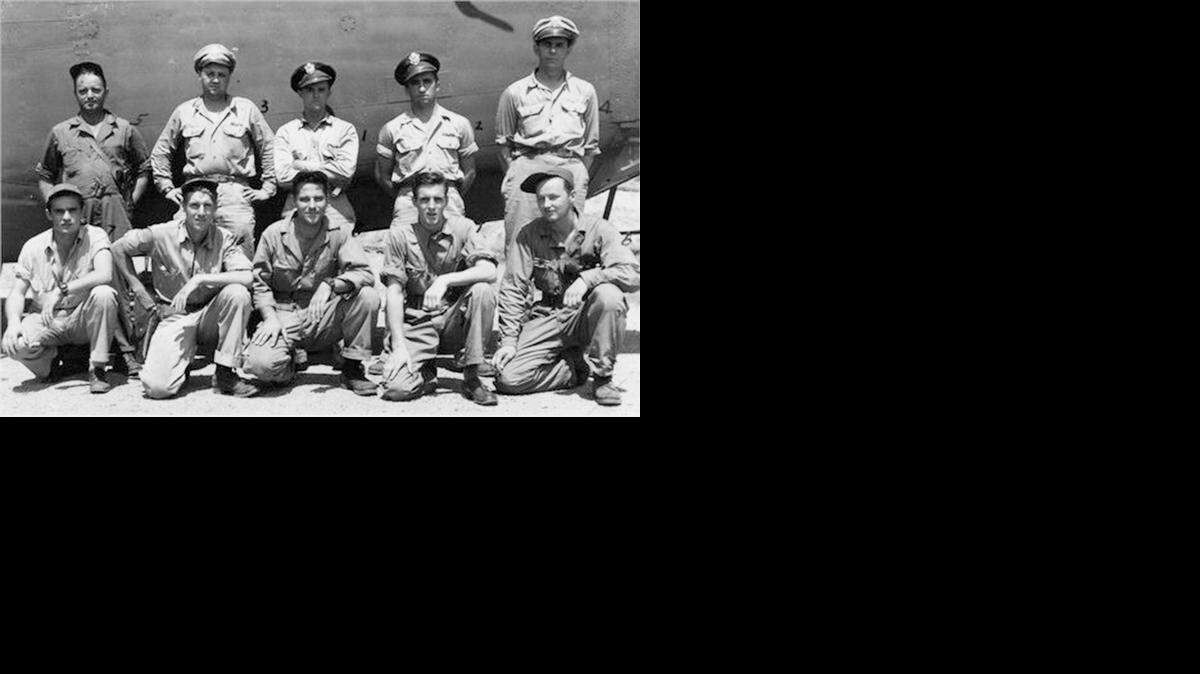
World War II was raging on April 10, 1944, but it was shaping up to be a good day for John Earl Copeland Sr.
An Army Air Forces waist gunner for a B-24 Liberator based at Nadzab Air Field in New Guinea, he woke up that morning to learn he had been promoted to staff sergeant.
A few extra bucks would help. Back home in the southeast Kansas town of Cherryvale, his wife, Betty, was caring for their 9-month-old son, John Jr.
John Sr. hadn’t seen his son. Betty was pregnant when he left for overseas duty.
Later that morning, he and other crew members for the B-24s in the 321st Bomb Squadron, 90th Bomb Group of the Fifth Army Air Force, headed for a mission.
The seven heavy bombers – with Copeland’s plane leading the formation – took off from their base on New Guinea’s eastern coast. Their target: a Japanese-held naval base at Hansa Bay on New Guinea’s northern coast.
Heavy fire from enemy anti-aircraft guns struck Copeland’s plane – nicknamed “Hot Garters” – as it approached the target at 12,000 feet. The plane crashed in a ball of flames, setting the dense bamboo forest on fire.
Four of the 12 crew members parachuted before the crash and landed safely, although they were badly injured. They were captured by the Japanese and later executed, said Air Force Lt. Col. Melinda Morgan of the Defense Prisoner of War-Missing Personnel Office.
Remains of three of those four were recovered immediately after the war, identified and sent home to family for burial. Remains of the fourth have never been found, Morgan said.
For more than 70 years, the remains of the eight other crew members – including Copeland – were unaccounted for.
Last week, the Department of Defense made an official announcement that those crew members had been accounted for or identified.
Remains of Copeland and the pilot, 1st Lt. Bryant E. Poulsen, 22, of Salt Lake City, were the only two that couldn’t be identified. But officials confirmed they were among the dead because it was known they were on the plane.
`Love of her life’
Several years ago, the Army called Taina Copeland to say there was a possibility that her grandfather was in the crashed plane.
In early August, she was notified by the Army Service Casualty Office that officials had accounted for her grandfather’s remains as being in the plane.
The news was unexpected.
“All I knew about him was that he died in the war,” Taina said. “My dad’s side of the family didn’t talk about him. My grandmother didn’t talk about him.
“I was told it was taboo to talk about him. He was the love of her life, and she lost him.”
Betty was 18 when John Sr. and the 11 others were killed in the crash. He was 21.
She remarried in 1946, had two more children and died at the age of 79 in 2004, Taina said.
The news about the crash has not only provided information about a grandfather Taina never knew. It has also brought back a flood of memories.
John Jr., the boy his father never saw, married and became Taina’s dad. But she never saw him.
He was killed in a car wreck just outside Cherryvale in Montgomery County on April 2, 1965 – about three months before Taina was born.
Like his father, John Jr. was 21 when he died.
“My mother was really freaked out the year I was turning 21,” said Taina, who moved from Cherryvale to Olathe more than a year ago to take a job with a funeral home. “I told her I broke the curse.”
Montgomery County
Cousette Copeland, a second cousin of John Copeland Sr., also wanted to know more about her family history.
She was born at Fort Benning, Ga., grew up in a military family, and lived around the country and overseas. Never in Kansas, though.
Her father, James D. Copeland, was an Army veteran of the Korean War, where he contracted an illness that would take his life 20 years later at the age of 42.
“I never heard about the Copeland side of the family,” said Cousette, a technical writer who lives in Santa Clara, Calif. “I don’t think my dad knew them.”
In 2007, her curiosity led her to launch two genealogical searches, including one to learn about the Copeland family.
Abner and Samantha Copeland, who had 10 children, moved in 1882 from Indiana to Montgomery County. They helped build a Quaker meeting house at Harrisonville, a town just outside Independence that no longer exists, Cousette said.
John Sr., an only child, grew up in rural Montgomery County on the family’s farm. He worked briefly as a civilian at the Independence Army Air Base and enlisted in the Army in 1942 – not long after the Japanese bombed Pearl Harbor on Dec. 7, 1941, 73 years ago Sunday.
In the same year that John Sr.’s bomber crashed, his cousin George Copeland’s plane was shot down over Germany. Now 93 and living in Springfield, Mo., George Copeland spent a year as a prisoner of war and survived a winter march to Poland, Cousette said.
Cousette’s research on the Copeland family led her to publish a book – “An American Genealogy: The Copeland Family of Montgomery County” – in 2010.
The book contains two declassified military documents. One is the history of John Sr.’s squadron for April 1944, and the other is the official missing aircraft report.
The squadron’s history report said 20 combat missions had been conducted that month.
As part of a celebration marking the formation anniversary of the 90th Bomb Group, a movie was shown and beer was served. The squadron “won one softball contest decisively, then lost the second for the group title by a close score,” the report said.
Combined with “laundry facilities, ice cream sales and somewhat improved mail service,” the report added, “the games were a morale booster.”
The history report also covered the crash of Copeland’s plane, adding that the crew was considered missing.
“All these men were held in high esteem by their fellow members and will be long remembered,” the report said.
The missing aircraft report had a different tone.
Poulsen, the pilot, was the squadron leader. First Lt. George R. Anderson, who was No. 2 in the formation, wrote the following account for the report:
“Lt. Poulsen had apparently settled down on his bomb run and I would say about thirty seconds before his release, point ack-ack started to burst all around him. Number two engine seemed to be hit and flames came back way past the tail … I saw bombs being salvoed.
“Lt. Poulsen started a gradual turn to the left, he was losing altitude … the left wing folded up and the plane started to spin. The tail assembly came off and the plane disintegrated. It was approximately 10,000 feet. The plane was still burning on the ground when we left the scene.”
An account from Anderson’s navigator, 2nd Lt. Ray E. Colvin, said: “The burning plane … was falling apart. It started a large fire in the jungle.”
As the planes started to break up their V-formation about 10:20 a.m. and prepared to make individual bombing runs, 2nd Lt. Julius J. Sas, a pilot on another plane, reported seeing about 25 bursts of anti-aircraft fire bracketing Copeland’s plane.
Eyewitnesses reported either five or six men had parachuted from the burning aircraft. Officials later confirmed there were only four.
The dense jungle would cover the crash site for decades to come.
Discovering wreckage
Of the 16 million Americans who served in World War II, more than 400,000 were killed. When the war ended, officials couldn’t account for more than 79,000, according to the Department of Defense.
That figure hasn’t gone down much – it is now at more than 73,500 – despite extensive recovery efforts over the years.
“The Army told me they never stopped looking for my grandfather,” Taina Copeland said.
The Army received some help about 15 years ago.
A local man bought the land that turned out to be the site of the crash in what is now Papua New Guinea. He was clearing it out, saw the wreckage and notified U.S. authorities.
From 2001 through 2011, U.S. recovery teams conducted five surveys and excavations of the site. A military lab in Hawaii, operated by the Joint POW/MIA Accounting Command, spent the next three years examining the remains of the eight crew members who went down in the plane for possible identification, the Air Force’s Morgan said.
In recent months, Morgan’s office has notified the eight families of those men of the results.
Stories have unfolded about the men, such as 1st Lt. Herbert V. Young Jr., 23, of Clarkdale, Ariz.
Young, a former football player at Arizona State University, was a co-pilot on the plane. Normally, he was the pilot of another aircraft, according to the website of Pacific Wrecks, a nonprofit that has conducted searches and provided information about World War II’s Pacific Theater and the Korean War since 1995.
But Young’s plane wasn’t operable at the time, and Copeland’s plane was short a pilot. So he joined the 12-man crew.
A normal crew for a B-24 is 10, but this flight included a military photographer and another service member who was listed as a passenger, according to Pacific Wrecks’ report.
The Army gave the families of the eight crew members a thick book that provided details of the crash, recovery efforts, what was found and the identification process.
“I read through the whole book cover to cover,” Taina Copeland said, “and then I read it again.”
The book contained pictures of artifacts, such as bones, rings, wrist watches, pocket compasses, parts of eye glasses, belt buckles, pocket knives, big knives and even coins and buttons, she said.
“It’s amazing that some of these were in fairly good condition after all this time,” Taina added.
Identifying remains was tricky. The identification of the remains of six crew members was done by using mitochondrial DNA, a process that compares DNA to living relatives on the maternal side.
Copeland and Poulsen couldn’t be identified by the method because of conditions that included intense heat from the burning plane. However, they were accounted for because authorities knew they went down with the plane.
On Aug. 29, at the Cherryvale cemetery where John Jr. is buried, the Army conducted a ceremony honoring Taina’s grandfather. His medals and ribbons were presented to her.
Family members of the six crew members who were identified have had funerals or will have one in the coming months, Morgan said.
A group funeral representing all eight crew members who went down with the plane will be held soon at Arlington National Cemetery outside Washington, D.C., Morgan said.
Immediate family members of the eight will be brought to the nation’s capital at the Army’s expense. Taina and her adult daughter, Belinda Busto, will be attending.
A date is still being worked out, Morgan said.
Besides Copeland, Poulsen and Young, the others in the group funeral will be: 1st Lt. William D. Bernier, 28, of Augusta, Mont.; Tech Sgts. Charles L. Johnston, 20, of Pittsburgh, and Hugh F. Moore, 36, of Elkton, Md.; Staff Sgt. Charles J. Jones, 24, of Athens, Ga.; and Sgt. Charles A. Gardner, 32, of San Francisco.
Unidentified remains will buried as part of the group ceremony.
Taina Copeland would have much preferred for her grandfather’s remains to be buried in Cherryvale next to his son and her father.
But that wasn’t possible. She’s grateful for what is being done.
“To me, that’s the most important thing is that the families know what happened to them,” Taina said. “I’m also very proud of my grandfather.
“It’s so good to have him home.”
Reach Rick Plumlee at 316-268-6660 or rplumlee@wichitaeagle.com. Follow him on Twitter: @rickplumlee.
This story was originally published December 6, 2014 at 4:18 PM with the headline "Remains of Kansas man shot down in World War II finally accounted for."