Riding buses in Wichita will change next month. Here’s what will be different
Riding the bus in Wichita should look a little different by the end of May.
Commuters will board at a new Delano transit hub instead of boarding at the old hub on Topeka Avenue downtown, be able to catch the busiest buses more frequently, have new connections to grocery stores and go farther faster with a new crosstown route.
The sweeping remodel won’t cost taxpayers more to operate, said the director of city transit and the Wichita City Council members who approved the Transit Network Redesign Plan unanimously this week.
But it could reshape how residents move around the city.
Here’s what changes to expect:
A new centralized hub for route connections
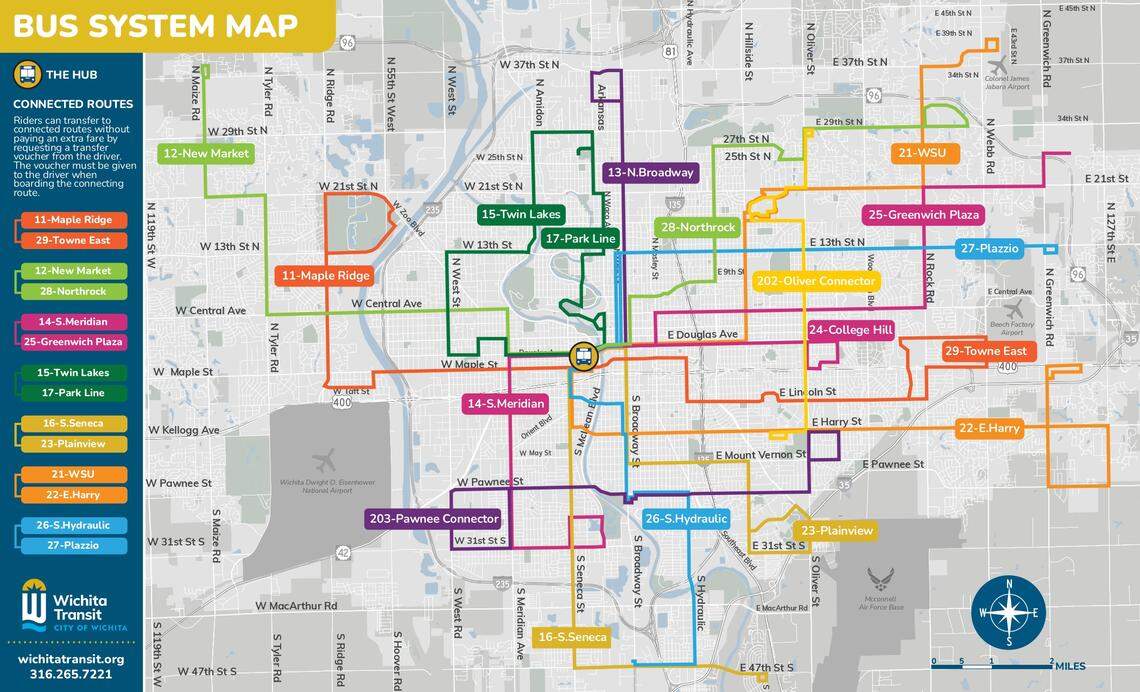
With the opening of the new Multi-Modal Facility, also called The Hub, slated for May 23, all city bus routes will connect through the new 207 S. Sycamore location instead of the Transit Center at Topeka and William.
The new hub center will support all the services previously housed in the Topeka Street Transit Center, and will sit between Oak, Texas, Sycamore and Burton streets. Buses and shuttles are set to enter the new plaza from the south, off of Burton, before exiting off Texas.
The facility will also include three levels of parking, which will be accessible via a ramp on the west side of the building.
More frequency on busy routes
Two of the city’s busiest bus routes — Route 21 and Route 22 — will be available more frequently when the new hub opens.
Route 21 primarily serves northeast Wichita with several stops at Wichita State University’s campus, as well as stops near shopping areas on Hillside and Douglas, 21st and Rock and 21st and Greenwich, to name a few.
Route 22 provides access to the E. Kellogg Walmart and has frequent stops along Harry at Broadway, Edgemore, Longfellow, Rock and Parkwood.
Of the more than one million commuters who used Wichita Transit last year, more than 120,000 people rode a bus on each route, Wichita Director of Transit Penny Feist said. Currently, buses on those routes run almost every 30 minutes during peak weekday hours — from about 6:00 a.m. to 9:00 a.m. and again from 3:30 p.m. to 6:30 p.m — and run every hour on Saturdays and in the evenings.
With the changes, buses on Routes 21 and 22 will stick to 30-minute frequencies throughout the week.
Route 16, which goes along parts of South Seneca, 47th, South Hydraulic, Pawnee Plaza and Broadway, will also begin offering routes every 30 minutes during peak hours, as opposed to hourly.
Route extension for grocery access
As part of an effort to better connect residents with essential services, Route 28 will be extended to improve access to grocery stores for commuters.
Route 28, which frequently pairs with Route 29, offers bus rides to the north part of the city, with stops at the KU School of Medicine, 25th and Hillside and The Coleman Company.
With the extension of Route 28 to 29th and Rock, Feist said every Walmart in Wichita will then be accessible to residents via city transit.
District 1 Council Joseph Shepard said he was grateful to see community-driven feedback, like improved access to grocery stores, included in the transit overhaul.
“I know that that has been a major conversation as you are continuing to engage the community,” Shepard said. “And so I think it’s always important to point to things we hear from the community and how we’re incorporating them in the plan, because I think that builds trust.”
A new crosstown connection
Feist also emphasized that new routes can adapt to changes in the city. They’re putting that to the test with Pilot Route 203 – Pawnee Connector to tentatively establish an east to west connection in south Wichita.
One motivator, and a point of interest regarding the pilot route, is a new mental health hospital set to open in January 2027.
“Once that facility is open, it should be very easy for us to swing 203 a little bit further south to where they’re located,” Feist said. “But what that is going to be contingent upon is the success of the pilot route.”
What comes next
Over the next month, Wichita Transit will launch an intensive 30-day communication campaign, complete with printed and digital materials, to inform bus riders of the coming changes.
“When you move a transit center that’s been in place for 30 years, and you change the routes, there’s an anticipated ridership decline,” Feist said, “so we’d like to launch that marketing plan to recover from that and engage new riders.”
Slated for future conversations with city leadership is how transit will adjust to an evolving downtown, particularly the Q Line. The Q Line, which began in 2006 as a fare-based downtown route, became fare-free in 2009 but has since lost the outside funding needed to support it. After examining its low ridership in comparison with its more-accessible-than-most route offerings, Feist recommended that it not continue into the evenings or on Saturdays, and that it should not run any more frequently. Feist floated the possibility that it will transition back to a paid transit service at some point, though that adjustment will be considered at a later time.
“We know that downtown is developing quickly and that there is a need for transportation downtown, and we want to continue the conversation on how Wichita Transit can support … downtown Wichita and, for the time being, leave the route fare free,” Feist said. “But perhaps in the future, we’ll come up with an alternative solution, and this route will be treated like other routes as well.”
Additional information about city bus routes can be found on the Wichita Transit website.