Haysville residents asked to avoid Big Ditch after sewage overflow
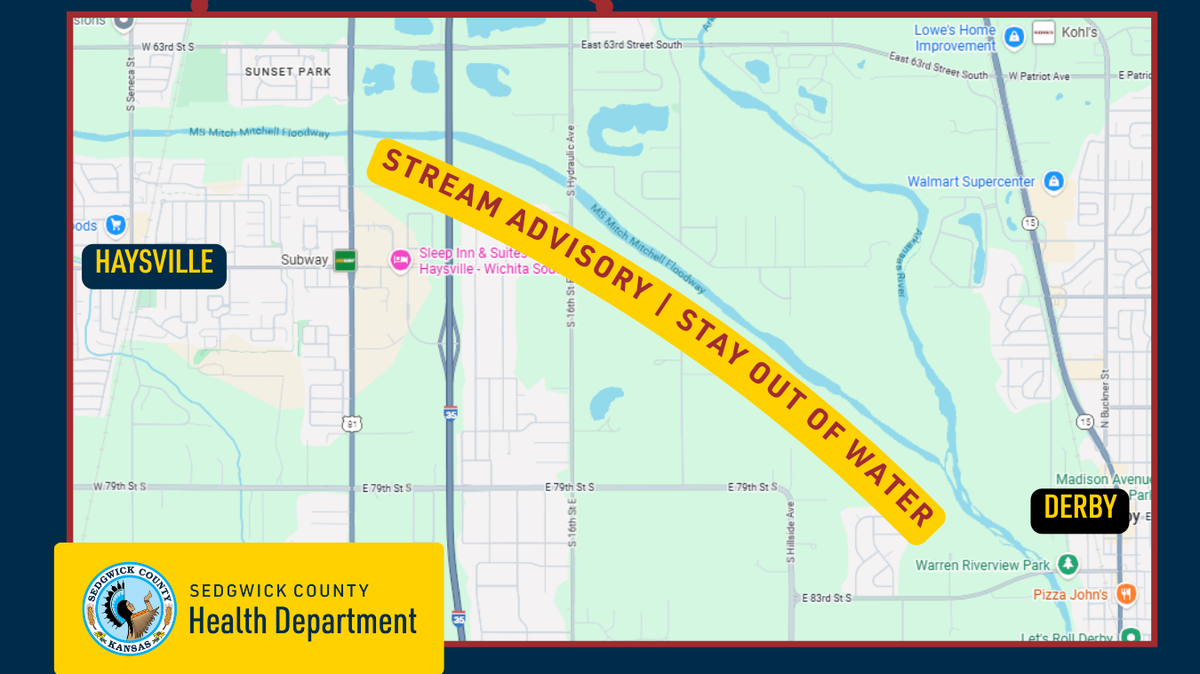
State health officials are urging residents to avoid part of the MS “Mitch” Mitchell Floodway near Haysville after a sewer overflowed, exposing the waterway to potentially elevated levels of E. coli bacteria and other contaminants.
Haysville Public Works expects test results from the state the week of Dec. 7. If contaminant levels come back within acceptable limits, the waterway will again be considered safe for swimming, cold weather notwithstanding.
The Kansas Department of Health and Environment issued a stream advisory on Dec. 2 for the affected Haysville Big Ditch area, which stretches east of the Haysville South Seneca Street bridge until it meets the Arkansas River just west of Derby.
For the duration of the advisory, residents and animals should avoid swimming in or drinking from the waterway.
“If you live or have activities near this stream, do not enter the stream or allow children or pets to enter the stream,” the KDHE media release read.
The problem surfaced the day before Thanksgiving, Public Works Director Tony Martinez said. While most folks were home with family enjoying the long holiday weekend, public works employees, consultants, engineers and construction crews worked to replace failed sewer pipes — the source of the overflow that later prompted the advisory — beneath the floodway.
Like nearly all city sewer systems, Haysville’s sewage moves through sewer lines via gravity, Martinez explained. From Haysville homes, most wastewater flows downhill through pipes until the lines go too deep underground. It’s then routed to a lift station where pumps push the sewage toward the city’s treatment plant.
One of those lift stations sits on the north side of the floodway and sends wastewater through a pressurized force main that runs beneath the channel. Martinez said that’s where operators discovered that failed pipes in the system were allowing sewage to escape, later prompting the state E. coli and contamination advisory.
E. coli is a common bacteria found in human and warm-blooded animal feces. While some strains are harmless, others can cause illness including fever, diarrhea and vomiting. People can be exposed to E. coli by touching infected animals, through person-to-person contact, by swimming in tainted water or by ingesting contaminated food or water.
Anytime a sewage overflow happens, Martinez said, the public works department must make a report to KDHE, which then conducts water testing and issues advisories or warnings based on the levels of contaminants detected.
Over the Thanksgiving weekend, Haysville Public Works ordered replacement pipes. Those arrived Monday and as of Tuesday afternoon, Martinez said, contractors were about halfway done drilling the holes for the new pipe.
“When they get to the other side of the floodway, they’ll hook up the new pipe, and they’ll pull the new pipe back,” Martinez said. “And then at that point, they make the connections to the existing pipe that’s in good condition.”
With all factors considered — the unforeseen pipe failure, the recent winter chill, the holiday season and having to order pipes from outside Wichita — Martinez said he’s been pleasantly surprised by the speed and efficiency of the work.
“(It’s frustrating) for all of our employees that are dealing with it — it’s Thanksgiving weekend and all that good stuff,” Martinez said. ”But ... I can’t complain. I wouldn’t wish this on anyone, but it’s actually gone pretty well.”
Martinez said the force main was replaced and put back into service Friday morning. But because the required incubation period for the E. coli sample test can’t be run over the weekend, they’ll send a water sample to KDHE on Monday. The state department will then determine whether the amount of E. coli in the water meets or is below acceptable levels. Martinez said the department regularly sends samples to the department as part of standard wastewater testing and has seen results come back as soon as 24 or 48 hours.
“We expect lab results early to the middle of next week,” Martinez said. “KDHE will review the results and determine when the stream advisory can be lifted.”
This story was originally published December 2, 2025 at 5:49 PM.