
Tips for fresh Christmas trees; shop for Kansas-grown trees at five area farms
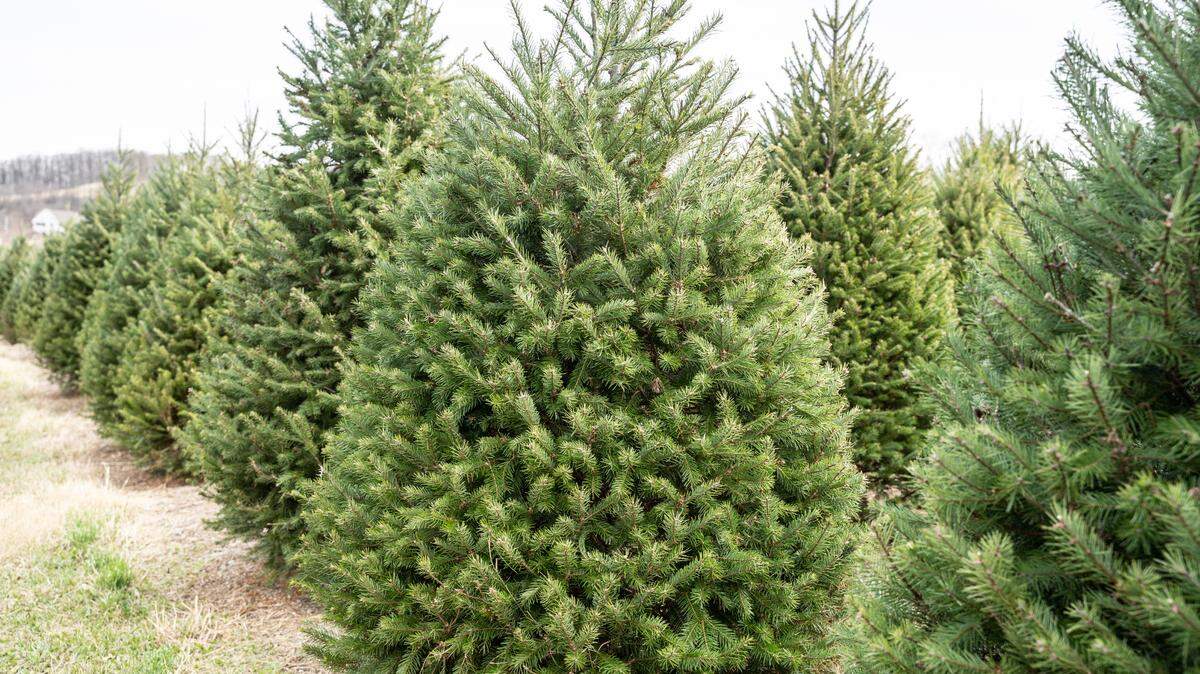
It’s opening week for five area Christmas tree farms that offer the experience of choosing and cutting a tree straight from the field.
In Kansas, tree growers primarily raise pine trees in their fields and ship in other evergreen varieties, such as firs and spruces, from out-of-state farms for live-tree options for consumers.
“Each free farm is generally going to have one or two or three (pine-based) varieties that they prefer to grow and have the best success with, so the type of tree that you’re going to find is going to vary a little bit from tree farm to tree farm,” said Matthew McKernan, a horticulture agent with the K-State Research and Extension Center in Sedgwick County.
Austrian and Scotch pines are the two most common varieties grown on Kansas farms, with some farms also offering Virginia pine and even Southwestern white pine, although the latter is more difficult to grow in Kansas.
Pine Lake Farm in Derby, for example, offers all four varieties, with the most popular choice being Scotch pines, which are fuller with medium-length needles and sturdy branches, according to the farm’s website.
Care for fresh Christmas trees
McKernan shared five tips on choosing, caring for and disposing of live trees purchased at area tree farms or from tree lots.
1. Check the color and condition of the needles and branches. “You want both the branches and the needles to be able to bend without snapping or breaking and have some flexibility to them,” McKernan said.
“Ideally, when you break the needles, sap is going to ooze out of them, indicating that there’s lots of moisture in the needles; those will last longer. And the other test that I think is helpful is when you lightly tug on the needles of any Christmas tree, ideally, they don’t fall off … or pull off easily.”
2. Check your space before you pick out your tree. A tree will often look much smaller when it’s outdoors. To avoid getting a tree that’s too big for your space, take some measurements using either a measuring tape or your own height and arm span as a guide. Most farms have measuring sticks available, since most will price trees by the foot, McKernan said. Another space consideration: Unless your tree is visible from all sides, it’s OK to have a bare section — and it might even fit better if your tree is going in a corner or along a wall.
3. Keep the tree hydrated. A live tree will seal up its cut trunk with sap and resin, so before putting the tree into its tree stand, make a fresh cut of about 1 to 2 inches off of the trunk. That final cut will expose the tree’s water-absorbing tissue and help it stay hydrated, McKernan said.
4. Be sure your tree stand is large enough to hold between 1 and 1 ½ gallons of water. The rule of thumb, McKernan said, is to provide one quart of water for every inch of the trunk’s diameter. For example, a tree with a 4-inch trunk will need at least a gallon of water every day. Use warm water for the initial watering.
“No need to add sugar, aspirin or bleach or pennies or 7Up or any other things. Research shows just tap water is going to be the best for the tree . . . and you never want to let that water level fall below the bottom of the trunk,” McKernan said. Fresh-cut trees tend to absorb water more quickly during their first couple of weeks, so keep check water levels often.
5. Return your tree to the outdoors, not the landfill. After removing decorations, residents have a few options for disposing of their trees and keeping them out of the landfill, McKernan said.
Between Dec. 22 and Jan. 23, you can drop off your tree —sans stand and decorations — for recycling at one of 20 sites in Sedgwick County; 10 of those sites are in Wichita. The sites are listed at sedgwickcounty.org/environment/christmas-trees. Residents can take free mulch home with them for landscaping use.
Some residents put their Christmas tree in the backyard for birds to use as cover from predators or inclement weather during the rest of winter, McKernan said. For residents with ponds or lakes on their property, the trees can be sunk into the body of water to form a sort of coral reef for fish.
“There are lots of ways to get your money’s worth out of your Christmas tree,” he said.
Christmas tree farms
Here are five farms within an hour drive of Wichita where you can find homegrown trees as well as live trees from other states.
Pine Lake Christmas Trees, 6802 S. Oliver in Derby, is open daily through Dec. 21. Extended hours for Friday, Nov. 28, are 9 a.m.-6 p.m. Regular hours are 2-6 p.m. weekdays, 9 a.m.-6 p.m. Saturdays, and 1-6 p.m. Sundays. Additional activities include hayrack rides, complimentary hot beverages and an outdoor fire pit. Individual s’mores kits are available for a nominal fee. More info: 316-258-0088, pinelakechristmastrees.com
Pine Creek Farm, 994 Meridian Road, Newton, will have extended hours on Friday, Nov. 28, from 9 a.m. to 5:30 p.m. Regular hours are 1-5:30 p.m. Tuesdays-Fridays, 9 a.m.-5:30 p.m. Saturdays and noon-5:30 p.m. More information: 620-367-2606, pinecreektreefarm.com
Peaceful Pines, 762 80th, Walton, will be open Fridays through Sundays on the four weekends following Thanksgiving, with extended hours from 9 a.m.-5:30 p.m. Friday, Nov. 29. Regular hours are 1- 5:30 p.m. Fridays and Sundays, 9 a.m.-5:30 p.m. Saturdays. More info: 620-367-2612, peacefulpinestreefarm.com
Prairie Pines, 4055 N. Tyler Road, Maize, will start selling both homegrown and imported trees on Friday, Nov. 28, from 9 a.m. to 5 p.m. It will remain open daily through Sunday, Dec. 7; and then Dec. 10-14 and Dec. 20-21. Santa is scheduled to be at the farm on Friday, Nov. 28, and then Saturdays and Sundays. For hours and more info: 316-303-2037, prairiepines.com
Windy Knoll, 15630 E. 47th St. South, Derby, will be open from 10 a.m.-5 p.m. Friday and Saturday, Nov. 28 and 29, and 1-5 p.m. Sunday, Nov. 30. Visitors can also stop by the farm’s petting zoo comprising baby doll sheep, miniature donkeys and goats. More info: 316-644-1519, windyknolltrees.info