
City may narrow Douglas: ‘They’re going to make 15,000 cars a day really angry’
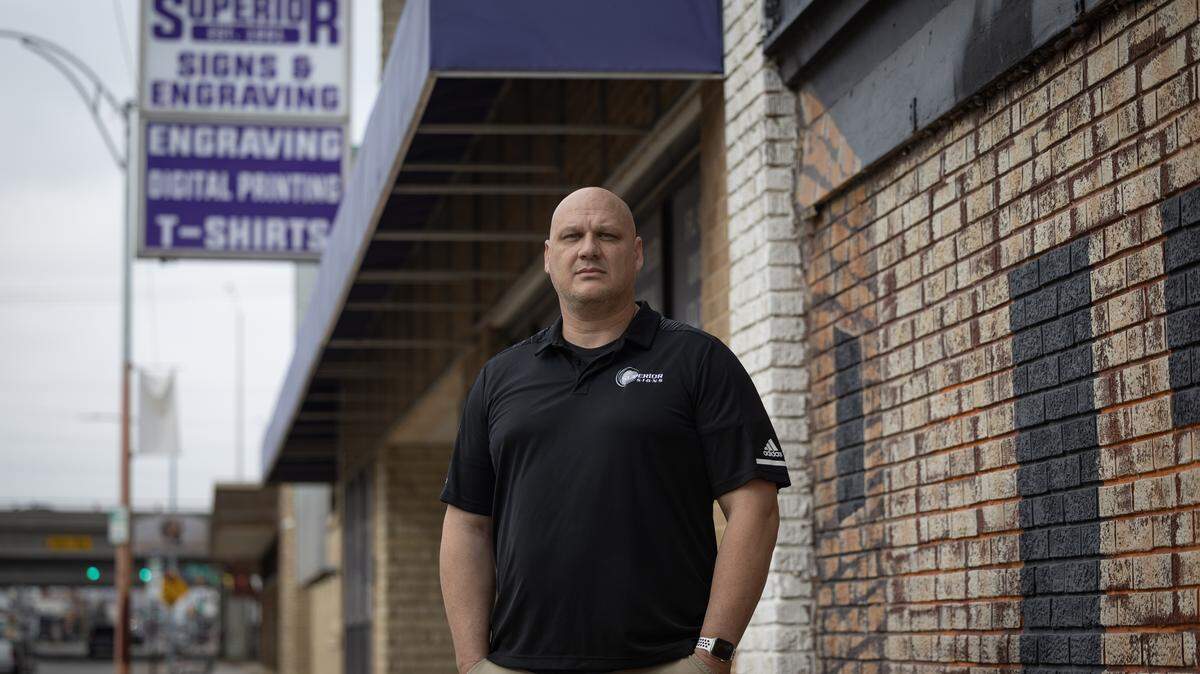
The city has brought back a plan to narrow Douglas Avenue from Washington to Grove, and a lot of people who own businesses there or frequent that area are not happy about it.
“They’re going to make 15,000 cars a day really angry,” said David Holt, who owns Wichita Wood Floor Specialists across from East High School. “They’re going to cause traffic jams, and they’re going to cause wrecks.”
About two thirds of that stretch is five lanes and would change to three lanes. Part of the stretch currently has four lanes and would drop down to three — one in each direction plus a turning lane.
Jeff Breault is concerned even though his RJ Discount Liquor on Douglas is just outside that area.
“No one that owns a business on Douglas can figure this thing out,” he said. “They presented it at a DAB meeting a month ago, and it was a fiasco. It was two or three hours of yelling.”
Instead of voting on the issue, the District Advisory Board tabled it until some community meetings could be held to hear from citizens. The next community meeting is at 5 p.m. Monday at the Advanced Learning Library ahead of a DAB vote on Dec. 1 and a possible City Council vote on Dec. 2.
“Right now, it’s the group that’s not supportive that are really loud about it,” said City Council member Brandon Johnson.
As Johnson nears the end of his time on City Council, he’s trying to finish up the projects he’s been working on. This is one he’s been trying to accomplish since at least 2009.
Also, he said, “It’s the right time.”
He said there’s so much happening downtown, and city leaders have been discussing how Douglas could be redesigned, both for aesthetic reasons — such as adding more medians and plants — and to make the city safer and more friendly for pedestrians and bicyclists by slowing down vehicles.
Johnson said the city was making progress toward a three-lane design when the pandemic happened and things were put on hold.
Before then, he said, a lot of people who “were absolutely against” the plan to go to three lanes had come around to supporting it.
He said even though there will never be a complete consensus, “I’m hoping we can get back to that again.”
However, the issues with the city’s latest proposed road diet, or narrowing of streets, are lengthy, according to business owners in the area.
Issue No. 1
The first issue is what some say has been the city’s lack of notice about the first meeting, which was about two days for most.
“It seems to me that was a very, very short notice for us to get together,” said Tim Devlin of Devlin Rod & Customs.
“It blindsided all of us,” Holt said. “I had to just scramble to get caught up.”
Adam Stiles of Superior Signs & Engraving said, “We thought it was kind of a dead-in-the-water project.”
Following the DAB meeting, Stiles said the city was supposed to get more community input and make changes to “make these plans a little more user friendly for everybody involved.”
“They took out a few medians, but that’s not going to be enough.”
Holt said he doesn’t believe people who frequent that area and use it to get downtown even know what’s proposed.
Also, he said, “They keep saying they’re working with the business owners. I’ve never been talked to once about this.”
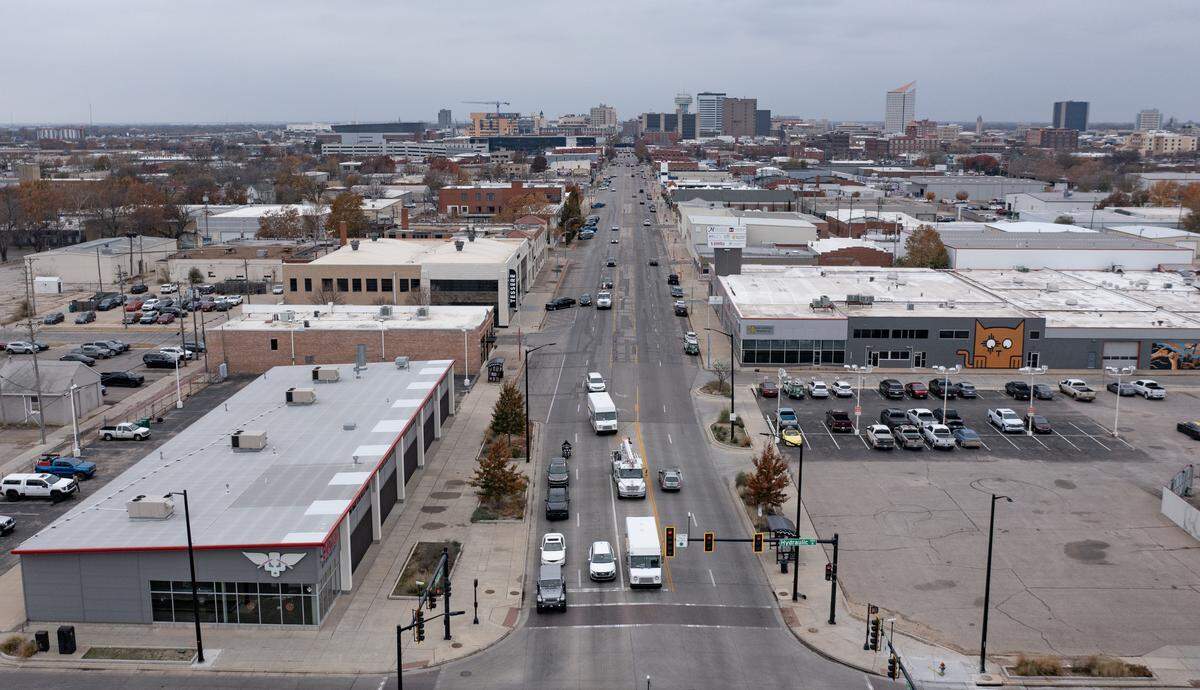
When he learned of it, Holt sent Johnson “a huge email” that included examples of where similar road diets have failed in other cities.
Johnson, who said he believes people have had ample time to learn of what’s happening, said it’s not like construction is starting immediately.
“To make sure that we get it right on the medians, the planters . . . all of that will continue to be discussed throughout design.”
Reverie Coffee Roasters owner Andrew Gough said a lot of business owners, much like himself, don’t like being told what to do or being dictated to about plans that may affect them. He said that’s why it’s important for people to get involved with planning discussions.
“I’m feeling better about it the more I participate in it.”
Gough said he wants the city to use national data to improve safety along Douglas and to employ ideas like road narrowing if they make sense.
“There’s enough research and evidence to support that does slow traffic. . . . It increases safety,” he said. “I’m overall in favor of improving infrastructure.”
Johnson’s replacement, incoming council member Joseph Shepard, said he has concerns about making sure Wichitans have been made aware of what could happen.
“It takes time to bring people along, and my concern is how much time have we taken to engage and bring people along in the conversation even if we don’t change their minds.”
Issue No. 2
Congestion is one of the main issues business owners fear with only one lane of traffic each way plus a turn lane. Then, there are the medians along with curb extensions that are designed to calm traffic.
“I just feel Douglas Avenue is a main thoroughfare . . . from the east to downtown,” Devlin said.
He said it’s potentially going to take a long time getting in and out of businesses without the extra lanes. Devlin also said there is heavy truck traffic in the area, and the vehicles need a wide area to turn.
He and others compare what potentially could happen here to what happened in Delano when it was transformed into a more walkable area.
“We’re just not the same neighborhood,” Devlin said. “That’s not what this section of Douglas is all about.”
He said he worries about emergency vehicles being able to get through along with everyday traffic.
“How far back are they going to be backed up?” Devlin asked.
“What happens when your FedEx truck parks in that one lane of traffic?” Breault said.
Johnson said the proposed narrowing is “all about pedestrian safety.”
Currently, he said, the wide lanes of traffic are enough to land a plane on.
“That’s a lot,” Johnson said. He said decreased lanes “will definitely slow traffic down a bit.”
Still, he said, data shows that traffic actually can move more swiftly with three lanes than five since motorists would not be able to zip in and swerve out of traffic.
If pedestrians feel more confident to walk safely, Johnson said, it ultimately could help businesses.
Holt said most businesses in that area are destination businesses — like his flooring business, the sign company and a paint shop— and they aren’t the kind of places that will benefit from people strolling by.
He said they do, however, benefit from people driving by and seeing that they’re there.
Holt said slowing down traffic is not a bad idea, but he said there are other ways to do it, such as lower speed limits like in Eastborough or speed bumps like in Old Town.
“But don’t choke the traffic down.”
Issue No. 3
Parking is another issue that business owners fear with the road diet.
There would be angled parking in some areas and parallel parking in others.
Holt, who used to own Delano Barbecue, said the only accident he’s had in 35 years was when he was attempting to back out of an angled space in Delano.
“You can’t see when you’re backing out of parking spots,” Stiles said.
He and Holt also are concerned about the city keeping the parallel parking by East High School with just three lanes. Holt said there won’t be room for people to pull forward and then back into spaces.
“You are going to have all kinds of accidents doing that,” Holt said.
He said the buses that park along Douglas picking up and dropping off kids and the food trucks that are there during lunch also are a huge issue with only three lanes.
Holt said he’s not opposed to upgrades, such as extra lanes for bikers and delivery trucks or more lighting in the area. Stiles and Devlin, too, said they’re all for beautification in the area.
That doesn’t mean they’re in favor of all the plans, though.
As a former Delano business owner, Holt said he knew firsthand some people simply won’t go there because it’s too congested and tricky to park, and he doesn’t want to see that happen where he is now.
“This is about to become an area that everyone will avoid.”
Additional issues
Though Breault said he’s all for making Douglas more attractive, he said, “Don’t put crap in the middle of the road.”
What the city is doing to create a calming effect is only going to make people angry, some business owners said.
Also, Stiles said there was no one to keep flowers alive in the medians the city installed near Douglas and Hydraulic, so native grasses were planted instead.
“They look like a bunch of dead weeds.”
Faissal Abou-Faissal, who has commercial properties along Douglas, said he likes the idea of green space in the middle of the street.
“It will beautify Douglas.”
He said he’s in favor of a lot of the city’s plans “with some adjustments.”
“Nothing is perfect and will never be perfect for everyone.”
Abou-Faissal said he’s concerned that bike lanes aren’t included in the plans.
Even if it’s only one lane on one side of Douglas, he said, “We should have a bike lane.”
Though some cyclists have said they don’t mind popping up to First or Second streets to use bike lanes there, others are deeply concerned there aren’t bike lanes planned for this stretch of Douglas with the street narrowing.
Shepard said he’s heard people complain that “this doesn’t align with the bike master plan.”
He said walkability and bikability are important to him.
Shepard currently is on the District 1 DAB and has heard the concern of residents and business owners on multiple fronts.
“I always lean towards the idea of who we are, what’s here now and where we need to go? And it just does not seem like there’s room for that in this conversation,” he said.
He said it’s not solely about what is a best practice, “But does it work for Wichita?”
Why spend the money?
For Breault, perhaps the biggest issue with the road narrowing is that “no one yet has explained why they have this overwhelming need to spend $8 million.”
Johnson said the city has money from a 1% sales tax that the county charges, and it receives half of the money to pay for roads, bridges and highways.
“And you’re telling me that $8 million can’t be spent in District 1 in a lot better way?” Breault said.
Holt asked if the city spends $7.5 million to rework the road and affect people’s livelihoods, “Are they going to have another 7 and a half million dollars to turn around and bail them out?”
Johnson said if this issue isn’t resolved during his time in office, “I will feel like I let down some of the business owners who were supportive of it.”
He said, “We’ve got to push through sometimes.”
Shepard said he feels like there are “conflicting values” between what the city is proposing and what people want. He said there are “significantly concerned” business owners.
As Holt said, if he had a choice between the city’s current plan and making no changes, “I would absolutely, positively leave it just how it is.”