
Wichita’s first Jewish mayor honored with street sign near community center
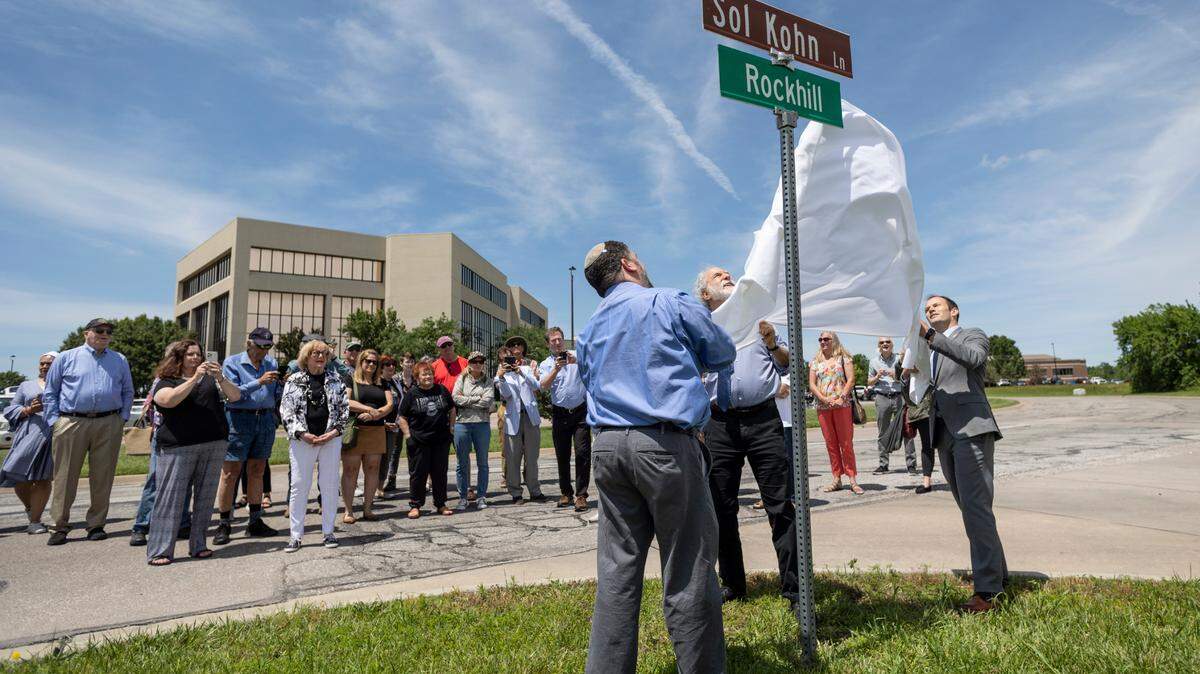
Sol Kohn, Wichita’s first Jewish mayor, is being honored for his legacy and ability to represent diversity.
Wichita unveiled a new street sign bearing Kohn’s name on Wednesday, on East Rockhill Lane in northeast Wichita. The street sign is southeast of 21st and Woodlawn by the Joan S. Beren Wichita Jewish Community Center.
Sol Kohn Lane is a symbolic street sign, called an over-naming. Public Works and Utilities of Wichita had a sign blade made that sits on the top of East Rockhill Lane’s street sign. The address for East Rockhill Lane will not change.
“In Wichita our strength is in our diversity, is in celebrating that, is in talking about the different histories people have had here in our city and the contributions they have made,” Mayor Brandon Whipple said.
Kohn emigrated to the United States from Bohemia, Austria in 1852. He helped found the Jewish congregation Emanu-El in Wichita. He also signed the city charter in 1868 to help bring the railroad and cattle industry to Wichita.
In 1879, he was elected mayor of Wichita.
Kohn’s legacy is not lost on the Jewish community, but bringing it to the community at large took some work.
Brooke Kauchak a management fellow for the city, is responsible for the research that led to the naming honor.
Kauchak wrote a memo with basic research about Kohn’s contribution to Wichita. Interest picked up from there.
Kauchak was about four months in as a fellow when she started the project. She looked through old newspapers, scanned, then emailed the Sedgwick County Historical Museum for more information. She put together a timeline of his life and tracked down lineage on ancestry.com
Kauchak got in contact with one of Kohn’s great granddaughters to tell her why the city was interested in Kohn and to see if she was supportive.
“They were still so connected to this place, and it was pretty true in the legacies of his children as well,” Kauchak said. “They all did very great things. Their communities had wonderful things to say about them.”
After receiving validation about Kohn’s legacy in Wichita from his family, Kauchak presented her research to the naming committee, the Diversity and Inclusion Civil Rights Advisory Board, in March for approval. The sign was created in May.
Jay Price, a professor of history at Wichita State University, spoke about Kohn’s contributions to the community when the sign was unveiled.
“Talking about diversity and emigration is not a new conversation. If anything, it’s exactly who we are,” Price said.