
What will it take to replace the tens of thousands of trees cut down in Wichita?
Harold Schlechtwag has started calling Wichita “Stump City.”
But he’s hoping it doesn’t stick.
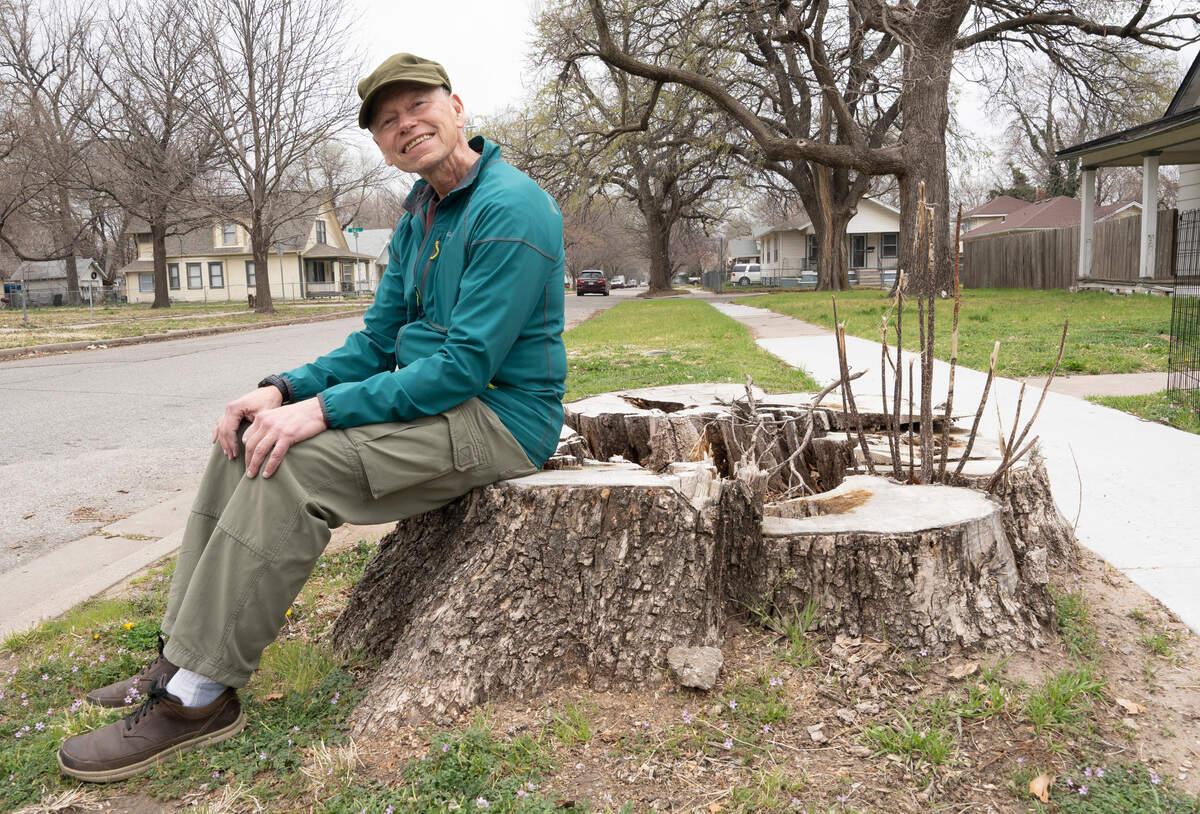
It came to Schlechtwag, one of the founders of a new local environmental group, when he counted the tree stumps in his neighborhood.
“In a two-block area around my house, I discovered seven stumps, some of which are quite old trees,” Schlechtwag said.
Some of the trees that had been chopped down were on city easements, between a curb and a sidewalk. Others had been on private land.
“One of them was removed by the person who flipped a house, before he renovated that house to sell it,” he said. “And that’s another part of the problem here.”
Since 2010, Wichita has removed nearly 44,000 more trees than it has planted on city-owned or controlled property, according to city data. That number doesn’t include the trees on private property, which satellite images show are also declining in number.
Trees have been felled by the acre for a new water treatment plant, parks, parking lots and Wichita State University’s Innovation Campus, among other projects. Meanwhile, in an effort to save money during the Great Recession and the pandemic, Wichita has in recent decades planted fewer and fewer trees to replace the losses.
At stake are the benefits of the tree canopy: cooler temperatures, lower energy bills, increased property values, cleaner air, more wildlife, less flooding. And hundreds of millions of dollars in savings.
City officials and environmentalists both say the city should plant more trees. But they disagree on whether the city should require private developers to protect certain trees and plant new ones to offset those they have removed.
CanopyICT, the coalition of local environmentalists Schlechtwag helped organize, is pushing city officials to spend more on planting trees. But they also want the city to adopt an ordinance regulating private development that uses public subsidies for construction that often displaces trees.
“We’ve got to start telling developers if they want to get economic benefits that they receive from the city, they’ve got to pay back — both in terms of planting trees and taking care of trees that are there,” Schlechtwag said.
A survey by the city manager’s office of tree protections in 11 other cities put Wichita near the bottom of the list. Austin, Seattle, Oklahoma City, Des Moines, Omaha, Kansas City and Kenmore, Washington, all had stronger ordinances. Wichita performed better than Fort Worth and Derby.
The city’s park board and sustainability and integration board are pushing the city to adopt a new ordinance or policy that would encourage saving old trees and planting new ones. A draft is expected to be presented to the boards this spring.
City Manager Robert Layton said the city supports planting more trees and acknowledges the problem. But he said regulations for private developers are likely a no-go at this time.
“Let’s first deal with public property, city-owned land, and determine how we want to go forward,” Layton said. “The types of trees we want to plant, what the general policy should be, and then probably work more on a volunteer basis with private developers. Then see what it would take for them to take into consideration more tree planting.”
“I don’t see taking any kind of heavy regulatory hand in moving forward,” Layton said.
Jeff Lowrance, networking officer for Lange Real Estate, said Wichita real estate developers and the city don’t have good track records when it comes to saving mature trees and planting new ones. But he said he doesn’t think added regulations are the solution.
“Imposing more rules that make it harder for a developer to go take risks and develop a piece of ground into something that adds value to the community is the wrong way to go,” he said. “The city and real estate developers should collaborate to try to save our landscape and try to save some of these trees. It’s being more deliberate, and working together to save the trees that make sense to save. I think that’s smart.”
“When you impose rules on people, they just go do stuff somewhere else,” he said. “When you make it hard to redevelop a property that the developers are willing to risk their money on, if you make it too hard, they’re going to go somewhere else. So there’s a balance to be struck. I’m not saying give developers everything they want; that doesn’t work. But there has to be a balance.”
A problem years in the making
City officials agree that growing the city’s tree canopy would help fight climate change and save money for Wichitans.
A 2018 urban tree canopy assessment by the city found Wichita was using roughly half of its possible tree planting area. It found the existing tree canopy removed 3 million tons of air pollution annually, valued at $107 million; absorbed $4.7 million worth of stormwater runoff; and held $100 million worth of stored carbon.
But restoring and growing the tree canopy will cost money and require long-term buy-in from public officials, homeowners and developers, city officials said.
The city has a lot of catching up to do.
Wichita planted 22,208 trees in the 1990s and 21,214 in the 2000s. But then planting took a back seat to other priorities as the city struggled to recover from an economic downturn and weathered drought, extreme temperatures, ice storms and tree disease. In the 2010s, the city planted about half as many trees as it did in either of the previous two decades, 11,037 trees.
Layton, who was hired to manage the city in 2009, said Wichita slowed its tree planting to save money but continued removing trees as a matter of public safety.
“There’s a real simple reason why our tree planting program was not as aggressive over the last decade or so,” he said. “And that, primarily, is the Great Recession. It took us a long time to recover.”
“That’s been the primary driver. It has not been any other reason, no de-emphasis on the program or anything like that. It’s just a matter of how do we get the budget balanced and what do you protect and what has to slide for a period of time.”
When the coronavirus pandemic hit in 2020, tree planting was one of the first city services to be halted entirely to cut costs.
Maintaining the city’s tree canopy while growing as a city is a game of give and take.
Nearly a third of Wichita is covered in concrete parking lots, roads, highways or structures where trees cannot be planted. And some of the city’s most recent projects — from the new water treatment plant to Botanica — have eviscerated mature trees without replacing them.
Layton said the new focus on the tree canopy is likely to shift its redevelopment plans for Clapp Park, a 95-acre heavily wooded former golf course in southeast Wichita.
No protection
Wichita does not have a city ordinance that protects its tree canopy on public or private property.
“There is really nothing on the books right now,” Wichita Parks Director Troy Houtman said.
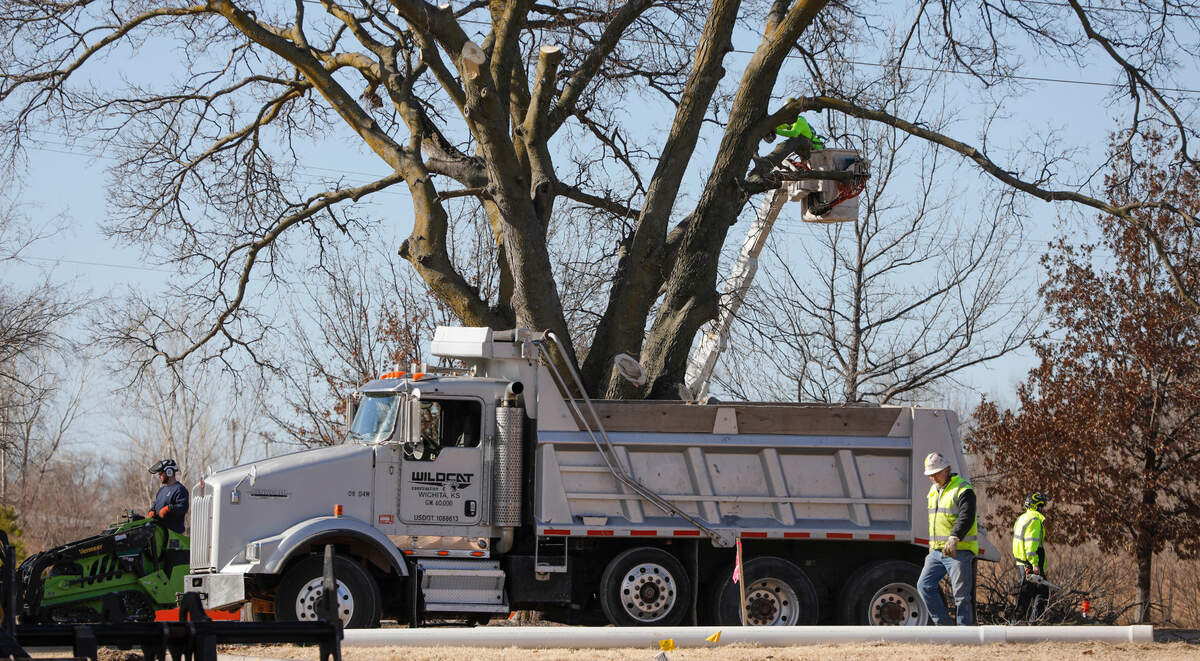
The issue of tree protection was thrust into the spotlight in January when the city chopped down without warning what was potentially the biggest and oldest hackberry tree in Wichita, frustrating residents of the Riverside neighborhood. The city said the tree had structural weaknesses and was unlikely to survive nearby digging to accommodate water pipes connecting the existing water-treatment plant to the new plant.
“While the city of Wichita is failing to keep pace in replenishing the tree canopy in its neighborhoods as older trees die, it has also actively contributed to the deforestation of the city through many of its recent development initiatives,” urban sociologist and Wichita State University associate professor Chase Billingham said.
Recent projects in Wichita have included the removal of mature shade trees that had been around for decades:
▪ Northwest Water Treatment Facility — Several acres of canopy were cleared to build the new water treatment plant near Zoo Boulevard and 21st Street.The city entered a conservation easement with the Kansas Department of Wildlife, Parks and Tourism to develop habitat for protected eastern spotted skunks on a 22-acre parcel owned by the city at the Cowskin Creek Water Quality Reclamation Facility near 135th Street West and 37th Street North. The agreement does not require the city to plant new trees.
▪ Naftzger Park — A redevelopment and redesign of Naftzger Park removed the trees that made the park the most shaded area of downtown and replaced them with astroturf, turning what was once a popular hangout for many in Wichita’s downtown homeless population into a public gathering place. Initial plans showed the city would save several of the more mature trees at the park, but they were later cut down.
▪ Botanica Koch Carousel Gardens — Mature trees surrounding city-owned Botanica Wichita Gardens were removed and replaced by an astroturf lawn at the city’s premier horticultural destination and a 350-stall parking lot. Trees were not added to the parking lot until after CanopyICT complained to the City Council in late March. Botanica Board of Trustees President and former City Council member Janet Miller said the city has planted 64 trees in and around the new parking lot and that the complaints did not drive the decision. She said more trees could be removed and replaced as part of an upcoming entrance project. Botanica has planted more than 450 trees in the past 10 years.
▪ Wichita State University’s Innovation Campus — Nearly 150 acres that were formerly Braeburn Golf Course east of Wichita State’s main campus have been transformed over the past eight years into a massive redevelopment project. Most of the property’s mature trees have been chopped down to make room for buildings, roads and parking lots. Dozens of smaller trees have been planted in the medians and on easements.
▪ Clapp Park — The 95-acre former golf course in southeast Wichita could face a fate similar to that of the Innovation Campus. A master plan approved recently by the City Council calls for much of the canopy to be stripped and re-purposed into a park with commercial businesses, parking lots, an amphitheater and pavilion, pickleball courts and a large “Aviation Hill” for watching planes fly to and from McConnell Air Force Base. The city plans to reconsider how many trees are removed as part of the project. “We’re going to save as many trees as we can at Clapp,” City Council member Mike Hoheisel said.
Billingham said some of those projects have contributed to “making our city a sunnier, hotter, and — especially for our most vulnerable residents, the homeless — more sweltering place.”
Steve Howard, another founding member of CanopyICT, said a new tree ordinance should require private developers — and the city — to protect trees.
“There’s no reason why you can’t encourage private developers to be good actors,” Howard said. “But right now in Wichita, Kansas, I’m not seeing a lot of good actors.”
What other cities do
Before the parks director Houtman came to Wichita, he worked for the city of Austin.
He said the Texas city has had a much more robust tree protection policy. There, most large trees are protected, meaning property owners must have a permit to remove them. A mature tree must generally prevent access to a property or be an imminent hazard, be dead or be diseased beyond saving to be removed.
On city property, a mature tree may only be removed if it prevents the opening of necessary vehicular traffic lanes in a street or alley or prevents construction of utility or drainage facilities that may not be feasibly rerouted.
Houtman said Wichita’s tree ordinance likely won’t be as comprehensive as Austin’s. He said it will primarily focus more on encouraging tree planting and preserving trees than requiring a permit to remove a mature tree.
“There’s a lot of things to consider in regards to private property and private development and what kind of things we can do to try to encourage that,” Houtman said. “A lot of that focuses on nonprofits taking the lead, nonprofits helping education with the state and the county with regards to educational material.”
Mayor Brandon Whipple said the City Council is unlikely to adopt an ordinance as restrictive as Austin’s. But he said he would like to increase the city’s tree canopy and protect mature trees.
“These are investments that taxpayers paid for,” Whipple said. “Is it finding areas in which we have land that we can actually plant some trees to offset the ones that have been aged out or cleared out?”
“We have done nothing about an ordinance so far, and we’re falling behind other cities, so it makes me want to bring people into the room who know more than I do about this and bounce ideas between us so that we can make the right policy moving forward,” he said.
Why trees matter
City arborist Gary Farris said the benefits of a healthy tree canopy are sometimes obvious and other times difficult to measure.
They help slow climate change by removing carbon from the atmosphere. They could increase the lifespan of city streets and sidewalks by shading them from the sun. And there is reason to think they are good for business: A shopping district with trees retains more customers, Farris says.
But possibly most important for Wichita: They clean the air, which in Wichita is frequently reduced to poor quality by wildfires and by controlled burning in the Flint Hills.
“We have a clean air crisis on the horizon,” Farris said. “It is my understanding that we are on the verge of falling into a category that the EPA will come in and say, your air is not clean enough; therefore, we are going to start mandating regulations on your vehicles and things like that.
There’s a lot of costs involved to the citizens if we cross that threshold. Trees help us not cross that threshold.”
An equity issue
Tree planting is also an equity issue, Houtman said. Neighborhoods with more renters, more people living on lower incomes and more minorities typically lose more tree canopy.
For example, when the city removes a tree from a city right-of-way, usually between a sidewalk and a street, those trees are replaced only at the request of a property owner. That sets up areas with a high concentration of renters to lose their canopy, Schlechtweg said.
“In those neighborhoods, the trees come down, but they don’t go back up,” he said.
Billingham, the urban sociologist, said the city could help vulnerable populations by properly funding its own forestry department.
“Numerous studies have documented that, in our segregated society, lower-income communities and communities of color have significantly less tree cover, on average, than wealthier and whiter neighborhoods,” Billingham said. “In cities, which contain a lot of pavement, shadier places are cooler places—often by several degrees—which is a big deal in a hot city like Wichita.
“That makes shadier areas more pleasant places to live and invest than hotter areas with less shade, contributing to widening inequality between neighborhoods. In this way, building our tree canopy is important not just for environmental protection, but also as a way to promote social equity,” he said.
The city of Wichita has partnered with NASA on an “Environmental Justice” project to create a heat map of the city and identify the areas that need more shade.
The NASA Develop program will use overhead maps and other technology to identify the hottest areas in the Wichita. It comes at no cost to the city and is set to begin in June.
“There’s planting in our public areas, such as parks and city buildings, but one of the huge issues with regard to equity is going back to the whole situation of redlining,” Houtman said.
Wichita was recently identified by the National Community Reinvestment Coalition as one of the three most “redlined” cities in the nation in the 1930s, with nearly 64% of its neighborhoods graded as “hazardous” by the federal Home Owners’ Loan Corp. Such redlining made it more difficult for neighborhood residents — largely racial or ethnic minorities —to get a home loan and contributed to generational poverty.
“We have a lot of areas — private property — that really need support in regards to planting trees,” Houtman said. “And if there was an opportunity to support that, to have resources so those folks could plant trees, which could reduce their electric bills, make their curb appeal even more, increase the value of their houses, there’s so many other opportunities that trees provide, other than just being a tree – it adds so much value to property and aesthetics – but where it really needs to be done is in the areas with the lowest income.”
Houtman said the city does not have any plans at this time to fund such a program.
“I’m hoping this NASA study can help identify those areas that are losing trees,” Schlechtweg said. “But we don’t have to wait for that study, necessarily. The city already knows it’s a problem.”
Room to grow
The largest potential for growth is on private property, Farris, the city’s tree expert, said. Homeowners play an important role in restoring the city’s tree canopy.
“For plantable area, you still have a vast majority that is privately owned versus under city control,” Farris said.
A tree canopy assessment in 2018 determined that nearly twice as much land could be used for tree planting as was in use at the time. Schlechtwag said environmentalists and the city should work to encourage owners to plant and maintain trees, especially in economically distressed areas and areas with a lot of renters.
He said before planting a tree, residents may check with nurseries or the Sedgwick County Extension Office for advice on what would be the right tree for their property.
“The next piece of advice is don’t plant a monoculture,” he said. “What that means is a lot of trees of the same species in the same area. If we have a disease in those trees or a problem with those trees and they need to be removed, it would transform the entire area.”
Homeowners also need to call 811 before digging to locate and avoid utility lines, he said.
The assessment found that City Council districts 1 and 6 — which include the College Hill and Riverside residential neighborhoods — have the highest percentage of tree canopy (26%) while District 4 in southwest Wichita — which includes Eisenhower Airport — has the least (18%). District 3, in southeast Wichita, has the highest potential for tree canopy (48%). But its tree canopy is at 25%.
Layton said the city likely won’t focus on regulating its private tree canopy anytime soon.
“We’re going to have to have a lot more discussions,” Layton said. “We’re going to have to get a little bit of input from developers right now, just to get their ideas about how far we should take this. And I think we’re going to take an incremental approach.”
Howard, of CanopyICT, said the city should bring more tree advocates into the decision-making process.
“We need to start looking at the system here. This economic development model that we’ve tried for 20 years, this idea that we’re going to build one more building on the river and it’s going to save us all, that’s just not going to happen. What we have is one of the most priceless ecosystems in the world, and we don’t even appreciate it.”
This story has been updated with comment from Botanica.
This story was originally published April 14, 2022 at 5:00 AM.