
Need a telescope? Now you can borrow one from the Wichita Public Library
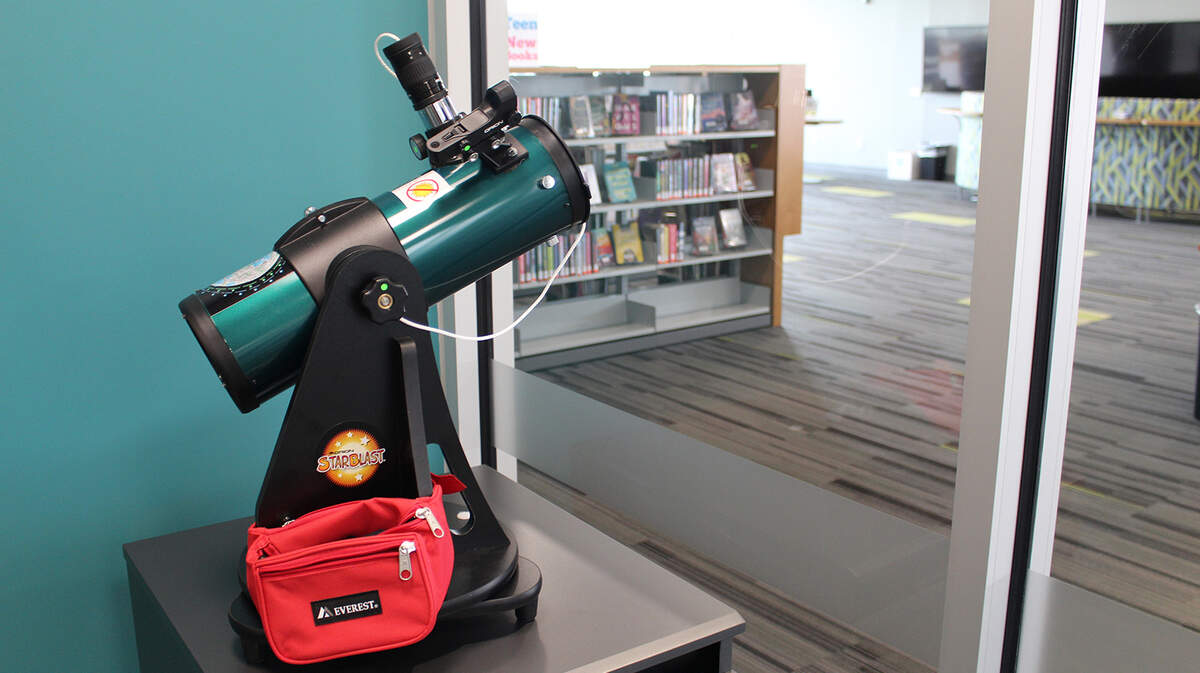
Starting July 12, Wichita Public Library patrons will be able to use their library card to check out telescopes for free.
The library purchased 11 new Orion Starblast telescopes, 10 for circulation, and patrons can borrow them for two weeks at a time.
“It’s an excellent program. I’m really excited about it,” said Jerelyn Ramirez, the president of the Kansas Astronomical Observers, whose organization has been working with the library to prepare the telescopes for the public. “Some telescopes are very complicated, but this one is the most simple telescope one can buy.”
The library purchased the telescopes through a donation by the Georgia Eakins family through the Wichita Public Library Foundation.
Wichita Public Library will join over 600 other libraries, and four in Kansas, that let patrons borrow telescopes through the Library Telescope Program.
“One of our focuses recently has been increasing access to STEAM- [Science, Technology, Engineering, Arts, and Mathematics] and STEM-related options from the library,” Sarah Kittrell, the collection development manager for Wichita Public Library said. “This is an opportunity for families to experience that together and help develop the love for astronomy.”
How do I check out a telescope and what comes with it?
The telescopes will be included in the library’s “Library of Things,” which requires a library card in good standing and the person checking the item out to be at least 18 years old.
Kittrell said that holds on the telescopes can either be done by contacting the library or online by searching “telescope” in the library’s catalog and then clicking “Request It” on the Orion Starblast telescope. They can be checked out at any location.
The telescope will come with an instruction manual, a constellation guide and a red headlamp for reading the instructions at night without losing your night vision.
In addition, before taking the telescope home, library staff will provide an overview of how to transport the telescope, how to care for it, and go over the basic features of the telescope.
Based on the telescopes’ popularity at other libraries, Ramirez recommends that those interested in borrowing a telescope place a hold on it as soon as possible.
“Once patrons discover this telescope program, there have been known to be really long waiting lists because it becomes extremely popular,” she said.
According to the library’s website, there are already more requests for telescopes than the library has available.
What can I see with a telescope?
Provided the sky is clear, the moon and some of the nearest planets to Earth, including Mercury, Venus, Mars, Jupiter, and Saturn, should be easy to see with the telescope, according to Ramirez.
In addition, there are many deep sky objects, celestial objects located outside of the solar system, that can be viewed with the telescope.
“Charles Messier was an astronomer back in the 1700s and he catalogued . . . 110 different [deep sky] objects. He had a telescope that wasn’t even as powerful as this one,” Ramirez said. “You are able to see all of those objects that he cataloged. That includes some globular clusters, open star clusters, some nebulosity, even galaxies.”
To help you determine where to look for objects in the sky, the Library Telescope Program website recommends Skymaps.com, which publishes a free, downloadable monthly sky map. Other websites such as Sky & Telescope provide interactive sky maps that can be adjusted based on geographic location, date and time and some smartphone apps allow you to point your phone at the sky to see what stars and constellations you are looking at.
According to Sky & Telescope, Venus and Mars should be visible in the western sky at dusk, while Jupiter and Saturn should be visible in the southern sky later in the night and early morning this week.
How can I get the most use out of my telescope?
For an ideal telescope observing experience, Sky at Night magazine makes a few recommendations.
First, consider the temperature and dress appropriately. In addition, Ramirez says to check the weather to ensure that the sky isn’t too cloudy for observing.
Second, for best visibility, pick a location away from tall objects like buildings and trees that may block your view. Also, consider areas with less light pollution that will make it harder to see faint objects in the sky. If you are at your home, consider turning out the lights.
Finally, give your eyes about 30 minutes to adapt to the darkness so that you will be able to see more stars with your naked eye. Browsing your phone during this time can cause your eyes to need more time to adapt. If you must browse your phone, turn the brightness down and consider using night mode or using a red filter to preserve your night vision.
This story was originally published July 12, 2021 at 12:03 PM.