
‘They saved me.’ The story behind a routine medical 911 call in Sedgwick County
News reporters always listen with half an ear to the newsroom police scanner, in case something interesting happens — a shooting, a homicide, a bad wreck.
We ignore thousands of routine calls — “difficulty breathing,” for example. On those calls, over my 42 years working in newsrooms, (21 at The Wichita Eagle) I never tried to learn names, or what the story was.
No story there. Right?
But last month — two days after I got out of the intensive care unit, with a green tube still whispering life-giving oxygen into my nose, out of gratitude to six people who saved my life days before — I finally made that call to 911’s non-emergency number here in Sedgwick County. I tracked down those six names — at first only so I could send thank-you notes.
But now I’m writing this story — to remind us that we are surrounded by rescuers every day.
Sedgwick County’s 911 dispatchers answered 510,000 emergency calls last year, more than 50,000 of them medical calls like mine. There are 475 paramedics/emergency medical technicians. Many answer hundreds of 911 calls apiece every year. Supervisors say these calls often traumatize dispatchers and first responders. The dispatchers and “call takers,” said their director Elora Forshee, “provide CPR instructions to mothers who have just found their children not breathing. We talk to sons and daughters who have just watched their parents take their last breaths. And at times we are the last person somebody talks to before dying on the phone with us, sometimes at their own hand.”
They don’t save everybody.
But they saved me.
5 p.m. Tuesday, Feb. 2
Dispatcher: “911, what is the location of your emergency?”
Polly Wenzl: “Forty-three Forty… No! Sorry! 1486 (street name). My husband is having a pulmonary el…embolism.”
Kaylyn Perez, the 911 “call taker,” answered my wife’s 911 call on the first ring, speaking in the flat, measured tone that 911 call-takers are taught to use — the words deliberately slow-paced — to calm the caller. Polly needed calming: In her panic, she’d begun to mistakenly recite the address she’d lived at before we’d moved into our current home five years ago.
Kaylyn: “Could I have you repeat that address one more time for verification, please?”
Polly: “One, four, eight, six,” Polly couldn’t remember our address — so she ran outside and dictated our house number bolted to the wall outside.
Kaylyn: “And sorry, real quick, what number are you calling from?”
Polly: “Yes.” Polly gave her cell number. Then: “PLEASE hurry.”
Kaylyn: “Okay, and what is the nature of your…
Polly: “PLEASE hurry. He’s having a pulmonary embolism. He’s collapsed. He’s had one before.”
Seconds to get help
I had felt funny for a month — and said nothing to Polly.
Polly’s a worrier. I dismiss her worries. I thought there was nothing wrong that more exercise couldn’t fix.
I do punishing workouts to stay fit. But for the past month, I’d sat down after every weight-set. The day before, when I climbed my usual 500 stair-steps in the stairwell connecting our kitchen to our office room downstairs, I sat down short of breath after every 12 steps.`
I remembered how HBO’s ruthless gangster Tony Soprano once told his fat fellow gangster Bobby Baccalieri — “If I were you, I’d seriously consider salads.” The thought of calling a doctor because I am overweight, 65 and breathing hard, did not register in my man-brain.
So, when I got up from dinner that night — and felt funny — I didn’t even glance at Polly, or Henry Elliott, my stepson, who were lingering over Jason’s Deli take-out.
I walked to the kitchen, tugging up the sleeves of my shirt to wash dishes. I loved that shirt — flannel, soft as baby skin, bright colors. Within minutes a woman I’d never met would cut my shirt off my chest.
I glanced left, into our stairwell, and said a swear word. Polly and Henry had left the downstairs office lights on again.
I walked down the 12 steps, shut off lights and began climbing to the kitchen.
On stair-step number six, I felt a light jolt in my lower gut.
There it is, again. What IS that?
By stair-step nine, my middle gut clenched.
When I reached the kitchen and gripped the sink rim, my entire torso convulsed — a torso-sized angry fist. Shocking suffocation, every molecule of oxygen sucked from my lungs. It had happened before. I knew I had only seconds to talk.
“Polly!”
“Yes.”
“I’m having a pulmonary embolism.”
I hit the linoleum floor face-first, breaking my upper lip into a bloody wound.
But I didn’t know this. I was as blank to pain as any highway cluster of feathered roadkill.
It felt like hours
Polly: “PLEASE hurry.”
Kaylyn Perez, the 911 call-taker, had gone silent for 20 seconds as she tapped our address into her computer and studied a computer-screen map.
Polly: “Please hurry! He’s unconscious.”
Kaylyn chose Station 7, one of 22 Wichita Fire Department substations, located a mile and a half north of our home. She called them out and called out an EMS ambulance two miles south of us, based at the old Riverside Hospital building.
Kaylyn could hear Polly’s panicked breathing. Polly ran outside again to flag down rescuers, though they were long minutes away. Henry knelt beside me, watched my face turn gray; if this was a pulmonary embolism, there was little he could do.
Polly: “Please hurry.”
Kaylyn: “Okay, are you with him?”
Polly: “Yes. Well. I’m outside the house now but can go back in his direction now.” More ragged breathing.
Kaylyn: “How old is he?”
Polly: “Sixty-five. Okay, I’m with him now.”
Kaylyn: “Is he awake?”
Polly: “No.”
Kaylyn: “Is he breathing?
Polly: “Yes. Are you going to be able to send somebody?”
Kaylyn: “I’ve made the call. They are going to get out there as soon as they can.”
Less than a minute had passed. To Polly it felt like hours.
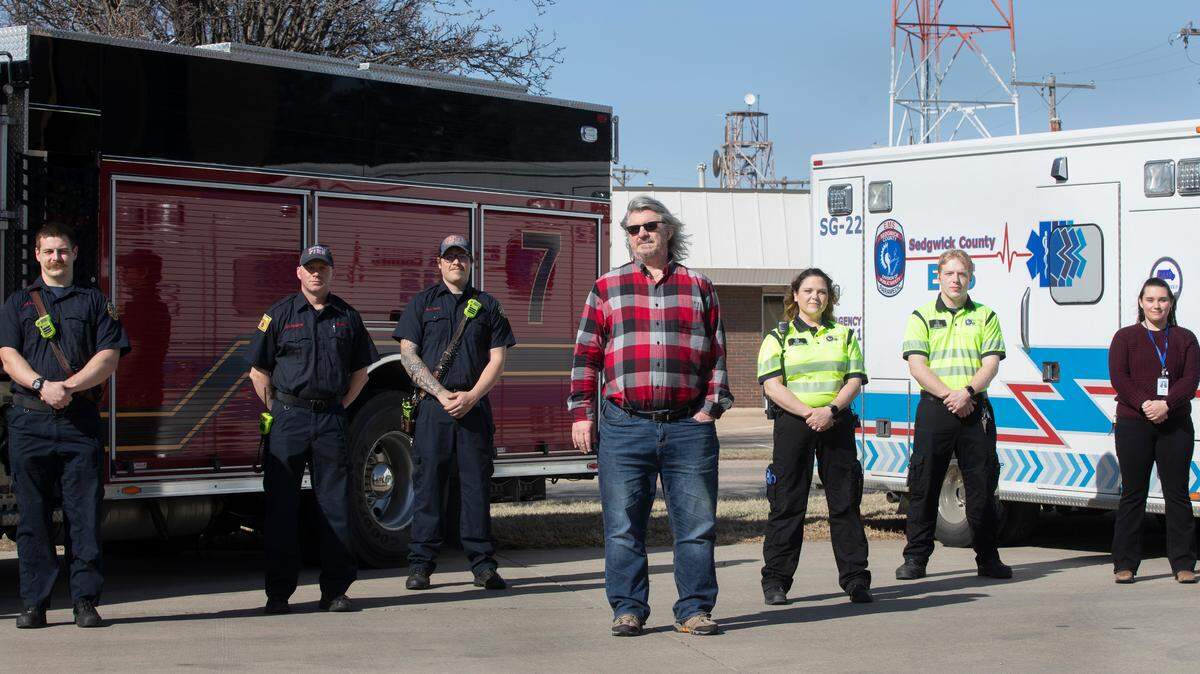
At Station 7, Wichita Fire Capt. Rocky Bumgarner and two fellow firefighter/paramedics, Garrett French and Dalton Scott, stepped aboard the long, red, chrome-edged body of Engine 7. In the ambulance four miles south, two EMS paramedics, Stuart Fayette and Sarah Cindric, listened to the emergency channel to prep for whatever my problem might be. They heard “difficulty breathing.”
They turned on their sirens. Four minutes later, Sarah and Stuart walked into my kitchen.
‘Please hurry’
Five years before, after my first near-fatal embolism, I’d asked my cardiologist why I survived.
That clot had passed through my heart, Dr. Wassim Shaheen said. Then it draped itself across the junction of both major blood vessels leading to my lungs. The clot stayed there for half a minute or more and began killing me — but then moved ever so slightly, allowing some oxygen into my lungs. My face turned gray, but I slowly got better.
New blood clots move quickly in the bloodstream once they break loose inside us, Dr. Shaheen said. They are often lethal, always sticky – they stick hard onto the insides of our blood vessels once they land somewhere. But before they land, they travel to our heart and lungs, dancing unattached through our big blood vessels, riding the flow.
If you are lucky, Dr. Shaheen said, the clot might shift a bit as the heart pushes blood against it.
Polly: “PLEASE hurry.”
On Feb. 2, hours after my second collapse, a hospital scan would show that I’d formed multiple blood clots in both lungs in the days before. One of them had broken loose and was trying to kill me.
Would I be lucky again? The 2016 clot never knocked me out; but this clot was more belligerent. Henry saw my face turn from gray to blue. Inside me, as an echocardiogram showed later, my heart began to damage itself as it pumped against the blockage.
Kaylyn: “I’ve got the paramedics on the way. Is he changing color?”
Polly had run outside again: She called out to Henry.
Polly: “Henry, is he changing color?”
Henry: “Yes.”
Kaylyn: “Describe the color change.”
Henry: “Gray?”
Polly: “NO, he’s turned purple!”
Kaylyn: “Stay on the line, I’ll tell you what to do next.”
Polly: “Ok.”
Henry: “His breathing is labored, HEAVILY labored.”
Kaylyn: “Listen carefully. Lay him flat on his back, put your hand on his forehead, the other hand behind his head. Tilt his head back.”
Polly: “Henry, she says turn him on his back.”
‘Crap — I’m dead’
What does dead feel like? It’s instant nothing.
It is … void, an absence of moments and hours and seconds, an infinite, yawning Big Nothing deeper than sleep. If you are lucky enough to wake up from that place, it seems to you that you’ve been out for hours, not moments. In the realm of Nothing there are no words, no thoughts, no memories — no joys or regrets. There is only that tiny microsecond of awareness when you sense that time both stretches to the infinite and ends so abruptly that time never existed.
And neither did you.
Polly: “Please hurry.”
With Henry’s help, I rolled onto my back. The clot shifted. There is an up-side to being unconscious or dead: You don’t feel the strangling suffocation I felt now. I gasped and gasped.
I passed out again — and woke up seconds later.
Henry: “He’s got blood in his mouth, possibly coughing up blood.”
I blinked my eyes open, saw grief on Henry’s face.
Blood in my mouth? Crap — I’m dead. Coughing up blood is a symptom of the deadliest pulmonary embolisms — as I had read after my 2016 attack.
I felt hands on my face as Polly tilted my head. I looked at the kitchen light — fluorescent glare staring fiercely into my eyes. I gasped so long that my mouth dried — it later took two days for my tongue-tip to regain feeling.
Kaylyn: “Stay with him, and I’ll stay with you until they arrive.”
Me: “I can’t get enough air.” I forced out the words.
I heard a siren.
Polly: “Sirens. I hope it’s coming our way.”
Kaylyn: “I’ll stay with you until they come.”
I looked to my left, saw my eyeglasses on the floor — popped off my face when I fell. I reached for them — they would get crushed under firefighter boots. But why should I care? I won’t need glasses anymore.
I passed out again. When I awoke, I saw EMS paramedic Sarah Cindric’s masked face, leaning close to mine.
“Stay with me, sir. We got this.”
“What’s with the blood on his face?” a voice said.
I felt fingers on my broken lip. “Looks like he hurt his lip,” Sarah said. “I don’t think it’s from his lungs.”
I passed out and woke up again. I felt Sarah’s hands pulling a plastic green mask onto my face; I felt an elastic strap snap into place. “Oxygen,” she said. “This will help you, sir. I know this is tough, but we got you. We got this.”
Stuart tossed down an EMS soft-cot beside me. Stuart, Garrett, Dalton, and Rocky worked shoulder-to-shoulder in our small kitchen. I felt hands tug my shirt-tail, heard the snip-clack of scissors.
“I’m cutting off your shirt and tee-shirt, sir,” Sarah said. “We need to get at your chest.”
They saw that I was purple from my upper chest to my hairline. Doctors in our COVID-19 time tell us that if our oxygen level drops below 90 percent, we should go to an emergency room; when Sarah tested mine, it was 66.
Stuart and the firefighters knelt beside me. Rocky gave one quick command after another — what to do, how to do it, how to do it fast.
Rocky saw my eyes open. “Do you think you could scootch yourself onto this cot?”
“No way,” I said. I saw them glance at each other, shaking their heads. I should seriously consider salads. My weight might injure the lower backs of four good men.
Sarah’s oxygen, pouring into my mouth, began to take hold. Maybe I’m not dead after all.
They lifted me.
My body spasmed; Sarah told me later that my arms began shaking involuntarily.
“Seizure, he’s coding,” Rocky said. “Put him down! Put him down!”
One in 3 die
After my first attack in 2016, Dr. Shaheen told me that one in three pulmonary embolism victims die, unless the embolism “is treated immediately.”
That’s why this rescue counts as a save.
Did the clot shift in my favor? Yes — but then it shifted back, and I turned blue again. I passed out again and again because the clot hovered over an artery junction. My heart swelled like a balloon, (so doctors said later). But Sarah’s oxygen, reaching my lungs as I turned blue, began to take hold.
Unless treated immediately.
In our yard, as my chest rose and fell with every breath, Rocky asked: “Which hospital?” Polly said “Wesley,” out of habit.
I saw firefighters glance at each other — and hesitate. “We’ll take you where you want to go,” Rocky said. “But Wesley’s seven or eight miles and St. Francis is two.”
“St. Francis then.” Polly kissed my blue forehead. She had little expectation of seeing me alive again. Neither did I.
We rolled to St. Francis, with Sarah planting an IV needle into the crook of my arm, then putting sticky pads on my chest for an ambulance-ride EKG.
I passed out, woke up.
“Code Red,” Sarah said. She was talking on the ambulance radio to St. Francis.
“What does Code Red mean?” I asked. (I already knew).
“It means you’re sick,” Rocky said.
“Uh-huh,” I said.
Rocky saw my grin.
“It means you’re sick,” he said again.
“Does it mean I’m critical?”
Hesitation. Then: “Yes.”
I turned to Sarah.
“I know what this is.”
I gasped a few breaths, then: “Good chance I’m a dead man, but that’s not on you guys.”
Sarah frowned, cocked an eyebrow.
“Oh, not on MY watch.”
‘We will never forget’
“Dear Sarah,” I wrote. “My mother Rosie is 86 and fragile. I’m husband to Polly; father to Rose, Eric and Kristina; stepfather to Henry….
I wrote to EMS paramedics Sarah Cindric and Stuart Fayette, to 911 call-taker Kaylyn Perez, to the firefighters Capt. Rocky Bumgarner, Dalton Scott and Garrett French:
“I’m grandfather to Olivia, Natalie, Charlotte — and one more:
Seventeen days after my rescue, my fourth grandchild was born: Eliza Michelle Bukowski. I got the gift of knowing all about her arrival, and I saw a picture of her, wearing a cute cap and booties.
“We are family. They would have suffered but for you.
“We will never forget your names, or what you did.”
This story was originally published March 14, 2021 at 6:01 AM.