
Things are looking up for the once-abandoned Lake Afton Public Observatory
Once left for dead, the Lake Afton Public Observatory is on the rise with a new look, new exhibits and a new telescope.
Since volunteers resurrected the observatory in 2016, they’ve updated the facility and are now preparing for a party to celebrate the 50th anniversary of the first Apollo moon landing on July 20, said elevator contractor and space enthusiast Fred Gassert.
“There is a passion and you’ll see that when you come out here,” Gassert said, standing in the observatory’s metal dome. “Anybody that’s working out here is passionate, as passionate as I am. We’re just excited to talk about what we do.”
Gassert is president of the nonprofit board that runs the observatory and past president of the Kansas Astronomical Observers, the volunteer group that saved it after Wichita State University shut it down in 2015 to save money.
Gassert recently gave a progress report to Sedgwick County government, which owns the building. County commissioners congratulated the observers’ group on their perseverance and success in saving and improving the observatory.
“The community wanted to keep it,” Commissioner Jim Howell said. “And somehow, (through) partnerships and a lot of involvement by a lot of volunteers, it endured. And I’m so thankful that it’s there.”
Since the volunteers took over, they’ve made numerous improvements, including:
▪ A new telescope — The centerpiece of the observatory is a massive 16-inch Ritchey-Chrétien reflector telescope that belonged to WSU, but was donated to the volunteers group when they took over.
Now, the main scope has been augmented with a six-inch refracting telescope, used for wide-field observation and photography. A benefactor has donated the use of the telescope for as long as the observatory wants it, Gassert said.
▪ New controls — The software to point the telescope ran on a DOS operating system that’s been obsolete for decades. The system has been replaced by a modern computer that runs on Windows. Three donors funded the $6,000 project, the biggest single expense so far in upgrading the observatory.
▪ New exhibits — Several science exhibits have been restored, replaced or updated, including a popular interactive exhibit called “One in a Million.”
“The tub there has 1 million white pellets in it and one black one, and you roll it ‘til you find the black one,” Gassert said. “It kind of gives you an idea of what one million of something is, so when you’re looking at stars, you’re looking at galaxies, what does that really mean.”
▪ Computers — A volunteer built a four-station work center with donated computers where space enthusiasts can run astronomy programs and children can play science games. The observatory has applied for a grant for new computers so the current ones can be put to use elsewhere in the facility.
▪ Dimmer lighting — Volunteers installed diffusers over the lights to cut down the brightness in the exhibit area. That was a problem because the telescopes are in a darkened room.
“White light really affects your night vision,” Gassert said. “If you went into the observing room (after spending time in the exhibit area), you couldn’t see to get in there to where the telescope was.”
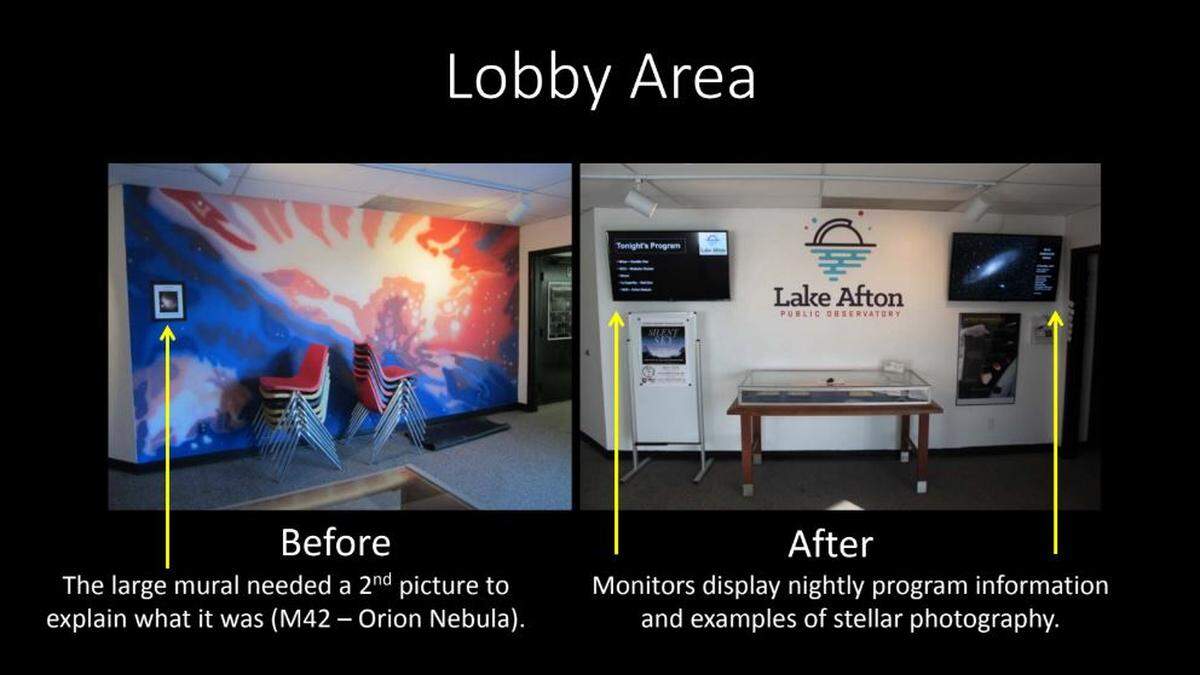
▪ Lobby improvements — “There was a mural on the wall of an abstract (painting) of the Orion Nebula,” Gassert said. “We’ve painted over that, much to the chagrin of some of our volunteers.”
In its place is the new logo of the Lake Afton observatory and two monitors displaying program information and examples of stellar photographs taken with the telescope. Also, the admission desk area has been tidied up and volunteers added a small gift-shop area with shirts and souvenir items for sale.
▪ Dome motors — One of the first things the donors found out when they took over was that the rotating dome that protects the telescope had a tendency to get stuck. “When it got about a third of the way around, we would have to climb up on a ladder and pull on it while somebody was running it,” Gassert said. “It was kind of dangerous.”
It turned out there were supposed to be two motors to run the dome but there was only one, he said. Now the second motor’s been put in and the dome spins all the way around
Gassert said the board has also received a grant from an astronomy enthusiast’s estate to update monitor screens in the “light trap,” the area of transition between the exhibit room and the observation dome.
The observatory is at the north end of the county’s Lake Afton Park, off MacArthur Road about 10 miles west of Wichita Eisenhower Airport.
It was originally a joint project of WSU, the county government, the city of Wichita and the Wichita school district. Over time, sponsors dropped off, leaving the university to run the facility by itself.
The observatory was once a money maker for the university, but use had declined dramatically by the time WSU closed the facility.
Easy access to stunning space photography on computers and smart phones played a part in the declining attendance, along with a shifting focus in science education that de-emphasized astronomy in favor of more career-oriented education in biosciences and engineering.
Since its revival, the facility runs on a shoestring budget: $17,250 in revenue and $15,228 in spending last year.
About 87 percent of that comes from admission charges and memberships. Merchandise sales and donations make up the rest.
“It looks like your business model works,” Howell said. “It’s not like there’s a lot of extra money there but it looks like it is sustainable.”
If you go
What: Lake Afton Public Observatory offers area residents the chance to view space objects, from the moon to distant galaxies, through high-power telescopes. The facility also includes interactive science exhibits.
When: Friday and Saturday nights, 9 p.m. to 11:30 p.m. for the current summer season.
Where: At the north end of Lake Afton Park, off MacArthur Road about 10 miles west of Wichita Eisenhower Airport.
Cost: $8 for adult, $7 for seniors, $4 for youth 5-13, or a maximum $20 per family.
Upcoming events: July 20, celebration of the 50th anniversary of the Apollo 11 moon landing; Aug. 10, Astrofest; Oct. 5, International Observe the Moon Night.
More information: 316-448-6911
This story was originally published May 4, 2019 at 8:00 AM.