
Twenty years later, life goes on for families of Oklahoma City bombing victims (VIDEOS)
She heard a couple of pops and then the line went dead.
The walls of the portrait studio in which Tina Tomlin sat shook as she put down the phone.
It was part of her routine to call her husband, Rick, every day at 9 a.m. at the Department of Transportation in downtown Oklahoma City, where he worked. Rick, 46, had been talking about how he needed to go to the credit union to make a deposit.
That was the last conversation Tina had with him.
Rick Tomlin – who grew up in Little River – was killed along with 167 others when a 5,000-pound bomb detonated below his fourth-floor office at the Alfred P. Murrah Federal Building on April 19, 1995. The 20th anniversary of the worst act of domestic terrorism will be remembered in a ceremony Sunday in Oklahoma City.
“I don’t think you ever come to terms with it,” Tina Tomlin said. “You learn to live with it.”
Falling in love
Tina, now 62, has never remarried. She lives in Oklahoma City with her 9-year-old strawberry-blonde Pomeranian, Fancy.
“If I’m just not feeling really whippy, she’s right there beside me,” she said. “It’s funny. She knows.”
She still keeps a 16-by-20-inch photo of a smiling Rick over her fireplace.
Tina described how she first met Rick in the summer of 1969: He was the cute new guy who moved into her friend’s apartment complex in Hutchinson.
“We had a good summer together and decided that we were really in love,” she said.
Rick enlisted in the Navy later that year. After finishing boot camp, he made a trip back to Hutchinson with an urgent question before deploying to Vietnam.
It did not come as a surprise to Tina when Rick asked her to marry him, she said. He had been writing her love letters from boot camp for months.
They were married on Valentine’s Day 1970 – so that Rick could remember their anniversary.
After Rick finished his three years of service with the Navy, he took a series of jobs at grain elevators and oilfields in Kansas until he decided he wanted to work for the federal government, Tina said.
Their sons, Richard and Jeremy, were born in 1970 and 1974. The family moved to North Carolina for a while before relocating in 1991 to Piedmont, a town of around 5,700, 12 miles northwest of Oklahoma City. Rick settled into his new job with the Department of Transportation, where he regulated semi drivers, Tina said.
And then April 19 happened.
Tina and Jeremy left Glamour Shots, where they both worked, and got downtown as fast as they could. They arrived at the scene as plumes of smoke billowed from the Murrah Building.
“I didn’t really focus on the building because there were a lot of people standing across the street in front of the building in suits – I just knew he was standing in there,” she said. “I was just really sure he was standing over there. Unfortunately he wasn’t.”
Marines coordinating a search-and-rescue effort found Rick’s body less than two hours after the explosion. He was killed by a shard of shrapnel that entered his skull through the temple. On his other temple, there was an indentation where the blast had pushed the phone he had pressed to his cheek just hours earlier.
Jeremy said he was lost after his father died. He was a 21-year-old who thought he knew “more than everything.”
“It changed everything,” Jeremy said. “You go to work one day, you come home and it’s never the same. I matured a whole lot quicker, I believe, because of it.”
Jeremy and his father had worked for a while on a 1968 Plymouth Road Runner they had bought together. After Rick died, Jeremy finished the car work by himself and would take the Road Runner on drives through the countryside at high speeds.
Jeremy, now 41, stayed close to Tina and still lives relatively close, she said.
“I’ve been trying to help my mom and get things situated,” Jeremy said. “Trying to keep the homestead going.”
An epitaph on Rick’s tombstone at Hutchinson’s Fairlawn Burial Park reads: “Killed in the Oklahoma bombing. Let us never forget.”
Next to that, a photo taken of Rick and Tina’s last Christmas together is engraved in the shape of a heart into the stone.
Underneath that: “Forever in love.”
Good memories
Some who lost loved ones in the bombing have coped in a different way. Henry Biddy, who grew up in Wichita, said he has found peace by putting the bombing out of mind.
His wife, Oleta, worked for the Social Security Administration on the first floor of the Murrah Building. She was one of the last to be found – her remains were returned to the family 17 days after the bombing.
Henry did not attend any of the post-bombing memorial ceremonies, his brother Gary said.
“I asked him if he was going … to the site for the 10th anniversary of the bombing, and (in) the style which is very much my brother, he replied, ‘No, that was the worst day of my life. Why would I want to go back down to remember that?’” Gary Biddy wrote in a letter to The Eagle.
Henry, now 76, doesn’t like to remember the bombing, so his brother Gary does the remembering.
“I just figure that (Timothy) McVeigh and (Terry) Nichols messed up my life enough – I don’t need it messed up any more,” Henry said in a phone interview. “I try to get along with it. You never forget.”
McVeigh and Nichols were convicted of plotting and carrying out the bombing. McVeigh was executed for his crimes while Nichols is serving a life sentence.
Henry Biddy talked publicly about the bombing for the first time in 20 years last week. He said he is reminded of Oleta every day, which he’s fine with.
“They’re good memories – they’re not bad memories,” Henry said. “I don’t remember the bombing, per se, as a bad memory. My memories of Oleta are all good.
“We had a great and wonderful life together for 32, 33 years. It wasn’t like I could do anything about it.”
Gary Biddy, his 72-year-old brother, does his part to keep Oleta’s memory alive – namely by attending nearly every anniversary ceremony the Oklahoma City National Memorial has hosted since the bombing.
“I loved Oleta very much and miss her terribly,” he wrote in the letter. “Oleta loved my brother and his family, she loved her son Daniel and grandsons with a greater love than what will ever be described in this letter.”
Henry and Gary’s parents moved to Wichita from Tuttle, Okla., in 1950 so that they could take jobs in the aircraft industry. The brothers both attended Wichita West High School – though Henry enlisted in the Air Force before graduating.
After boot camp, Henry was stationed at McConnell Air Force Base. Then he met Oleta, who graduated from Wichita Southeast High School in 1959.
He moved to Oklahoma City while Oleta was still in Wichita. Every weekend, he would drive back to Wichita to see her.
Though Gary compared his brother’s looks to that of a movie star, Oleta was the first and only girl he took home to meet the parents.
“He would bring her flowers and he would bring her candy – he won her heart, and had it till the day that she died,” Gary said in a phone interview. “They had a very special relationship. That Oleta was … the best person I’ve ever seen.”
The two got married on April 8, 1961, and moved to Oklahoma City. Oleta gave birth to a son, Daniel, shortly after they were married.
After the two moved to Oklahoma City, Oleta started working as a service representative for the Social Security Administration. She came to work promptly at 9 a.m. every day and sat by the front door of the Murrah Building.
When news of the bombing hit, Gary rushed downtown and saw the rubble, knowing that Oleta had been buried underneath.
“It all came down on top of her,” he said. “I knew then that she wasn’t coming home.”
Henry spent the day at home surrounded by friends, silently clutching his newborn grandson, Lane, close to him, “as though his life depended on it.”
Henry has since remarried another Wichita woman, Gary said, though they live in a different house because “Oleta’s ghost was everywhere” in the old house.
Gary said in the letter he goes to the remembrance ceremonies “not in my brother’s stead, but on my own volition to honor not just the life of Oleta … but also (to) remember all the policemen and the hundreds of firefighters.”
And as he does every time there’s a remembrance ceremony, he will place a yellow rose – Oleta Christine Walters Biddy’s favorite – on the chair with her name on it.
Life goes on
Jeremy Tomlin, who now works as a medical coder in Oklahoma City, said there is not a day that he doesn’t think about his father and the other 167 victims of the bombing.
“You learn to deal with it,” he said. “We move forward. You never forget it, but you can’t stop living because of it.”
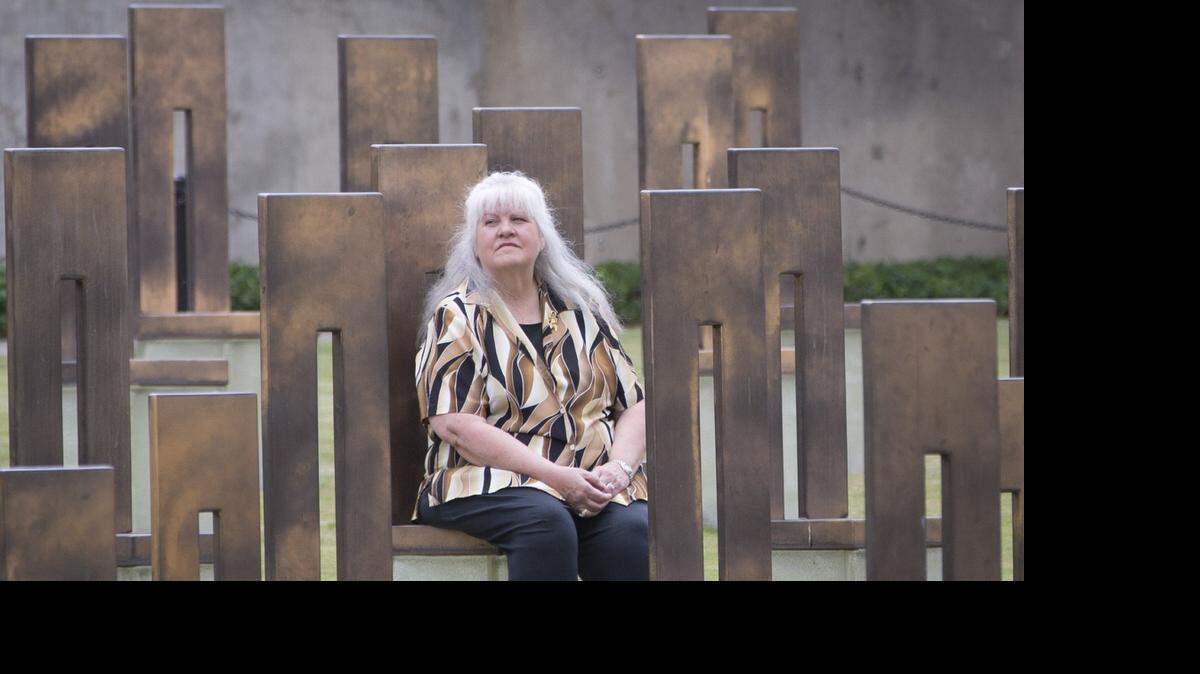
Tina brought herself to sit on Rick’s chair at the Oklahoma City National Memorial last week. She said it was the first time she had been there in five years.
“I didn’t like it,” she said. “It was very emotional. It’s hard. It’s very hard.
“It brings up a lot of stuff; a lot of memories and a lot of heartache.”
Every Friday, Henry and Gary Biddy drive into Oklahoma City to get hamburgers for lunch. And on the way back to Tuttle, they stop at Sonic for ice cream cones, which Gary said he pays for.
“He can freely talk about Oleta with me,” Gary said. “He will remember things about Oleta and remember things about Oleta’s family, and the way she did things, and the way she would laugh, without exception every week.
“She’s very definitely in his mind, and I don’t doubt that he remembers her every day.”
Oklahoma City has not forgotten. But life goes on.
“You know, the Bible tells us that God will give us a peace that surpasses understanding, and that’s what I have with that,” Henry said. “I know where she is, and someday we’ll all be up there together.”
Reach Matt Riedl at 316-268-6660 or mriedl@wichitaeagle.com. Follow him on Twitter: @riedlmatt.
This story was originally published April 18, 2015 at 9:56 PM with the headline "Twenty years later, life goes on for families of Oklahoma City bombing victims (VIDEOS)."