
Retiring Wichita airport federal security director reflects on TSA’s evolution (VIDEO)
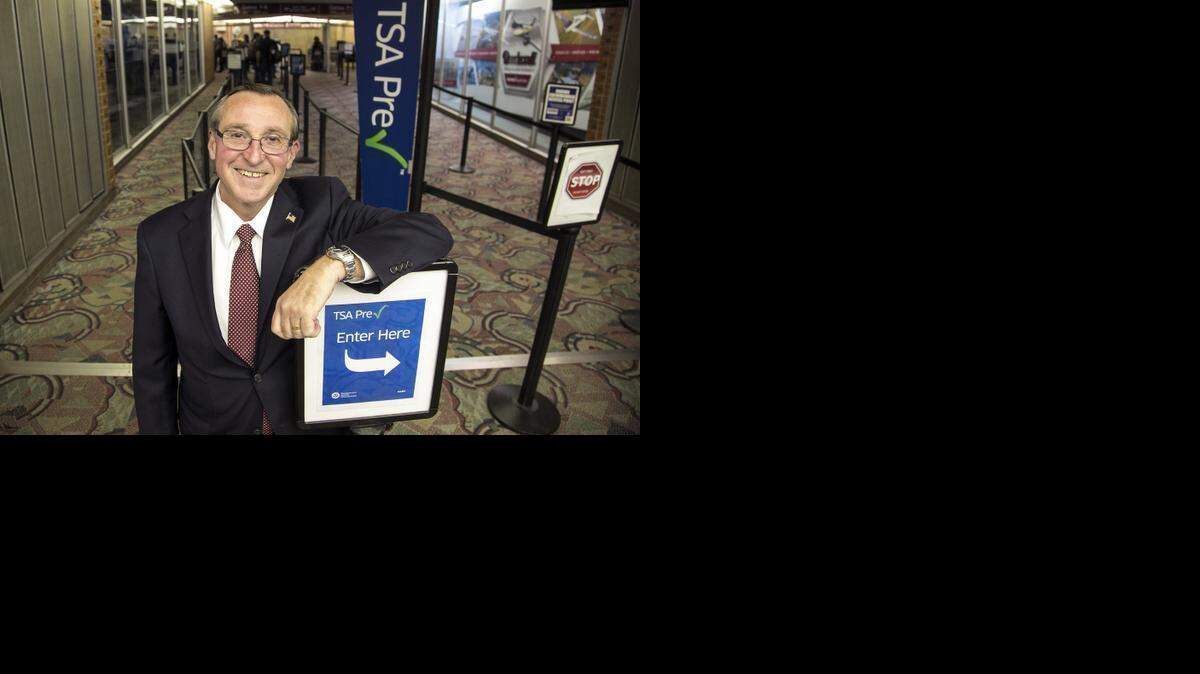
He has been here since the beginning, when the physical and psychological scars of 9/11 were still fresh and all he had was a cellphone, a laptop and a pager.
As the only federal security director for the Transportation Security Administration that Kansas has ever had, Keith Osborn has shepherded TSA operations in Wichita from trying to shoehorn passenger and baggage screening into an airport that opened in 1954 during the Eisenhower administration to the opening of a new airport terminal that bears the famous Kansan’s name.
Though it has been little more than a decade, Osborn said, the evolution of airport screening and security has been as dramatic as moving from the days of the pioneers to the space age.
“That’s a good way to put it,” Osborn said.
Osborn, 64, can see the new terminal looming across the airport grounds in Wichita but will never step foot in it as federal security director. He will retire May 1, shortly before the terminal officially opens. Osborn will be replaced by Jay Brainard, who currently works in Portland, Maine.
“I’ve had a lot of input on how it turned out,” Osborn said of the design of the TSA security area in the new terminal. “I’ve been over there numerous times. I’m delighted with the progress.”
He takes satisfaction from that and from knowing that new technologies and more operating space will significantly improve the screening process for TSA employees and passengers alike.
“I’m pretty confident from what I’ve seen that it will work pretty wonderfully from a TSA perspective,” he said. “I think the passenger will enjoy it more, too.”
Suspicious of everyone
Osborn spent more than 28 years in the military, the last two at McConnell Air Force Base, before retiring at the end of August in 2001. That retirement lasted only a matter of days.
He was recalled to active duty in the wake of 9/11 before retiring again early the next year.
When Osborn started his job as a federal security director in 2002, “we were creating something out of nothing.”
“A lot of my military experience came in very handy, having to deploy to far away places and showing up and in a matter hours being expected to run flight operations.”
Osborn remembers vividly the first time he called the TSA’s national headquarters and someone actually answered the phone. For weeks, he said, it was routine to leave a message and hope someone called back the same day.
The first TSA X-ray machines screening luggage at Mid-Continent Airport only showed shades of gray, Osborn said.
“The challenges the officers put up with are just tremendous compared to what they have now,” he said.
In the early years of the TSA, Osborn said, “We were suspicious of absolutely everyone. Based upon what had occurred, I think that was the right attitude to have.
“I won’t say you had to prove you weren’t a terrorist, but you had to prove you were trustworthy.”
Public outcry and improved technologies eventually led to changes in procedures by the TSA.
“Sometimes, we have been guilty of doing things perhaps we shouldn’t have,” Osborn said. “I won’t argue that.”
There have even been some local TSA agents who “may not have had as much integrity as they needed,” he said.
While those instances have been rare in Wichita, Osborn said, he acknowledged that many fliers have an unpleasant TSA experience to share from somewhere on their journeys.
“Over time, a lot of those functions have changed … all for the better,” Osborn said. “We’re more focused on an individual passenger instead of a cookie-cutter approach to every single passenger. It’s a much better way to perform our security mission.”
The risk-based security approach now being used means “you kind of have to do something to deserve the extra scrutiny,” Osborn said.
TSA officers are taught to watch for certain behaviors that might signal suspicious activity is possible, he said, and much greater communication means the TSA is alerted any time someone on a watch list makes a flight reservation.
The four state-of-the-art color X-ray screeners in use now in Wichita will move to the new terminal, where they will be joined by a full-body imager commonly seen in large airports. Mid-Continent didn’t have the space available to accommodate the machine that can detect both metallic and nonmetallic items beneath clothing.
Osborn said airport officials learned just a couple of weeks ago that the new machine will arrive and be ready for use when the terminal opens. The new terminal has so much more space than the old one that even as more flights and larger planes are added to Wichita’s flight schedule, he said, there shouldn’t be meaningful effects on passenger wait times.
The new terminal will feature a new system for the screening of checked luggage, which will be more efficient than the process now in use at the old terminal, Osborn said. The baggage will move through X-ray machines and on to the intended airlines without being lifted by airport employees unless they’re flagged for something requiring closer scrutiny.
Those efficiencies will likely lead to a reduction in the number of TSA workers needed in the baggage area, Osborn said, but that will be offset by an increase of workers in the body imaging area.
Retirement plans
Osborn’s original retirement plans were to stay in Wichita, fly Cessnas “and help sell them.” But9/11 changed those plans.
Osborn and his wife will still stay in Wichita, he said. They have sons in Oklahoma City, Kansas City and Minneapolis and plan to make many trips up and down I-35 to see them.
He’s also talking about taking a vacation in Europe soon. That means he will be standing in line with other airline passengers, trusting that the airport security he has overseen for more than a decade will do its job well.
“The layers of security we have in place today” should make passengers feel secure about flying, he said.
Reach Stan Finger at 316-268-6437 or sfinger@wichitaeagle.com. Follow him on Twitter: @StanFinger.
This story was originally published April 1, 2015 at 8:14 PM with the headline "Retiring Wichita airport federal security director reflects on TSA’s evolution (VIDEO)."