
Harper County man takes complaint about earthquakes to KCC
Because of concerns over increased earthquake activity, the Kansas Corporation Commission on Wednesday ordered new limits on underground oil wastewater disposal in certain areas of Harper and Sumner counties.
The order will eventually reduce wastewater injection up to 60 percent by operators in five “areas of seismic concern” in Harper and Sumner counties. After 100 days, disposal will be capped at 8,000 barrels per well per day.
After decades, possibly centuries, of geological inactivity, the area has experienced a spike in earthquakes in the past two years, since horizontal drilling and “fracking” have opened up previously unrecoverable oil deposits. Fracking is a process that uses high-pressure fluids to break rock around the well bore to release trapped pockets of oil and gas.
State researchers have said they don’t think the fracking itself is at fault, but that the quakes could be a result of underground disposal of salty, oily water that gushes from producing oil and gas wells.
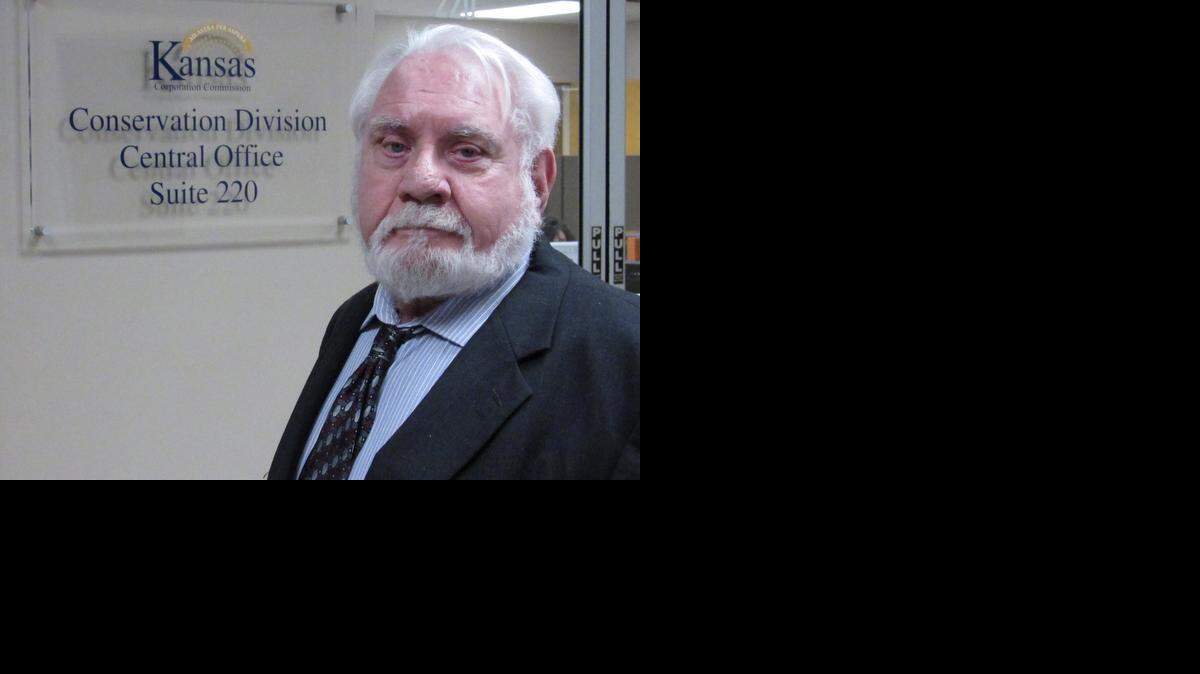
The KCC order came hours after a hearing in Wichita where the commission heard a formal complaint from a Harper County resident who said he’s frustrated by the frequent earthquakes that have rattled and cracked his rural home.
Frank Smith objected to a proposal by SandRidge Exploration and Production to dispose of as much as 10,000 barrels a day of wastewater by injecting it deep underground through two played-out oil wells near Smith’s home.
Describing the shaking at his house, he said, “It’s a lot like going to an amusement park, on some vigorous ride.”
The hearing on Smith’s protest largely turned into a missed opportunity for a test case, when Smith misunderstood a ruling by KCC Chairwoman Shari Feist Albrecht. Smith thought she had ruled against allowing testimony on induced earthquakes, when in fact she had ruled the opposite.
“I didn’t understand,” Smith said after the hearing. “I guess I should have been on my toes.”
SandRidge fought hard to exclude testimony on the possibility that wastewater injection is causing the now frequent earthquakes along the state line, saying such evidence would be inadmissible and irrelevant to the assessment of its application.
SandRidge’s lawyer, David Bengston, said the reinjection of wastewater into the dead wells is a “win-win situation” because it would get rid of the tainted water and help push more oil out of nearby producing wells.
SandRidge vice president Aaron Reyna testified that if the reinjection permits are denied, the company will have to cap the two wells at a cost of about $100,000 each. The company could have to spend about $4.5 million to cap about 45 other inactive wells, Reyna said.
While SandRidge and the KCC staff sent lawyers, Smith represented himself at the court-like hearing and clearly struggled with the rules of evidence and procedure. Several times, he had to ask SandRidge’s lawyer for help in locating paragraphs in the company’s testimony.
Smith didn’t question any of the oil company or KCC staff witnesses on induced earthquakes or offer any testimony of his own on the subject. He only spoke briefly on it after Albrecht told him that he had misunderstood her ruling, and that he could talk about earthquakes.
Over SandRidge’s objections, the commission did accept Smith’s written testimony and some articles he sent along after it, saying commissioners could decide for themselves how much weight to give them in deliberating the case.
“I have been feeling most that have epicenters anywhere from a few miles away to as far distant as Medford, Oklahoma,” Smith said in his written testimony. “The house sometimes shakes, walls crack, objects fall off desks and tables. There have often been loud reports heard outside the house, built in 1888.”
Smith briefly took the witness stand. Most of the questioning involved Bengston establishing that Smith’s college degree and post-graduate coursework are in psychology and other fields unrelated to the geological sciences.
Following the hearing, commissioners said they would deliberate and issue an order soon on SandRidge’s request.
Harper County has seen its oil production rise from 361,000 barrels a year in 2010 to nearly 1.9 million barrels in the first nine months of last year. Gas production rose from slightly less than 5 billion cubic feet to more than 16 billion in the same time frame.
Between 1977 and 2012, there were two earthquakes in Harper and Sumner counties of magnitude 2.0 or greater. Since Jan. 1, 2013, there have been 159. The biggest was a magnitude 4.8 quake centered near the town of Milan, about 15 miles from where Smith lives.
Smith said he frequently feels smaller temblors at his house, often several times a day.
“You’d have to be a complete moron to believe it (oil and gas activity) is not the cause,” Smith said.
Reach Dion Lefler at 316-268-6527 or dlefler@wichitaeagle.com.
This story was originally published March 19, 2015 at 7:58 PM with the headline "Harper County man takes complaint about earthquakes to KCC."