
Wichita hospitals warn COVID and flu season could overwhelm already strained systems
Wichita hospitals are treating more than three times as many COVID-19 patients as this time last year, and hospital officials warn the upcoming respiratory virus season could further strain already overwhelmed systems.
The delta variant is filling hospitals with younger and sicker patients, and Ascension and Wesley both report that at least 90% of their COVID-19 patients are unvaccinated.
“Overall, our data shows that the hospitalized patients we are seeing now are more acutely ill than earlier this year, which requires more staff to care for the same number of patients,” said Sam Antonios, chief clinical officer at Ascension Via Christi.
Sedgwick County’s highest hospitalization numbers of the pandemic came between November and January with a peak of 273 COVID-19 patients on Nov. 30.
“Looking ahead, the prospect of COVID-19 potentially being combined with a more typical influenza and viral respiratory illness season is alarming,” said Antonios.
Flu season typically begins in October and stretches into the spring with a peak during the winter months.
“While we do everything we can to provide quality care to our community, we are concerned about the imminent change of seasons, which historically brings with it a significant increase in respiratory and flu symptoms,” said Lowell Ebersole, chief medical officer at Wesley Healthcare.
“While mask mandates and other precautions helped to minimize the frequency of these illnesses last year, the current lack of adherence to these precautions is troubling.”
Sedgwick County’s Aug. 30 update reported 181 hospitalized COVID-19 patients, the most in Wichita hospitals since late January. Hospitalization data was not updated by press time Tuesday, but a county spokesperson said it will be posted as soon as it becomes available.
All four of the city’s hospitals have been operating at full capacity with limited beds and staff for weeks. Officials agree that an influx of patients suffering from the virus or any other condition could be devastating.
“A nationwide shortage of nurses, combined with an ever-growing number of primarily unvaccinated patients seeking care, is creating an environment that continues to stretch the capabilities of local providers and limit our ability to meet the health care needs of those who need care, whether for COVID-19 or other non-related injuries and illnesses,” Ebersole said.
Antonios said projected patient volumes for the coming months underscore the importance of community members getting vaccinated and taking other safety measures to prevent the spread of the virus.
“Obviously, things can change and any projections may not come to pass. However, if we were to stay on our current trajectory, that could mean triple that number this winter, despite 40% of the population being vaccinated,” he said.
Hospital capacity
Throughout the pandemic, the number of available ICU beds a hospital has to treat patients has been used as a metric for that hospital’s capacity to handle other illnesses or injuries.
CNN reported last month that five states, Alabama, Georgia, Texas, Florida and Arkansas had less than 10% of their ICU bed capacity left.
According to the Kansas Department of Health and Environment, 30% of ICU beds statewide were available as of Monday.
Linsey Coster, director of business operations for Ascension, said measuring capacity isn’t as simple as counting the number of beds in a given hospital.
“I think about capacity in hand with capability. Staff and space going hand-in-hand together, and so you have to have the right staff and the right space to care for a patient,” Coster said.
Aya Healthcare, a major travel nursing agency, reported requests to fill more than 400 positions in Kansas as of Aug. 30.
On Friday, Gov. Laura Kelly and other top lawmakers approved up to $50 million in extra pay for Kansas nurses working in hospitals, many of whom have been driven to exhaustion by the latest wave of severely ill COVID-19 patients.
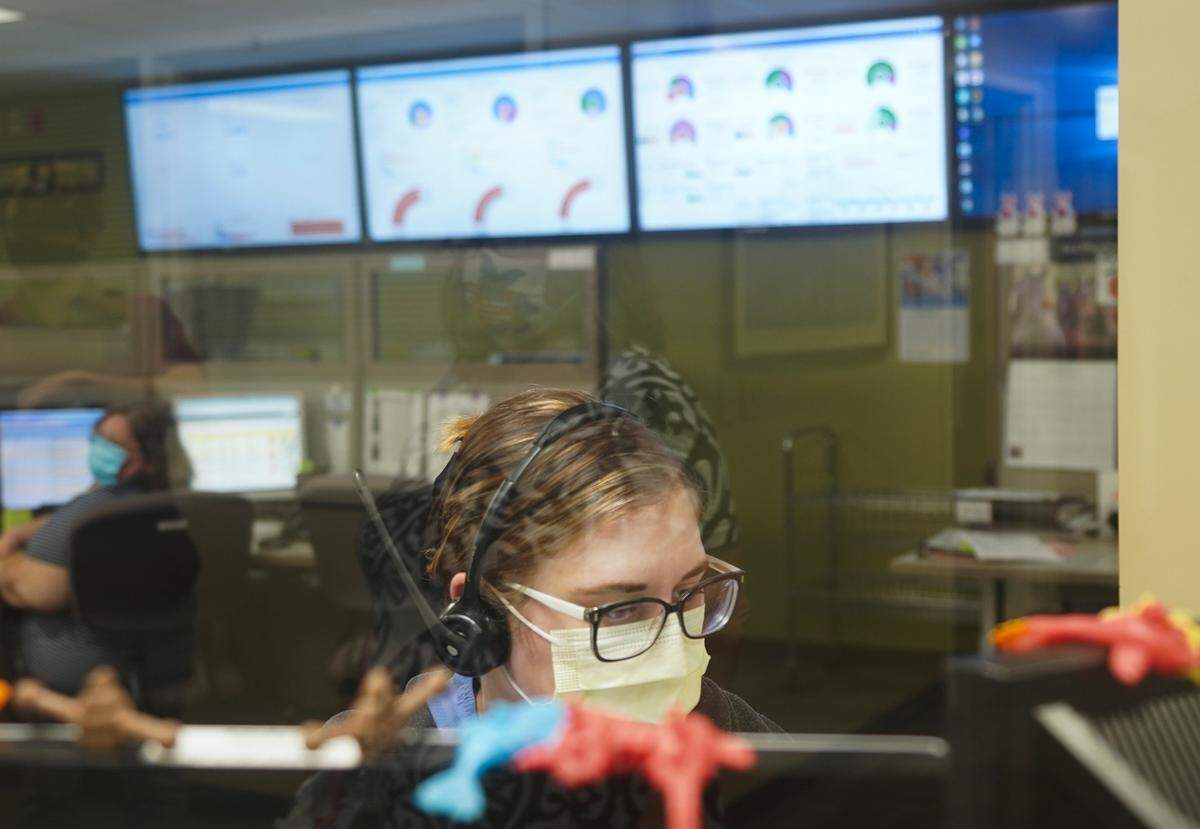
Coster said that to optimize staffing and patient care, a team of trained nurses in Ascension’s patient logistics center manage all admissions and transfers between facilities and units.
The logistics center, which Coster referred to as an “air traffic control,” provides real-time monitoring of every bed in all three of Ascension’s Wichita campuses.
“The center is able to look at three hospitals and help determine how do we get patients into our system and to the right bed with the right level of care in an efficient manner,” Coster said.
For the past two months, the center has been receiving between 8,000 to 8,500 calls per month, an average of 335 a day, according to hospital data.
Every morning, nurses have a “bed huddle” to discuss what beds are available and how many patient dismissals they anticipate.
Because Wichita hospitals are in critical condition, patients from out of county are currently less likely to find a bed in Wichita. Even in-county patients may have to receive treatment from the ER while they wait for an open bed.
“When a patient arrives at our facility, we’re going to treat that patient,” Coster said.
At various points in recent weeks, all four Wichita hospitals have had to go on diversion, meaning they request that ambulances bring patients to another facility.
“When EMS has a patient that they want to bring, diversion is really about us communicating with Sedgwick County EMS as a partner. What we’re telling them is, ‘Hey, caution, we are at capability and capacity. It is stretching us to take any more patients,’” Coster said.
Ebersole, Wesley’s chief medical officer, said the only way to ensure hospitals can continue treating every patient in need of care is if community members can work together to prevent the spread of the virus and preserve valuable hospital resources.
“Only by working together can we, as a community, ensure that our health care providers can continue to deliver the quality care our community needs and deserves,” Ebersole said.
This story was originally published September 7, 2021 at 4:30 PM.