
High COVID hospitalizations — and deaths — take a toll on Kansas health care workers
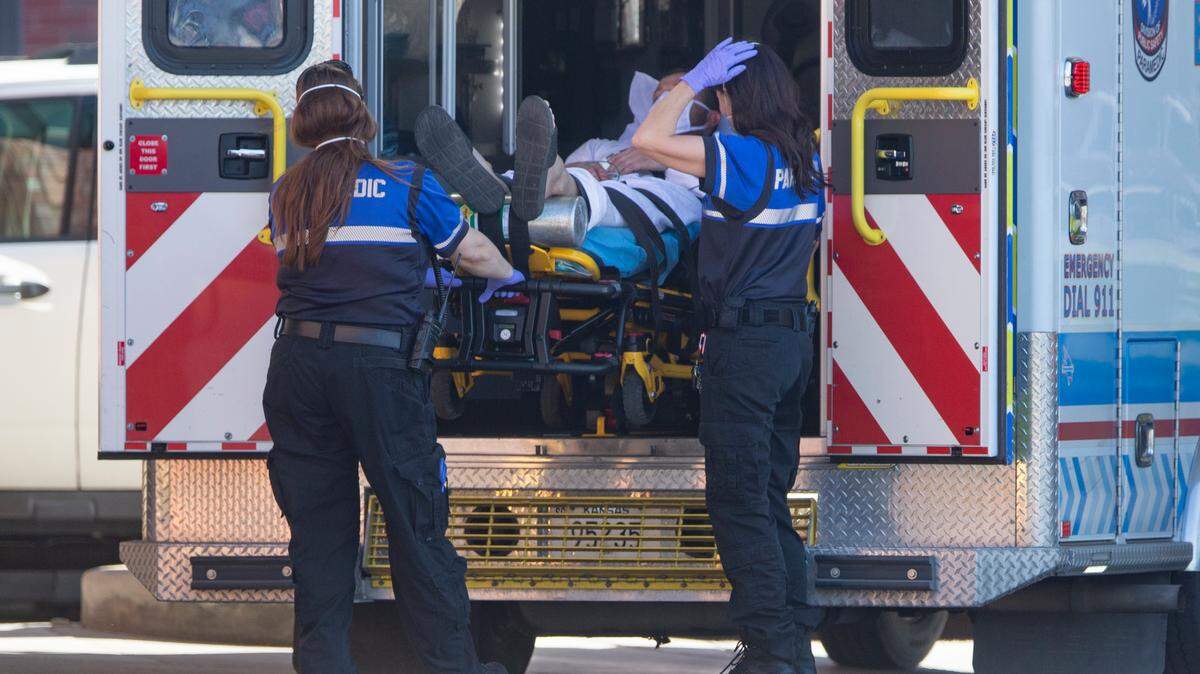
Kansas hospital officials are placing a greater emphasis on the mental and emotional health of doctors and nurses as they struggle with the unyielding death toll caused by the coronavirus pandemic.
“There really is an emotional investment,” said Jon Rolph, a Wichita businessman who hosted a regional hospital teleconference on Tuesday. “... Then you lose someone who you’ve poured into. That person is rolled out and another person is rolled in and you do it all over again.”
The Kansas Hospital Association and the Kansas Department of Health and Environment sponsor the weekly teleconferences for seven regions of the state. Dee Dee Dewell, an outreach representative for Ascension Via Christi, said during the south-central region’s report that many hospitals and their surrounding communities are working to improve the morale of health care workers.
“I think that’s something we really, really need to stay on top of these days, is what this long haul is doing to our health care providers over this period of time and the struggles they may be enduring,” Dewell said.
Jennifer Owen, a nurse at William Newton Hospital in Winfield, takes pictures of the outdoors on her phone, then shows the photos to the COVID-19 patients who can’t get out of bed and are unable to see outside. She said “it’s the little things that I think our patients appreciate from us.”
“The length-of-stay has been longer than usual than what we’re used to. But we get to know the patients, and I think it means a lot to them that they kind of see the same faces day-in day-out, even though they see this,” Owen said, motioning to her mask-covered face.
“A lot of times, the patients will go home. But then again, we have patients that have so many comorbidities that they can’t survive. So they make that decision to go on comfort care. It’s really tough for the families because they can’t be here. They can’t hold their hand. It’s really hard for us as nurses sometimes to tell the families: ‘We’re sorry, you can’t.’”
One COVID-19 patient, a man in his 30s, told the nurse he was scared. Owen tried to give him hope and prayed for him. He later died.
“It’s heartbreaking to find out that someone you fought so hard for did pass,” she said. “It’s really hard on us nurses. You talk about the emotional and mental part that we deal with. This is a whole new level.”
Kenny Wilk, representing the University of Kansas Health System, said during the teleconference for the Kansas City area that staff morale hit a low point over the winter holidays. It has started to improve since then.
“We have had a number of deaths, and that’s really hard on the staff,” Wilk said. “We’re sure hoping that peaks out. That’s been extremely difficult on the staff. But I think the combination of a little fewer patients in the hospitals, the vaccine’s coming across, and having more of our workforce available, you put all those things together and I think it (staff morale) is up.”
The holiday season was especially deadly in Kansas. Data from the White House COVID-19 Task Force and the Centers for Disease Control and Prevention showed Kansas had the worst rate of death reports in the country as the new year started.
The high number of deaths was likely due to a surge in cases in November, Rolph said.
Many health professionals have predicted another surge after the winter holidays. In Sedgwick County, the local health department’s numbers show a worsening trend. But statewide, there was some improvement in KDHE pandemic indicators last week.
Seth Konkel, who advises the state government on its vaccine rollout, said Wichita’s region had the second-highest positive test rate in the state last week. It also had the third-highest rate of new cases, KDHE statistics show.
“Definitely not going the correct direction, or the direction we want it to go,” he said of trends in pandemic indicators in the region.
“When we talk about vaccines, from a public health perspective, it’s not an end-all be-all until we can get a lot more people vaccinated,” Konkel said. “So it does not mean you can stop wearing masks and can stop social distancing, can stop washing your hands. It’s going to have to continue, again, until we get later into the year where we have a lot more people vaccinated.
“If we don’t follow those precautions, we will continue to see that number — along with probably, I would venture to guess, our death rate — increase as well.”
Hospital numbers improve, still ‘critical’
Though precarious, the hospital situation is not nearly as dire as it had been.
With 94% of the 31 hospitals in south-central Kansas reporting data, the region had about 17% of its adult, staffed ICU beds available on Monday. That’s an improvement from the 11% mark a week ago, but the Wichita area remains the worst region in the state for ICU availability. The region’s statistic is also in the red zone of the White House task force’s metrics.
“We have more ICU capacity here in south-central Kansas as of this morning than we’ve had in some time, and that’s good,” Rolph said.
Monday’s 17% is the best mark for the Wichita area since the regional reports were first issued on Dec. 14. That day had the worst, at 9%.
The improved ICU availability appears to be due primarily to an increase in the number of total staffed adult ICU beds, not a decrease in patients. This week’s regional report had a higher percentage of hospitals submitting data. Officials also were less concerned about staffing shortages than in previous weeks.
As of Monday, the south-central region had 286 total adult, staffed ICU beds, which was an increase of 30 from last week. Patients with confirmed or suspected COVID-19 occupied 88 of those beds, which was up two from last week, filling 31% of the beds. Non-COVID patients filled 148, or 52%, of the beds. That was an increase of six patients. There were 50 beds available.
The percentage of ICU beds occupied by COVID-19 patients is about double the red zone threshold established by the White House task force.
Dewell, of Ascension Via Christi, said Wichita hospitals have seen a small decrease in COVID hospitalizations, though there is still high demand for ICU beds.
“We do have to still remain very vigilant in our practices,” she said.
The Sedgwick County Health Department’s Monday report reflected an approximate 4.2% drop in current COVID-19 hospitalizations compared to last week. But current COVID-19 patients in the ICU had a 2.9% increase.
The Wichita hospitals have been operating with full ICUs since the start of November, according to the health department. The hospital status remains “critical.”
This story was originally published January 12, 2021 at 5:27 PM.