
COVID-19 patients in Wichita and Kansas getting younger
A young person with no underlying health conditions needed a bilateral lung transplant because of the coronavirus, Dr. Lee Norman, secretary of Kansas Department of Health and Environment, said this past week.
Norman added that some people with COVID-19 are suffering respiratory, cardiovascular and neurological issues after leaving the hospital. Unlike the influenza, people who recover can face further consequences, he said.
Health officials continue to learn new quirks about the virus, including its impact on younger hosts.
Norman’s comments to the Kansas Board of Education comes as the number of cases and percent positive increase in Kansas and while the age of people becoming infected continues to drop.
According to KDHE data, the median age of cases was 52 on March 24, the earliest date available, and is now 37.
Wichita hospitals have seen the age of their patients fall too.
Wichita hospitals
Ascension Via Christi, which reported an all-time high of COVID-19 patients in the upper 30s this past week, said the median age of discharged patients is dropping.
In April, the median age was 64; in May it was 71, June was 63 and July, through the 23rd, was at 52.
“It’s something to be noted but (the trend) could be gone tomorrow,” said Dr. Sam Antonios, chief medical officer for Ascension Via Christi hospitals in Wichita. “It doesn’t check your ID before infecting you.”
Early on in the pandemic, people admitted to Wichita hospitals were usually older and often connected to congregant living. As those facilities started to crack down and restrictions around town started to be lifted, the demographic admitted has shifted to younger people who often note going to bars and restaurants, Antonios said.
Wesley Medical Center spokesman Dave Stewart said they are seeing more people in their 30s and 40s than earlier on, when most patients were over 50.
“So far as common denominators are concerned, the general consensus seems to be that, once Wichita began reopening, younger people were the first to get back out — especially once bars and clubs were reopened — and weren’t as concerned about infection, since previous infections mostly impacted older individuals,” Stewart said in an email. “Some physicians seem to feel that has been a contributing factor, and are hopeful that the county’s new guidelines may help in that respect.”
Neither hospital has had a case of pediatric multisystem inflammatory syndrome, which is a rare inflammatory illness that has appeared in children and is possibly linked to COVID-19.
Ascension had a younger COVID-19 patient die but would not be more specific since it could identify the person. The KDHE lists the youngest COVID-19 death as a 29-year-old.
The University of Kansas Health System reported the death of a pediatric patient on Friday, according to media reports. Pediatric patients range in age from newborn to teenagers, according to KSHB.
Despite lower deaths in younger people, there have been other problems.
“It affects young people having strokes,” Sedgwick County Health Officer Dr. Garold Minns told Sedgwick County commissioners last week. “This is something new. We didn’t even know about this when the virus first came. It creates a clotting problem in many patients. We’ve learned to start treating that with anticoagulants.”
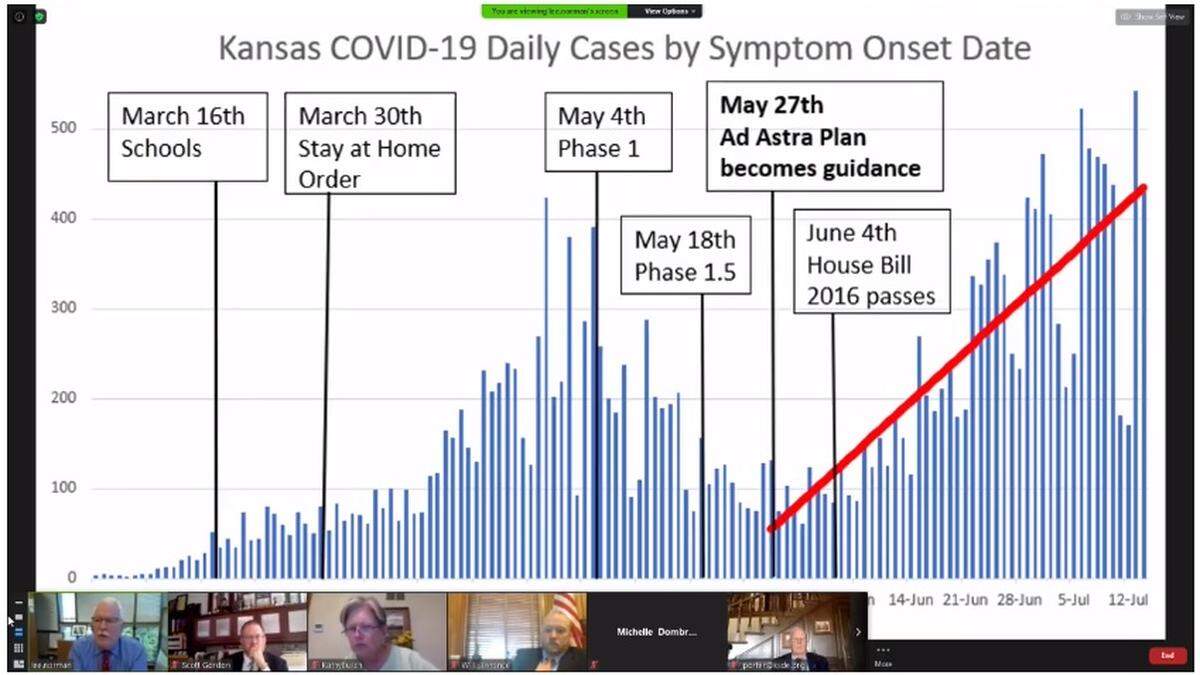
Correlation between reopening and a spike
Norman showed ed board members a graph showing an incline in new cases since the end of May when Gov. Laura Kelly turned over the right to county commissions to set their own local restrictions.
“So, basically now we are on a exponential, viral growth phrase,” Norman said. “This is a terrible trend line and it is not leveled off yet.”
Minns told the commissioners that cases have exploded from the last week of May compared with last week.
“Our numbers have gone up tenfold in six weeks,” he said.
Infections in a ‘younger population’
The average age of cases in Kansas is “getting younger all the time,” Norman said.
Ages 25-34 is the group that has the most cases in Kansas, according to the KDHE’s coronavirus dashboard. That age group has 4,822, or 19.2%, of the 25,109 cases. The second most cases are in the 18-24 age group, with 4,589, or 18.3%.
Norman, pointing out Florida had 31% of roughly 54,000 children tested positive, said there is a lack of consensus on what percentage of “young people are going to have a problem with it.”
In day cares and schools, clusters had led to 44 cases, Norman said.
“And curiously, of the 44 individuals … all but three were in people 18 to 76 years of age,” Norman said. “So even if the child or young people get the infection and do OK with it, the staff are at significant risk for it.”
It is also unclear how easily children transmit the disease, Minns said.
In Sedgwick County, the 20-39 age group has the most cases, with 1,450, or about 42%, of the 3,474 cases. Ages 0-19 have 477 cases or about 14% of cases.
“We had thought early on that this was a disease mainly of the elderly, at least in terms of mortality,” Minns said. “But with this recent increase in cases we are seeing a shift toward a younger population. And that is probably mitigating the fatality rate, but I can tell you a number of those patients are very ill and they have a very long hospital course.”
In the U.S., the mortality rate is 3.6% of observed cases, according to Johns Hopkins University of Medicine. The highest rate is 15.3% in the U.K.
The Johns Hopkins study did not break down mortality by age. The Center for Disease Control and Prevention said the mortality rate is higher in people with underlying medical conditions and people 85 or older.