
Secret document lists locations of Kansas coronavirus outbreaks. Here’s what it says
A document containing “classified” Kansas public health information identifies Lansing Correctional Facility as the largest single source of the state’s 10,393 coronavirus cases, followed by the Tyson Foods meatpacking plant near Garden City.
The report, provided to The Star by Columbia University’s Brown Institute for Media Innovation, also discloses what state and local health authorities have often refused to share with the public: a detailed account, by name and location, of every outbreak as of May 19.
The list illuminates the real-world consequences of the pandemic by putting names to previously-undisclosed locations. Outbreaks at three Sedgwick County churches collectively infected at least 32 people and resulted in one death. A retirees coffee group in Republic County led to six cases. A keg party in Wabaunsee County was linked to five cases.
Everything from El Torito restaurant in Topeka (15 cases) to the Bonner Springs Walmart (three) and Spectrum Brands in Johnson County (four) are listed. It shows that multiple residents have died at nearly every nursing home where a COVID-19 outbreak has been identified.
The list also specifies who possibly stands to benefit from the bill passed by the Kansas Legislature last week that provides businesses and healthcare providers substantial protections from COVID-19 lawsuits. Gov. Laura Kelly plans to sign the measure, which would shield many of the outbreak sites from suits if they were following public health guidance.
At least 846 cases and six deaths through May 19 were traced to the Lansing prison. The Tyson plant near Garden City has seen 571 cases and one death according to the document.
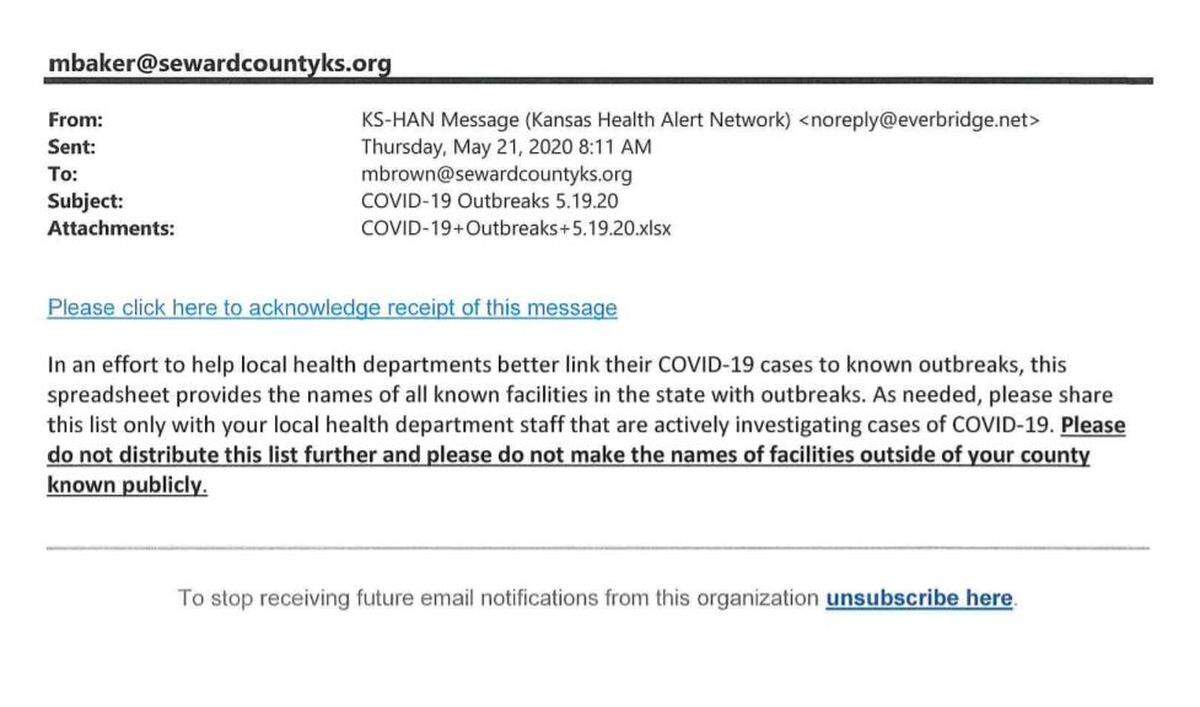
The confidential list is attached to a May 21 email from the Kansas Health Alert Network, an invitation-only messaging system used by the Kansas Department of Health and Environment (KDHE). The unsigned message says the spreadsheet provides the names of all known facilities with outbreaks to help local health departments better determine the sources of their COVID-19 cases.
“As needed, please share this list only with your local health department staff that are actively investigating cases of COVID-19,” the email reads. “Please do not distribute this list further and please do not make the names of facilities outside of your county known publicly.”
Columbia University’s Brown Institute for Media Innovation provided the list to The Star after obtaining it through a records request. The institute has been gathering government documents related to COVID-19 from across the country.
KDHE on Thursday said it doesn’t typically release outbreak locations because local health departments generally investigate clusters. Agency spokeswoman Ashley Jones-Wisner emphasized the Kansas Health Alerts are sent to local health officials and are not intended for public consumption.
KDHE Secretary Lee Norman said the agency relies on counties to discern whether releasing locations “helps them in their investigation.” He acknowledged that some states release the information as a matter of course.
“You could argue that that’s a good idea as well because you may not be able to ... contact trace everyone,” Norman said. “So an argument could be made both ways. We prefer to let that go to the county.”
Data ‘classified’
Local health authorities across the state have made conflicting calls about when to identify cluster sites and when to withhold the information. In some instances, officials are making crucial decisions about how to respond to outbreaks while the broader public is unaware of them.
Some officials contend that they’re withholding information because they’re in small communities trying to navigate a complex public health crisis. In some situations, businesses don’t want to be identified.
In southwest Kansas, for instance, meatpacking plants represent a huge regional economic engine, employing thousands of residents. Their success holds significant sway over the financial health of cities and towns there.
Dennis Kriesel, director of the Kansas Association of Local Health Departments, said his understanding was that the meatpacking plants didn’t want to be publicly identified.
“I believe the guidance to the locals in those cases was don’t name them,” Kriesel said.
In Johnson County, health officials refused for weeks to name the long-term care facilities battling the virus, saying it was an issue of privacy. After requests from the media, Sanmi Areola, county public health director, eventually began reporting the names of facilities, as well as the number of cases and deaths at each one.
“Releasing individual information about facilities is very, very, very unusual,” Areola previously said during a county commission meeting. “You will not see a lot of health directors or a lot of health departments doing that. ... It is very unusual.”
Johnson County officials have been even quieter about workplace outbreaks, at times alluding to new cases without providing specific details.
The Johnson County Department of Health and Environment (JCDHE) on May 14 announced it had located the first workplace cluster of coronavirus cases, but did not disclose the name of the business. It wasn’t until the following day that the business itself – a FedEx distribution facility – confirmed it was the site of the outbreak.
But sometimes health authorities are themselves thwarted by a lack of transparency. Behind the scenes, a dispute emerged about whether JCDHE could access FedEx to test the employees, according to records obtained by The Star through a Kansas Open Records Act request.
On May 12, an epidemiologist with JCDHE emailed a FedEx Ground employee confirming that the company declined onsite testing. The decision didn’t sit well with public health director Areola.
“I do want you to include in the email to your corporate office that this is not acceptable,” Areola wrote in a May 12 email. “I am happy that it seems you took some appropriate steps. To not allow for broader testing so we can understand the spread and take prompt actions is not good for public health. I will be pursuing getting that done.”
A FedEx spokeswoman told The Star that testing was ultimately made available at the site on May 15. The May 19 confidential list of outbreaks shows the site having 11 cases.
“While there have been some reported cases among workers, there continues to be no indication that the virus has been spread from within this workplace,” FedEx spokeswoman Meredith Miller said in an email.
There was no explanation for the initial hesitance to invite JCDHE officials three days prior to the start of onsite testing.
Ford County in southwest Kansas illustrates the reluctance of local officials to identify virus hot spots. The county, known for its meatpacking industry, has more confirmed COVID-19 cases than any other county in the state.
But when The Star called in May to confirm the linkage between coronavirus cases and meat processing plants in the county, local officials were reluctant to acknowledge it.
“We have not been publicly reporting on private business or private business COVID-19 status,” Ford County administrator Jonathan Gilbert wrote in an email. “Ford County is a relatively small community and commenting on any cases/number of cases related to a private business can allow for the identification of individual COVID-19 status and we want to avoid that.”
R.C. Trotter, Ford County’s medical officer, concurred with Gilbert’s assessment.
“I agree with (Gilbert) that we do not discuss specific business statistics,” Trotter said in an email. “I get that data from KDHE and it is considered classified.”
Meatpacking toll
Kansas meatpacking plants have been hit hard during the pandemic, linked to at least 2,767 cases and 10 deaths linked to the plants. Until now, however, there’s been no full, public accounting of the impact at each site.
According to the list, the five plants with the biggest clusters are:
- 517 cases and one death linked to Tyson Foods in Finney County
- 503 cases and four deaths linked to National Beef in Ford County
- 342 cases and no deaths linked to Cargill in Ford County
- 317 cases and no deaths linked to National Beef in Seward County
- 173 cases and one death linked to Tyson Foods in Emporia
When officials from the Centers for Disease Control and Prevention (CDC) visited National Beef’s plant in Ford County on April 24, they found that many people were not covering their noses when wearing a mask and that the plant had “limited signage” regarding COVID-19 precautions and notices.
“We saw limited information about symptoms and prevention, and visual cues to remind employees of social distancing at the Ford County plant,” a CDC report dated May 10 says.
Another CDC report from late April visits to Tyson Foods locations shows that handwashing stations and temporary restrooms were not located near overflow break areas.
National Beef spokesperson Keith Welty declined to comment on safety protocols and did not respond to questions about the level of production and employee absenteeism at each facility.
“Our focus throughout this COVID-19 situation has been to take the necessary steps to protect the health, wellness and safety of our employees while operating our processing plants producing high quality products to meet the demand of our customers across the United States,” Welty wrote in an email.
In a May 1 statement, National Beef CEO Tim Klein said that the company had invited representatives from the CDC and state and local health authorities to tour their facilities and review safety procedures, and that they were “pleased with the measures” that had been taken.
Tyson spokesperson Liz Croston said the company’s Kansas facilities are “operating near capacity” but would not provide an update on the number of cases currently associated with the plants.
“While I cannot share specific numbers, we have seen a significant decline in both new and active cases amongst team members in our Finney County and Emporia facilities in the past two weeks,” Croston wrote in an email.
She said Tyson has implemented a number of safety measures, including employee temperature checks before each shift, providing mandatory face masks, and putting physical barriers between workstations and in break rooms.
Cargill spokesperson Daniel Sullivan said the facility is currently operating at about 80% capacity.
In addition to implementing temperature checks, providing masks and installing protective barriers, Sullivan said Cargill is giving employees an additional 80 hours of paid leave for COVID-19-related needs, and waiving insurance copays and fees for testing.
The Triumph Foods meat-packing facility across the Missouri border in St. Joseph was also associated with 166 Kansas cases on May 19. A spokesperson for Triumph did not respond to The Star’s inquiries about facility safety and production.
Prison is largest outbreak
While meatpacking plants constitute the largest COVID-19 cluster in Kansas, the confidential list makes clear that Lansing Correctional Facility is the state’s single largest infection site.
KDHE data shows the state’s meatpacking clusters with far more COVID-19 cases than correctional facilities (2,767 cases to 1,018). But Lansing, with hundreds more cases (846) than any one plant, looms largest.
In many ways, a prison is the perfect place for a virus to spread. Social distancing is difficult to accomplish.
“It is the confined nature of the facility,” Jones-Wisner said about why Lansing became the largest cluster.
At one point, a group of inmates sued for early release and better conditions, but a state district court judge rejected their arguments. Gov. Laura Kelly also suggested for weeks that she was considering releasing inmates. Ultimately, only a handful for allowed to leave.
Norman, the KDHE secretary, has said the prison has made significant progress in containing the coronavirus. When Lansing first tested all its inmates in groups, 40-75 percent were positive. Re-testing shows the rate of positive cases has dropped to 6.5 percent.
“What we’re seeing … is the good result from cohorting inmates away from those that aren’t (positive),” Norman told reporters last week.
KDHE declared the Lansing outbreak “contained” on June 1. Kansas Department of Corrections spokeswoman Rebecca Witte said discussions have begun about when and how to safely allow inmates to begin resuming in-person visitation.
“It only takes one person to bring the virus into the prison and so limiting the number of people who come in is important for us to continue at this time. When we do resume this service, it will likely look different than what it did prior to the COVID-19 pandemic,” Witte said.
Nursing home deaths
Few Kansas locations have suffered more fatalities from the coronavirus than nursing homes and long-term care facilities. Many nursing home outbreaks have already been disclosed, but the confidential list — naming dozens of locations — underscores the tragic toll.
The list confirms that Riverbend Post Acute Rehabilitation in Wyandotte County is the largest hot spot in the state, with 141 cases and 36 deaths. Brighton Gardens in Prairie Village is second, with 75 cases and 15 deaths.
Life Care Center of Burlington and Forest Creek Memory in Johnson County both have seven deaths each. Numerous other facilities have a handful of deaths.
On Thursday, the Legislature passed a bill that would allow nursing homes to offer affirmative defenses in court to defeat COVID-19 lawsuits that come their way. In essence, the legislation provides protections for those that followed public health directives.
But it stops short of providing immunity from lawsuits, which the bill extends to other healthcare providers and businesses. The governor’s office made clear to lawmakers that she would veto the bill if nursing homes received blanket immunity.
The compromise upset both sides, with some arguing the limited protections aren’t enough while others said they would hinder seniors and their families from holding facilities accountable.
“Simply put, Kansas workers, senior home residents and most other Kansans are the losers,” David Morantz, president of the Kansas Trial Lawyers Association, said.
As health officials learn more about the coronavirus, so do long-term care facilities. And that has allowed nursing homes and assisted living centers to adjust their strategies, said Linda MowBray, president of the Kansas Health Care Association, a nursing home advocacy group.
“Our guidance from CMS has changed from March to April,” MowBray said. “At the end of May more guidance was coming in.
“In my mind, nursing homes are doing the best job they can. They are being nimble and changing their strategies, but it’s not over.”
The Star’s Laura Bauer contributed reporting
This story was originally published June 7, 2020 at 5:00 AM.