
Plastic – not cash – is king in retail payments, but for how long?
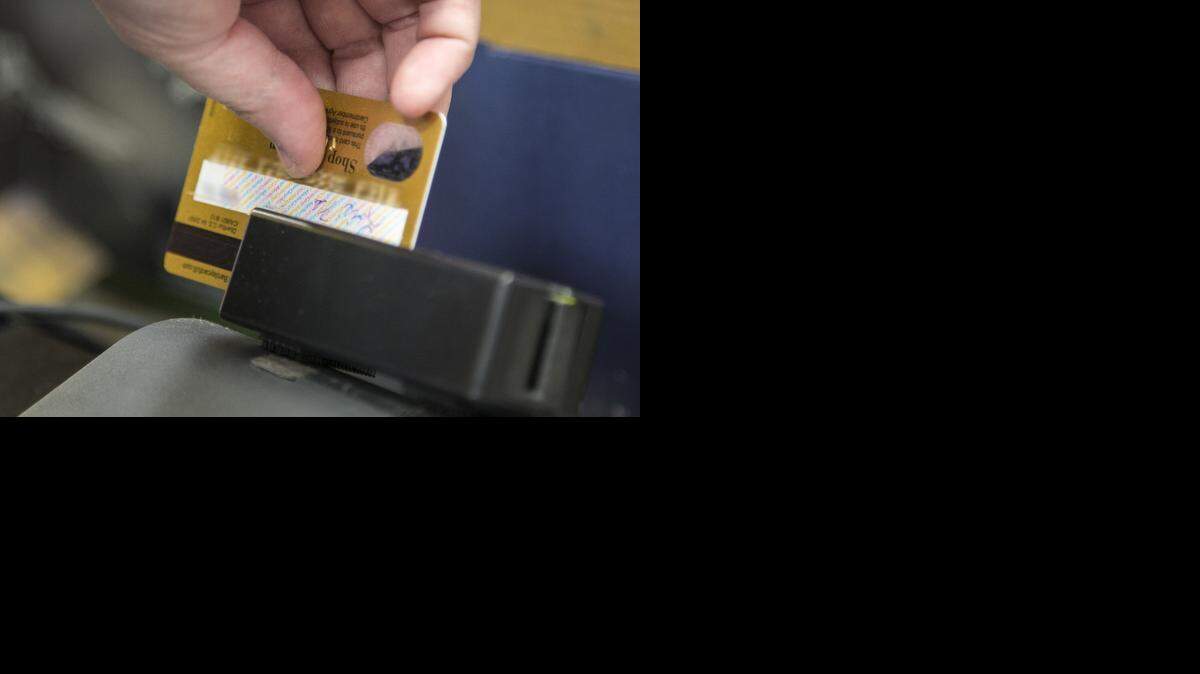
Gwen Ottenberg prefers cash.
And she gladly accepts $2 bills, gold dollars and Kennedy half-dollars.
“The tooth fairy leaves odd amounts,” said Ottenberg, owner of Imagine That Toys in northeast Wichita.
And while Ottenberg “loves cash,” the owner of the nearly 8-year-old specialty toy shop has no qualms accepting credit cards and debit cards, even though those kinds of payments cost her money.
“I really believe taking the credit (and debit) card is the cost of doing business,” she said. “Quite honestly, I don’t care how you pay as long as you’re shopping with me.”
That’s a good stance to take because plastic is king.
According to the Federal Reserve’s triennial Payments Study released last December, debit card payments topped 47 billion in 2012, and credit card payments totaled 26.2 billion in the same year. Checks, on the other hand, fell to 18.3 billion in 2012, which was half the number of checks that were processed 10 years ago, the Fed study said.
“Many trends observed in previous studies, such as the rise in the use of debit and prepaid cards and the decline in the use of checks, continued to be observed in the current data,” the study said.
Now a relatively new form of payment gaining traction: mobile payments. The technology promises to allow consumers to use their smartphones to make purchases at the checkout lane. While the technology has existed for several years, experts think mobile payments could get a big push toward mainstream acceptance when Apple Inc. on Monday launches Apple Pay.
Some experts think because the powerful Apple brand is behind the service, it will lead to faster and wider acceptance than other, established mobile payment services such as Google Wallet.
Others think it’s way too early for such pronouncements, given that the service has yet to launch, as well as the fact that there are other mobile payment applications already out there.
Plastic, they say, will remain atop the payment pyramid at least for awhile.
Apple Pay, which has hundreds of banks on board, is “hugely important,” said Forrester Research analyst Frank Gillett. It puts Apple in the middle of a wide range of consumer transactions, underscores Apple’s value as a brand, and gives people another reason to buy iPhones, iPads and other Apple gadgets.
Apple Pay is designed to work on the company’s newest iPhones, which contain a chip that allows payments at a special terminal in retail outlets. It also will be available on the new iPad Air 2 for online purchases only.
Apple is launching its new service at an ideal time, says Gartner technology analyst Van Baker. Consumers are increasingly worried about the security of traditional credit and debit cards, and U.S. merchants are facing new mandates to switch to systems by next fall that accept safer chip-based cards.
“Consumers are going to have to learn a new way to pay,” Baker said. “That levels the playing field for new technology.”
Mallory Duncan, senior vice president at the National Retail Federation, said he thinks there many barriers still exist and that it will be awhile before mobile payments become a substantial part of consumer transactions.
Duncan said the field of mobile pay applications is numerous enough that there will be some confusion and reluctance among consumers about which service or app to choose. Those apps may also have different steps involved in completing a transaction.
Handing over cash or swiping a card “is a simple process that people understand and use,” he said.
Just as important is the ability of merchants to accept payments, Duncan said. Even though two or three national retailers might have the necesary systems in place, there will be a lot of other merchants that don’t.
Duncan thinks one, clear mobile pay service has to emerge as the leader, and to do so it has to demonstrate that it’s “the one that offers the greatest consumer and merchant satisfaction,” he said.
“In a nutshell it’s unlikely that merchants or consumers will switch to mobile just because of mobile,” he said. “They will pay in the way that is most comfortable, familiar and easy for them.”
There is an exception, Duncan admits. If the cost of enabling mobile transactions is less for the merchants than processing cards, that could motivate retailers and “overcome the deficits that mobile starts with,” he said.
Neither Imagine That’s Ottenberg nor Nancy Robinson, owner of Best of Times Cards and Gifts, said they have been approached by their payment processing vendors about adopting mobile payment technology.
“They haven’t brought it up to me yet,” Ottenberg said. “I don’t know that my customers would consider using it at this point. I’ve got moms and dads and grandmas and grandpas.”
Ottenberg estimates 70 percent of purchases at her store are done with plastic.
Robinson – who started Best of Times Cards and Gifts, located at 6425 E. Central 33 years ago — said probably 95 percent of her customers’ transactions are made with plastic.
“I used to just absolutely hate it when (credit and debit card use) started happening,” Robinson said. “I have just accepted it and the fact that it is money coming in and that’s the way it is. I would prefer not to pay hundreds of dollars to … card companies.
“Cash, you get to keep every penny of it unless of course it’s a phony bill.”
Contributing: Associated Press
Reach Jerry Siebenmark at 316-268-6576 or jsiebenmark@wichitaeagle.com. Follow him on Twitter: @jsiebenmark.
By the numbers
This is how the number of payments made in the U.S. in 2012 without cash were split by payment type, according to the Federal Reserve.
Debit card: 38 percent
Credit card: 21 percent
ACH (i.e. online bill pay): 18 percent
Checks: 15 percent
Prepaid card: 7 percent
Source: 2013 Federal Reserve Payments Study
This story was originally published October 17, 2014 at 4:55 PM with the headline "Plastic – not cash – is king in retail payments, but for how long?."