
A conversation with Don Overstake
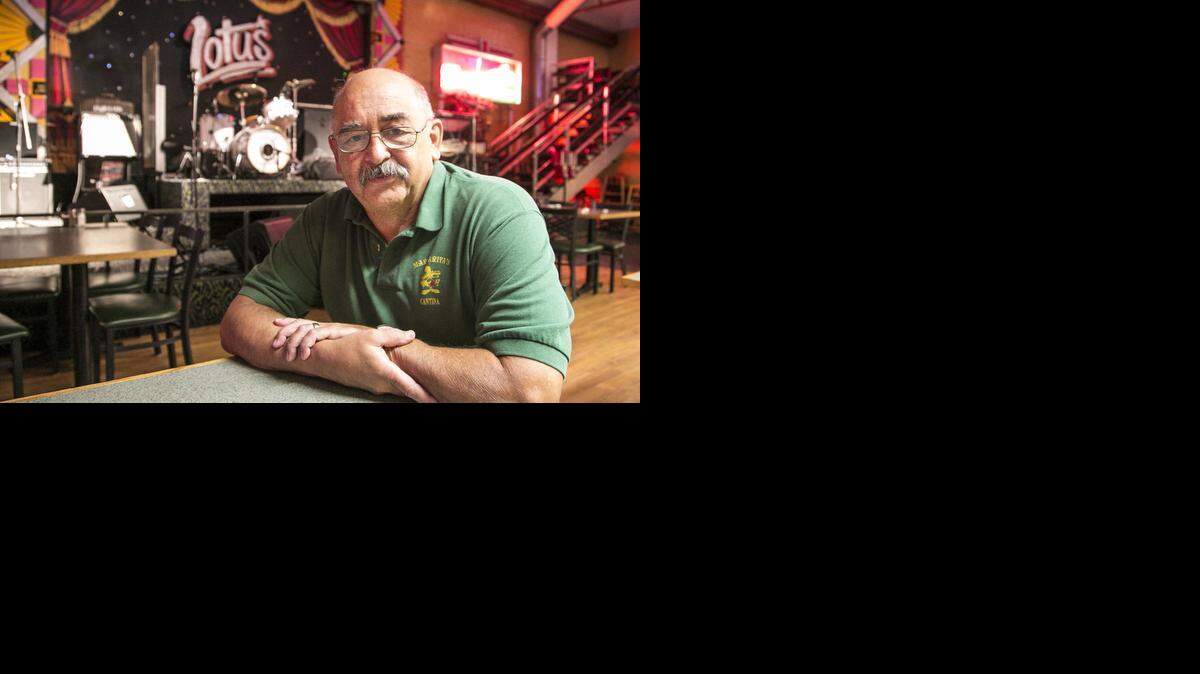
For most restaurant and bar owners, running a business is enough work.
Don Overstake, 66, has one more job on his plate, though. He’s the leader of the house band, Lotus, at his Margaritas Cantina just west of Douglas and Hillside.
Overstake credits the Beatles for that. He says he was about 14 when he discovered them.
The band “completely altered a lot of people’s” lives, he said.
“It was a pretty amazing time to be a teenager.”
Overstake’s mother started him on the piano when he was about 5. He eventually started playing the euphonium and then went to college to study music. He says a performance degree or an education degree were his only options.
“Neither one of them appealed to me that much, so I dropped out of college and got drafted and went to Vietnam.”
Overstake was in a number of bands during his two years at Wichita State University, though, including – memorably – the Electric Prunes.
“What I enjoyed was performing for people,” he said. “That’s what I knew. How I was going to make that work for me, I had no idea.”
A high school counselor had warned him his work life might be a challenge. Overstake had taken a preference test seven times to determine what might be a good career fit. After seven different results, the counselor had a talk with him.
“Don, you’re going to have an extremely difficult time in life until you can settle down and pick a direction.”
You were performing at the Fireside Club when owner Dan Daniels offered you the business. What did you say?
I basically told him, “Dan, I don’t know anything about running a business,” and he said, “Well, what’s there to know?” … I said, “Well, obviously something.”
But you didn’t think it would work?
I said, “Well, Dan, what are people going to say when they come in here and you don’t own it? … This is your place.” Dan looked at me and said, “Don, they’re not coming here to see me now.” … He made me understand that people were coming there for what I was doing and not necessarily because he owned it. … I guess he kind of gave me the confidence to do it.
How did it go?
It was just a thriving little business. … Very intimate. … I could play as much as I wanted, as late as I wanted.
After moving to a larger place, you eventually sold the business in 1988. Why?
I really don’t know other than I had been playing five nights a week until 2 in the morning. … We had a family. We had children. Maybe I was thinking it was my turn to be Mr. Mom. My wife put off her career.
Then you became a partner in the Safari Club, then the owner and, in 1992, you decided to open Margaritas in the same space. Why?
I have an innate desire. I like playing in front of people. You don’t have to work for somebody else to do it. … The food part was what was the big hurdle for me. I’m not really a food guy. … I really struggled with this for a while.
And you were warned off of it, right?
I had bankers, I had lawyers, I had a number of people tell me, “Don, do not do this. Just because you think you know how to run a bar, trust me, you do not know how to run a restaurant.” I said, “What’s the big difference?”
Then you found out?
It’s not for the faint of heart, I can tell you that. … It was hard on our marriage. It was hard on a lot of things. Man, we got right through it.
Was the concept a hit?
There was an adjustment period. … It was not an immediate success by any stretch. … Wichita never ate where they partied, and they never partied where they ate.
And you hoped to change that?
Now maybe my band was a little bit overkill. It’s a full-on ’70s dance band. We are not background music when we play. There’s little else you can do than listen. It’s not something you want to hire us to do while you sit down and have a martini and talk to each other. … It’s not Karen Carpenter.
You’ve had a lot of success, though?
I’m not patting myself on the back, but what’s actually happened here is pretty cool. I’m happy with it. … You create your own niche. … Unfortunately, the band is getting old. There’s a little bit of a culture split I’ve seen over the years. … I used to play to a room full of my peers. … It has changed – what people like, what people listen to. It’s kind of happening right in front of my eyes, but it’s OK. I think we’re still relevant on some level.
You play most Friday and Saturday nights?
What we play to initially is restaurant people. Then, what you hope for, what you want, is the party crowd to show up. … This business is so fickle, you can’t really count on anything. You just kind of hope. People today have so many more choices than they even did … 10 years ago. There’s a lot of people vying for this after-hours dollar. Coming to see these old war horses playing this ’70s music, (it’s) a challenge to keep ’em coming.
Anything keep you up at night?
Yeah. How am I going to spend the rest of my life once I sell this and retire. It is going to happen. This is a young man’s game. … I think probably if we’re going to do this, it should be sooner than later. … I guess there’s a lot of “up at night,” you could put it that way.
What’s one thing few people know about you?
I’m a Duck Dynasty guy living in a Miley Cyrus world. I don’t know who said it, but I love it. It fits me to a T.
Any last thoughts?
I’ve had a wonderful run. How many people can actually tell you they have enjoyed what they’ve done and got paid for it? It’s pretty awesome.
Reach Carrie Rengers at 316-268-6340 or crengers@wichitaeagle.com. Follow her on Twitter: @CarrieRengers.
This story was originally published October 10, 2014 at 4:33 PM with the headline "A conversation with Don Overstake."