
In new Eagle documentary, Jackie Robinson teaches the community about grace once again
Most Wichitans, along with a whole lot of other people, already know the story of how League 42’s Jackie Robinson statue was stolen from McAdams Park where the nonprofit youth baseball league plays on four fields.
However, as a new Wichita Eagle documentary called “More Like Jackie” shows, there’s much more to the story.
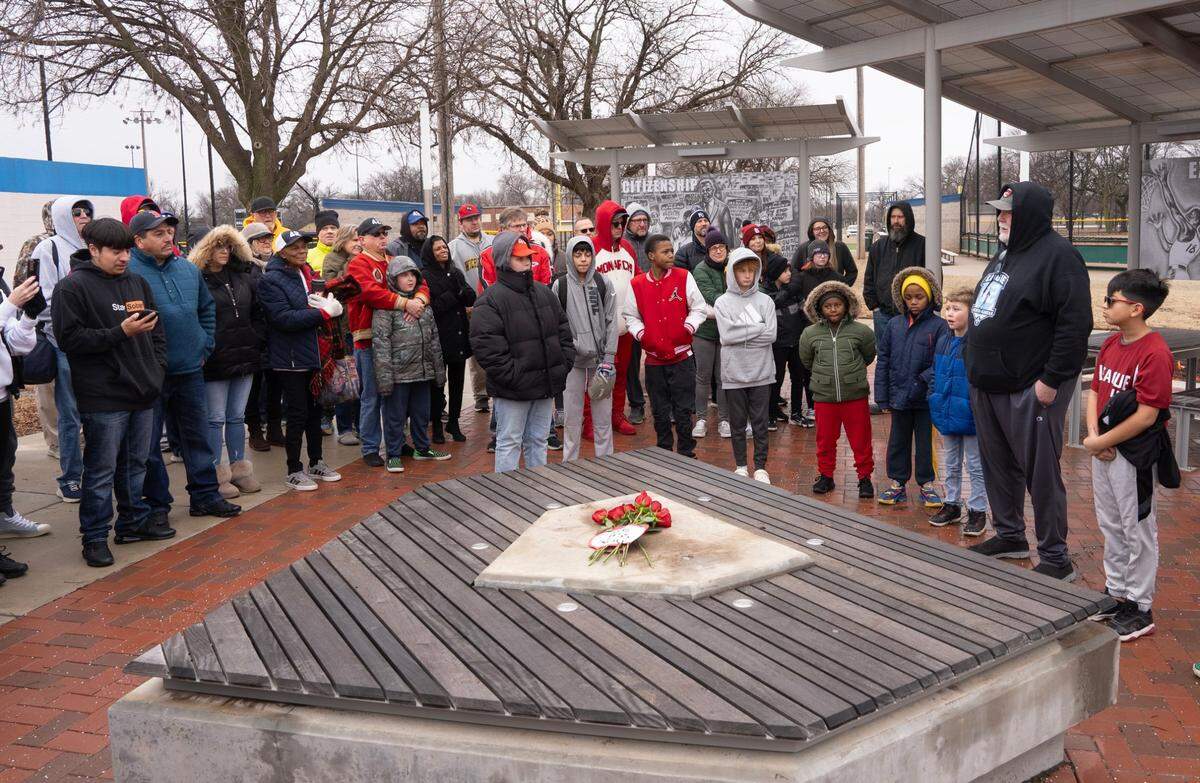
It starts on a frigid Saturday in January a couple days after the statue was stolen.
Wichita Eagle visuals editor Jaime Green attended a gathering that League 42, named for Robinson’s jersey number, founder Bob Lutz organized. His goal was to rally players and members of the community and figure out how to move forward.
“It felt like a funeral,” Green said. “People were offering their condolences.”
She learned it was the first time Lutz had an up-close view of the destruction at the site of the former statue, where only Robinson’s bronze shoes remained.
Eagle photographer and videographer Travis Heying shot a photo of the shoes that ended up circulating internationally, which he said, “was an indication that this was a big story that resonated with people” since Robinson was a sports and civil rights icon.
For Lutz, the pain was compounded because his close friend John Parsons had created the statue before dying in 2022.
Lutz “couldn’t take himself to that spot because he was so upset,” Green said.
After Lutz made some remarks, a young League 42 player — Marcus Jones Jr., who was 7 at the time — walked up to him and handed him $2 to help replace the statue.
“He was so taken by that, he just grabs him and hugs him,” Green said. “It was such a sweet moment. . . . It was a powerful thing to watch.”
She realized it also “was a powerful thing to document.”
So Green decided that instead of sharing the exchange in a daily news story, she’d save the footage and create a documentary around it.
“I wanted to hold onto this gem.”
Unlike previous documentaries she and Heying have done that relied on police body cameras or other video, Green said they were able to shoot this documentary in real time.
“That was really fun for us.”
There’s a lot of joy in the story, along with some sadness, Green said.
“Addiction is a part of this film.”
Heying said the story “turned out to have a lot more parts to it than I think we could have anticipated.”
That includes witnessing Jones “fall in love with baseball — and Jackie Robinson.”
There are stories of the people who worked on the statue and the plaza around it.
And there’s the story of the man who stole the statue and his later reconciliation with Lutz.
Heying said he felt like Lutz gave him and Green — both former colleagues from when Lutz was a sports columnist for The Eagle — special attention as well.
“We had a long working relationship with Bob, and obviously that came in handy because Bob was bombarded with media requests.”
The documentary was scored by Green’s husband, Carter, a musician who owns Greenjeans Studios in Wellington.
Some of the people featured in the film and others recently were given a sneak peek of the documentary.
“Well, through the tears, I thought it was really good,” Lutz said.
Like the entire experience, the 62-minute documentary was bittersweet for him. Lutz said it’s a well-told story that evokes a variety of emotions for him.
“That statue has such a symbolic meaning for League 42,” he said. “Just having that statue in place is really a comfort that you can’t imagine.”
Like Green and Heying, Eagle executive editor Michael Roehrman saw that, too.
“The point was not to make a true crime documentary but to tell a story about hope and grace,” he said.
Heying said it’s “about what it looks like when a community comes together” and offers forgiveness as well.
“I realized that in a way, Jackie Robinson was teaching us those lessons all over again, 77 years later.”
Try this link, if you’re unable to view the documentary.
This story was originally published December 31, 2024 at 4:42 AM.