
He shared his love of artifacts in a museum. This weekend, you can share memories of him
On a 1955 mission trip to the Holy Land as a young adult, Jon Kardatzke had an experience that would spark a lifelong love of learning history and collecting artifacts.
He held a Herod the Great coin.
“History just came alive,” said Mike Noller, Kardatzke’s son-in-law who also is president and CEO of the Museum of World Treasures that Kardatzke and his wife, Lorna, founded.
“He couldn’t believe that he could hold a coin that was thousands of years old, and history was right in front of him.”
Kardatzke, a physician who liked to be called Dr. Jon, died Feb. 25 at age 85. The family will greet visitors at an open house from 3 to 5 p.m. Sunday at the museum. In honor of Kardatzke, admission to the museum is free this weekend, and visitors are encouraged to share photos and memories of him.
The Indiana native moved to Lawrence as a small child and then to Wichita in 1948 when his father became pastor at what now is known as Central Community Church.
“The church was a very important part of their lives,” Noller said.
Jon and Lorna Kardatzke taught Sunday school for children and young adults. For more than two decades, they taught young married couples and held marriage seminars, which led to Kardatzke writing a book, “Marriage Can Be Fun.”
With his brother, Stan, Kardatzke started what today is known as West Wichita Family Physicians. Along with other doctors, he co-founded two nursing homes, Terrace Gardens and Maple Gardens.
As Jon Kardatzke traveled and collected artifacts, Noller said, “He loved sharing stories with people who would come into his practice.”
Kardatzke stored many of his finds in the walkout basement of his Calfskin Creek home. He had to turn to neighbors for help in the Halloween flood of 1998 when the creek quickly rose and threatened to flood his basement.
“Everyone was over in the middle of the night helping Jon and Lorna carry items up from the basement,” Noller said.
He said the water was six feet high against the sliding glass doors, which finally shattered “as that last item was being carried up.”
Lorna Kardatzke immediately declared, “You’re getting all of this out of the house, and you’re starting a museum.”
He began talking with the city about a place to show his artifacts. Nothing worked out initially, though he did have some small shows in the foyer at Century II.
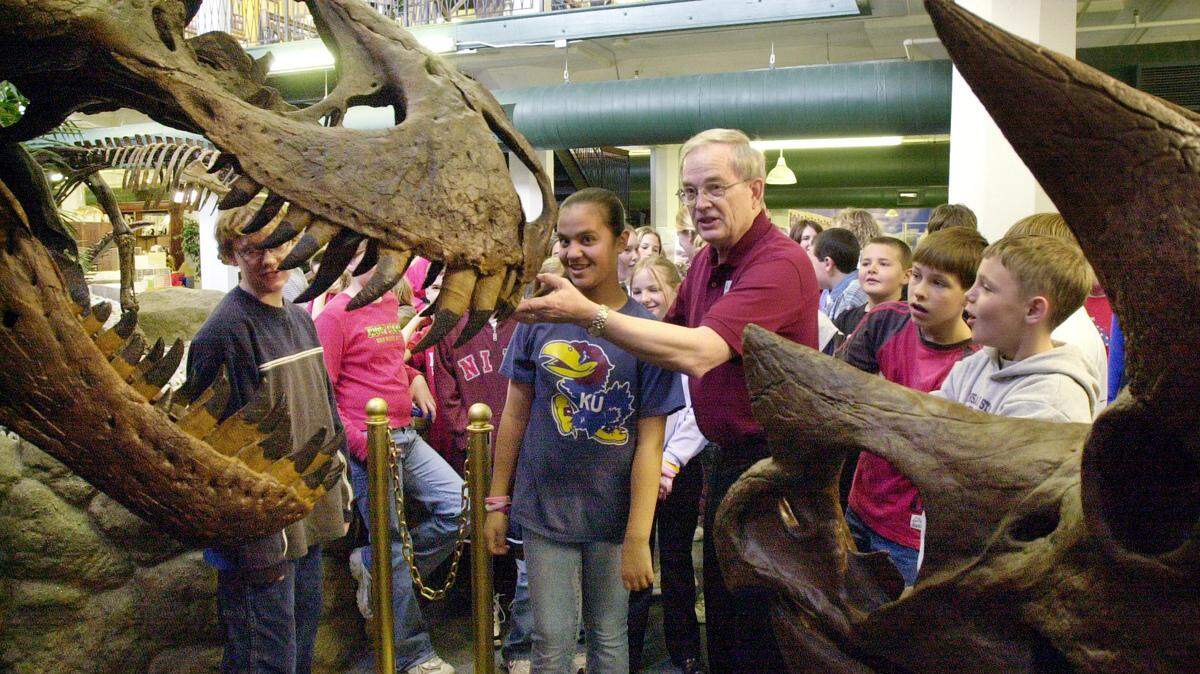
Then, in January 2001, Kardatzke opened the Museum of Ancient Treasures in 12,000 square feet on two floors of the Garvey Center, and it became popular with children and school tours.
“He always had a story for the kids, the most unique stories you would ever hear,” said center manager Larry Weber. “He loved getting them excited about history.”
Weber said his own children still remember the time Kardatzke handed them what looked to be a rock and let each child hold it before asking if they knew what it was.
“That was fossilized dinosaur poop,” he told them to many squeals.
“He was so animated,” Weber said. “So full of unique trivia.”
In 2003, the museum moved to the city’s former Farm & Art Market in Old Town and changed its name to the Museum of World Treasures to reflect all types of collections, such as military and presidential memorabilia and Kardatzke’s favorite dinosaur exhibit.
Chris Cherches, the late former city manager, “thought it was a legitimate opportunity,” said John D’Angelo, the retired city arts and cultural services director.
“Originally, it was just looked at as just Jon Kardatzke’s collection,” D’Angelo said.
Or worse, actually. Some called it derogatory names based on the randomness of the collection.
“Early on, it was difficult to understand how valuable the collection was or wasn’t,” D’Angelo said.
Noller said that changed when, hearing the criticism, Kardatzke took steps to create guidelines and protocols for the acquisition and handling of items for display.
“They did a lot to get the type of accreditation they needed,” D’Angelo said. “To their credit . . . they legitimized themselves.”
The biggest step for Kardatzke — other than finally agreeing to keep visitors from touching the artifacts — was relinquishing control to a board.
Noller, who joined in 2005, said he and the board helped Kardatzke “put more of the organizational structure and policies and procedures in place (to) address some of those concerns.”
“They were able to make it into something that continues to be popular,” D’Angelo said.
According to Kardatzke’s obituary, the museum has had “over 750,000 visitors and houses nearly 9,000 artifacts from over 250 collectors.”
D’Angelo said even as Kardatzke taught others, he continued to learn himself.
“That’s the thing I admired about him.”
Kardatzke is survived by his wife, three children, six grandchildren and six great grandchildren.
Weber said he’ll remember Kardatzke as a happy guy who always showed interest.
“Always a smile. Interested in learning, whether it be your past or anything. Just a great guy to sit down and chat with for 20 minutes.”
This story was originally published March 2, 2022 at 4:47 AM.