
Downtown Wichita businesses: Come soon or we may not be here next time you do
Out of an entire city struggling with the economic impacts of the coronavirus pandemic, downtown is a special case — and not in a good way.
While other areas of Wichita have tens of thousands of residents, downtown has only about 2,700, and it has lost untold thousands of employees who now are working remotely or are on a modified work schedule, meaning they’re either never downtown or are there only infrequently.
“We understand that traffic patterns have completely changed,” said Timirie Shibley, co-owner of the Doo-Dah Diner. “It’s just the luck of the draw as to what your concept is and what your location is.”
Even with light at the end of the pandemic tunnel, there are still many months to go. Shibley and other downtown restaurant owners and retailers are sounding an alarm to let people know that when they do return, their favorite businesses may not be there.
“If they don’t get down here and start patronizing us, we aren’t going to make it.”
Shibley, like others, said, “I don’t want to come off as whiny, and I don’t want to come off as desperate.”
The reality is, though, the restaurant business already has slim margins.
“Very few of us are guaranteed tomorrow,” Shibley said.
Now, following shutdowns that businesses still haven’t recovered from and operations at a mandated 50%, the situation is grim.
“That’s the one thing they all have in common,” said Jason Gregory, executive vice president of Downtown Wichita. “They’re not going to be able to get through it unless everybody pulls together to support them.”
He said downtown “plays a huge factor in overall quality of place and culture” for the city.
“When you think about Wichita’s identity, downtown is a huge piece of that,” Gregory said. “It’s those small businesses that make the district unique and authentic.”
He said downtown has the highest concentration of mom and pop restaurants and retail.
“That’s the reason people love downtowns.”
Gregory said suburban areas matter, too, but he said that “people need to understand that downtown is important not only just to Wichita but to the region as a whole.”
He said a lot of memories are made downtown — on date nights, at concerts in large and small venues and for business travelers and other visitors getting to know the city. He said it even helps companies with talent retention.
Gregory said companies have already been downsizing their footprints for the last 10 to 15 years, and he believes some of them have permanently changed how they operate with remote working.
“We don’t know how that eventually will shake out.”
‘A ghost town’
Rodney Horton owns three downtown businesses, none of which, fortunately for him, he depends on for a living. He has a day job that lets him continue to operate Cana Wine & Cocktails, Shift Auto Society and Standard Issue, a new men’s clothing store.
Cana’s “gotten hammered,” Horton said, because even the people still working downtown aren’t stopping in for happy hour cocktails or drinks after dinner. He said he can’t imagine another downtown business doing worse.
“It’s a ghost town.”
Standard Issue opened in the middle of the pandemic in June.
“People are happy we’re here . . . but we’re wanting the clouds to kind of part so we can get a fair shake,” Horton said.
His goal is for the business to be a lifestyle brand, and he wants to have mixers and other get-togethers for guys.
“But with COVID, we weren’t able to really leverage that.”
Also, there’s no walk-by traffic, and people don’t have as much of a need to buy new clothes right now.
“It has made us up our online game.”
Lucinda’s co-owner Valerie Reimers said a bright spot of the pandemic is that it compelled her to create a better website.
Despite being closed for two and a half months and reopening to sluggish sales, she is staying optimistic while still grappling with the pandemic.
“Ultimately, we’ll be stronger than we were going into it.”
Coming off of the preceding year when she’d already had to adjust for road construction near her Old Town Square business, Reimers said, “We’d already skinnied down our staff and expenses as much as possible.”
She said she’s done all kinds of adjustments, including offering “crazy customer service” in every existing and new way possible.
“You can’t find that with Amazon,” Reimers said.
“I would just like everyone to consider how they spend their dollars,” she said. “Keeping the dollars in our community is always important, but it’s hyper . . . important right now.”
Horton, who purposefully eats at a downtown eatery every day, said that “the big places are going to be taken care of.”
“It’s kind of a cliche at this point, but it really is support your anything local. This really is a Main Street problem, not a Wall Street problem.”
A roller coaster of a year
Dan Norton of Nortons Brewing Co. said he believes “people want to keep supporting local,” so he figured out a way to help them do it.
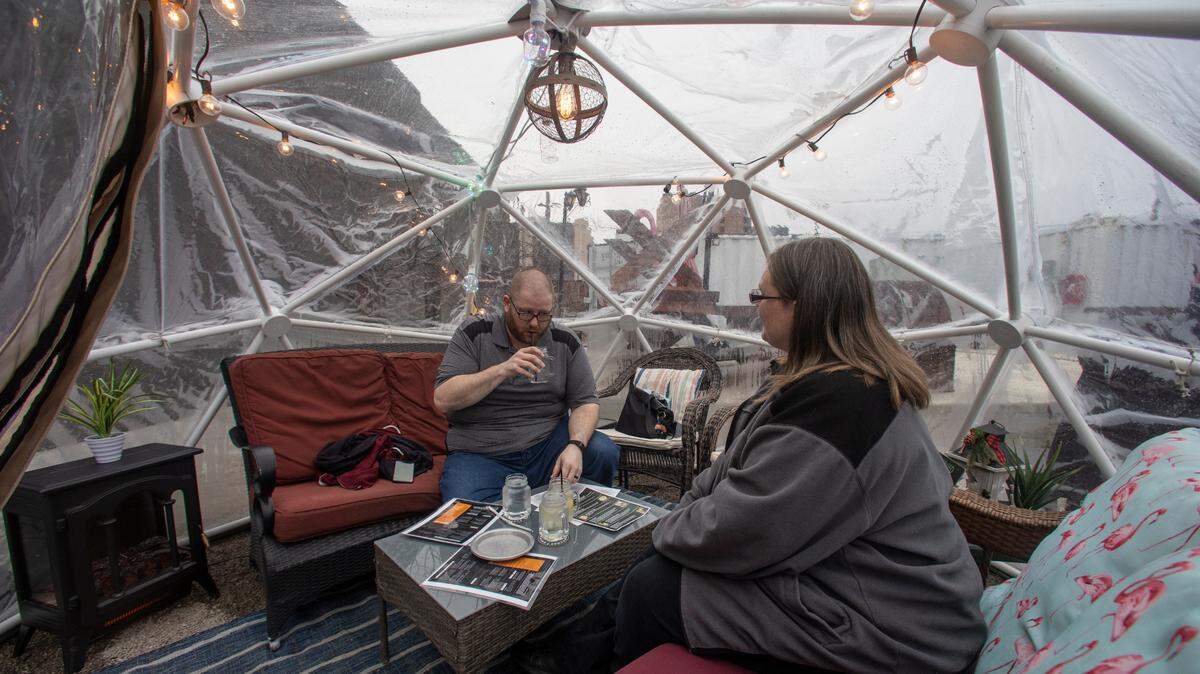
He invested in four garden igloos that seat up to six each. For a $25 nonrefundable deposit, people can reserve them. It expands his winter and pandemic seating.
“It had always been on our mind to do it, but COVID kind of forced our hand,” Norton said.
The igloos have had more than 510 reservations from the second weekend of December through late January. The igloos have been so busy, Norton said he and his wife haven’t even been able to use one yet.
Still, they’re just four igloos. At only 50% capacity, Norton continues to struggle and said he needs things back to normal sooner rather than later.
“That’s the only way this business survives and thrives.”
He had 78 employees before the pandemic and currently has a dozen. Norton said he’s tried to bring back more only to have to let them go again.
“We’re just not cut out for laying people off.”
Norton said he doesn’t want to sound like he’s giving an ultimatum, so instead he perhaps understated the situation by saying, “It would be more helpful if people came downtown.”
A year before the pandemic began, Cheris Coggins moved her Urban Interiors home store at Eaton Place to larger space within the historic building at Douglas and St. Francis. Though she loves her location, she said she knows what the problem is.
“It’s a designated trip to downtown. People don’t just drive by.”
Still, Coggins has no regrets about her decision.
“Oh, I love it downtown. It suits the personality of this store.”
Though the store suffered from a forced closure, Coggins said she’s benefited from people spending more time at home and wanting to make upgrades. It’s been a lot of ups and downs.
“Honestly, it’s just a roller coaster. I cannot explain it any other way.”
Adam Hartke attempted to open his Wave venue at Second and St. Francis, which sells food in addition to having live shows. Without those shows, though, he said, “We were actually losing way more revenue being open than we were just being in hibernation.”
The Save Our Stages Act helped him and other venues nationally.
“That’s going to help us survive for sure,” Hartke said.
He said Wave patrons can further help by going to its website to buy merchandise until the venue can open again.
Being intent in supporting businesses is essential, Shibley said.
For instance, if people are having large dinners for, say, weddings or funerals, she said they have to purposefully decide to choose local caterers or restaurants instead of chains.
“If we could get people to think about that, it would really help the small moms and pops,” she said. “That’s what I want to scream from the mountain tops.”
She said some people have the mistaken impression businesses like hers are doing well because they see one small snapshot, like rush hour on the weekend.
“On the weekend we have more business than we can handle, and during the week, it’s crickets,” Shibley said.
At a weekday lunch that saw just a few tables occupied this week, Sabor Latin Bar & Grille owner Melad Stephan sat down to discuss how he, too, may appear to be busy at times — like last weekend when he had a 45-minute dinner wait, only because he was limited to seating half the restaurant.
What’s also “killing him,” he said, is that “people are camping out.”
In pre-pandemic times, diners would pop in, eat and then leave to do something else — thus freeing tables for other diners.
“Now, they don’t have any plans,” Stephan said.
Shibley said she, her staff and many other businesses are adjusting and trying to stay positive, but she said all of Wichita needs to know how hard it is downtown right now.
“If these businesses go down, did everybody do their part to keep them afloat?”
This story was originally published January 29, 2021 at 4:47 AM.